


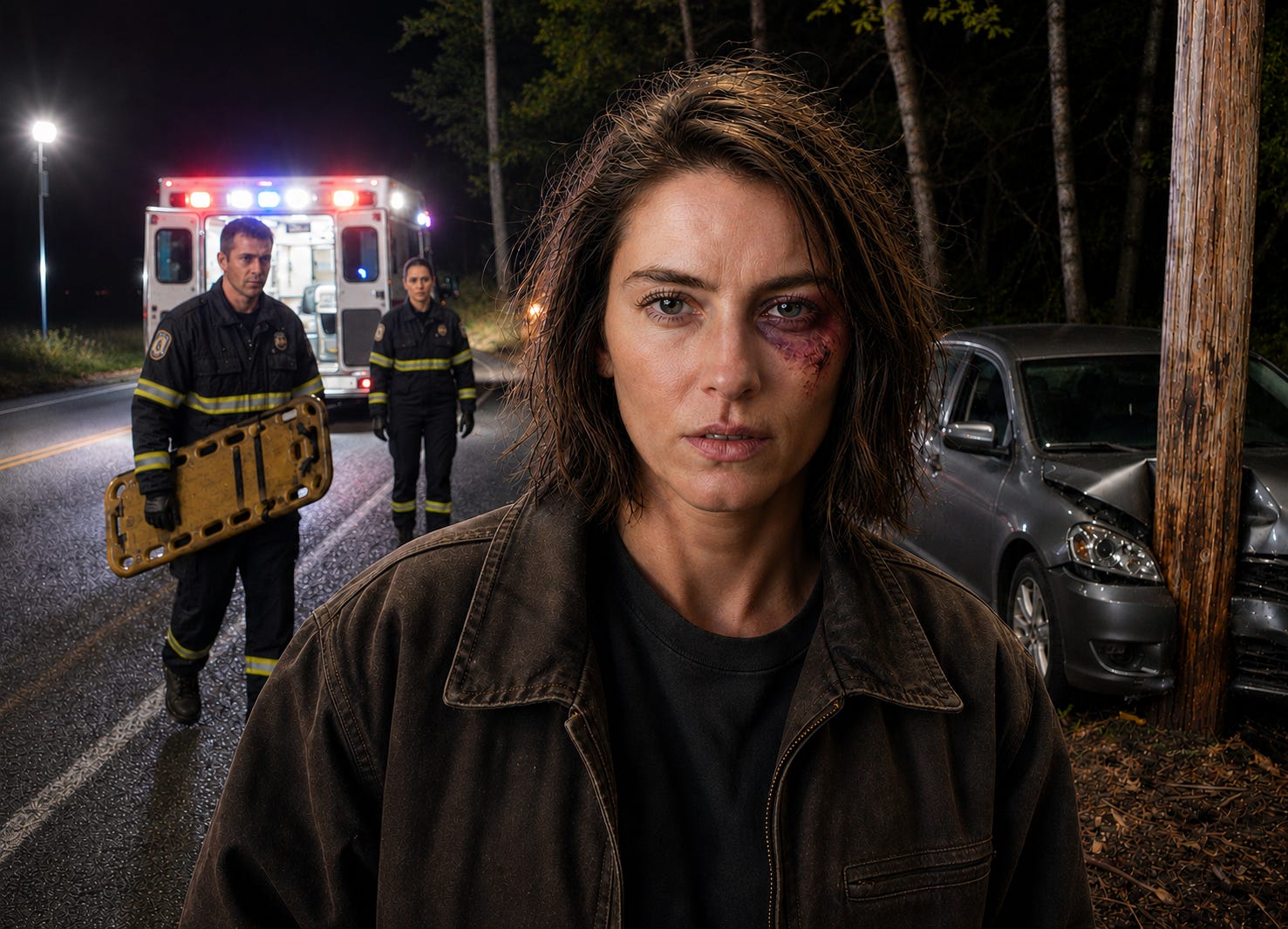
Three days after the Safeway run, I made a mistake. Not a catastrophic one, just a you-should-have-known better miscalculation. My gut had been screaming at me, but frankly, I was so exhausted I didn’t hear it. Or maybe I was just ignoring it. I don’t know. This was one of those mistakes that lives in that chasm between careful and paranoid — a gap you imagine you can jump across, no problem.
Bullshit.
The mistake? I let Isabelle drive off in the gray Civic. Alone. I didn’t protest. I said nothing.
Isabelle had asked about going out multiple times that week, and each time I’d gently expressed some discomfort and concern, while trying not to convey the terror I was actually feeling. Mine was not exactly an Academy Award-winning performance — I failed monumentally in covering up my worry. And so, on the third attempt to convince me she was good to go, I made an extra effort to sound supportive and to release my reservations. I encouraged her — you know, get out there, go see the world. I mean, there she was, standing in the doorway of the garage with her new dark tresses, wearing goofy faux glasses that someone had obviously swiped off Henry Kissinger during his open-casket viewing. Isabelle looked like a completely different person. So, yes, I caved. Hell, if I could hardly recognize her, surely no one else would. Right? She was no longer Isabelle. She was Izzy.
Then there was that look on her face — the one I’ve seen a hundred times — her jaw squarely set, brows furrowed, lips pursed, an indication she was done having this conversation we weren’t really having. I probably should have protested or at least made tears or created some sort of drama to get her to reconsider, but I didn’t. I kept telling myself she cannot live in a garage; she is twenty-three years old. She just did a trial run at the grocery store without incident. Quit being so paranoid, bitch.
Stupidly, I dialed down my worries, smiled, and said, “Okay. Get out of here, girl. Have yourself an adventure.” Then I handed her the keys.
We had parked the Civic a couple blocks away. Leaving it in the neighbor’s carport, as we had done for the last few weeks, wasn’t discreet enough for my taste. So, this was the new procedure we’d put together: keep the Civic parked down the block on the street, then move it from time to time so it appeared to be used regularly. Whoever was moving or driving the car was to wear one of our designated “disguises,” and there were several. Nothing was to be connected to my house, to Laura or me, or to Isabelle. And most decidedly, not to the car. On this particular occasion, Isabelle was to walk through the alley, turn onto Elm, then pick up the car from its spot behind the dry cleaner on Prospect, an unremarkable spot it had been occupying for the last three days. Then off she could go. I felt pretty confident in all of this.
And now, here we are, doing a meticulous reconstruction of what exactly went wrong, as well as a full psych-eval on what the hell I was thinking in not stopping her. What I didn’t know — what none of us knew at the time — was that Alexandros, from The Brotherhood, had made a call.
We didn’t put his name to any of this until much later, but this is what we eventually pieced together: Alexandros, whose identity was partially obscured in the Telegram threads Laura had been copying but had not yet fully decoded, had flagged a pattern two days before the crash and shared it with the group. It was not about Isabelle’s hair, nor the glasses, nor her new Carhartt clothing. Alexandros seemed clueless about those details. No, he was on to something subtler and less obvious. The Civic. And he’d noted it was sitting near the dry cleaner on Prospect.
Fuck.
He knew this because he knew Basti. Not personally — at least, we couldn’t prove they were pals or even acquaintances — but Basti had parked the Civic three times in the same location on three separate weekday afternoons. And he hadn’t worn a disguise. Everyone in town knew Basti, and they knew him to be one of Isabelle’s closest friends. And they knew his car. This Civic was not it. Why was he driving this instead? This is a soft detour from behavioral regularity that looks like it’s nothing unless that’s exactly what someone is looking for. The Brotherhood had not been tracking Isabelle’s face. They knew she was likely in disguise at this point. They had been tracking her network, all the people who still orbited her life. Me, Laura, Basti, the whole gang, though probably not Adam.
As Laura would quietly point out after all of this went down: they weren’t watching her, Isabelle. They were watching us watch her. This was a much more sophisticated operation than we’d given them credit for, and these were the types of details that kept me up at night. I got to thinking that the royal we were going to have to quit being so reactionary in our responses and start thinking and acting as they did. Calm, cool, and collected. The Brotherhood was playing a sophisticated game of chess, not participating in a WWE “professional” wrestling match, though their caveman mentality might have made one think otherwise. Our gang would have to strategize with clinical detachment and deliver either a checkmate or a forced resignation if we were to keep Isabelle and the other young women in town safe.
If you’re not fucking following this chess lingo, Google it.
So off Isabelle went. Then, only blocks from where the Civic had been parked, was Caden, standing right on the corner of Miller and Fourth, at the light. Isabelle, not having driven in weeks, was preoccupied. She didn’t see him. The gray Civic slowed to a halt as the light turned red. There was a good, long clearance interval at that intersection, something Caden and his helpmates had surely considered.
Isabelle conveyed these details to me later, in bits and pieces. You know, the way you reconstruct something that happened way too fast for your brain to properly process at the time. She said she didn’t see him until she rolled down the passenger-side window. Someone had knocked on it while she sat waiting for the light to change, the car idling. So she lowered the window, imagining god knows what — that people in our town could be trusted? She said the radio had been on. It was a favorite song, and she had it cranked — and she was toggling, keeping an eye on the light, while thinking about what type of coffee she was going to order at the Java Hut. Perfectly ordinary thoughts, really. The kind of thoughts a person with an ordinary life might have.
Isabelle was trying to be ordinary. For just a few minutes, please.
Then, without warning, the passenger door was thrown open. And Isabelle couldn’t move the car forward or backward. She was sandwiched between two cars.
She said her first instinct was not fear. It was confusion. Why was this fucker opening my car door? For starters, she was sure she had locked the doors before taking off. Then she thought: Who in the hell gets into your car at an intersection? That was not a scenario she had ever played through in her mind. This was a small town. A sleepy little community. Things like this didn’t happen here — carjackings, that is. Isabelle had not played out all the possibilities in her mind. She’d left that to me. She really hated that sort of thing — that planning for the worst. Isabelle was unapologetically a trusting, in-the-moment sort of person. An optimist.
Isabelle’s confusion was short-lived. She looked at this unwelcome passenger, recognized him, and her second instinct kicked in: fear. What the fuck was Caden Galt doing in her car? In the passenger seat?
Caden had the face of the hometown golden boy. A squarish Germanic face, sandy blonde hair and hazel eyes, a nice tan and a fine-tuned physique. He was photogenic, that was for sure. And he was Logan Hill High’s salutatorian in 2019 and was also the first among his peers to be making good money. At the tender age of 23, Caden had his own landscaping business with a steady clientele of middle-aged ladies, most of them recently divorced. He was, in essence, getting paid to play the part of “husband” — mowing the lawn, raking leaves, fixing a few things around the house, and yes, that. Caden was famous for his inexhaustible sexual appetite — which is exactly why Isabelle had sent him packing. Caden needed more than one woman in his life to meet his needs, apparently. Typically there were four or five. That had been a difficult secret to keep from Isabelle, whom he had convinced for three years was his one and only.
Caden also knew the secret handshake for all the upper crusty men in town who golfed, and he had the gift of gab — both qualities you typically only see in older misogynist pigs, not in a 24-year-old. These rich old geezers were his peeps, and he’d managed to bring more than one of them into The Brotherhood. They were ripe for it.
Caden and Isabelle had been a pair for over three years, and during that time, Caden had expressed to her his dream of building something real. He envisioned her being his wife, and them having children. He hoped to buy a large ranch which would eventually become the family compound, a place they would grow old together. And he hoped Isabelle would come around to the idea of his mother living with them. She was surely going to divorce his sorry ass father, if given the opportunity. Philandering was what Phil was all about. That and putting back the Jack Daniel’s.
Caden was going to take care of Isabelle, “til death do us part,” he said more than once and which, in retrospect, probably should have been perceived as a threat. This seemingly innocent cultural idiom had, at the time, been accompanied by a cheap bouquet of Trader Joe’s flowers. Caden attributed this expression to something he had read in the Bible, a book Isabelle had never cracked, nor had any inclination to read. Turns out those actual words are from the Book of Common Prayer of the Church of England. Not the bible. Caden relayed all of this in the way men say things they imagine demonstrates devotion, or will be perceived as a compliment, when all they are actually doing is announcing plans. Their plans. The plans they are making for your life, without your consent. Caden was in charge. He was the decision-maker. He was the man.
Caden got in the car and shut the door with smug authority. This was his woman; this was his space. He gave Isabelle the once-over, his expression delivering a verdict on her new look: it was disgusting. “Drive,” he said. The light had turned green. Behind them, someone tapped a horn — more than once. So, she drove.
But of course Caden knew who she was. The disguise — it was no disguise to him. Yeah, perhaps if he’d seen her from a distance, but this was up close. That’s the thing she kept circling back to as she told her story. He had looked at her — dark hair, glasses, shirt she’d borrowed from Basti — and he’d known instantly it was her, the way you know someone you’ve been intimate with for years. He didn’t hesitate. He didn’t do a double-take. He opened the door with all the confidence in the world and said, “Drive.”
For the first few blocks, he was silent. He sat with his right hand gripping the grab bar above the passenger door, his arm hanging down, swinging slightly, his jaw clenched into a hard line. He had the casual, relaxed body language of someone just catching a ride with a friend — this, though something was clearly off. Then he slowly reached into his right pocket, pulled out a gun, and laid it across the dashboard, just out of Isabelle’s reach. Only then did he start talking. The fucker.
I’m not going to transcribe all that came next. I can’t anyway — I wasn’t there, and I didn’t record Isabelle’s recitation. Though I am inclined to fill in details that suit my narrative of what likely went down, what would be the point of that? My problem: I have no tolerance or patience for stories left unfinished. Filling the void — that is one of my obsessions. It’s what I do. It’s who I am. I consider it my way of arriving at a much-needed conclusion before it’s too late.
I look at it like this: rather than waiting for all the pieces to fall into place, I imagine what those missing parts might look like, and when I feel my vision resonate, I know that’s it. I feel confident I understand what’s going on.
As the expression goes, the wheels of justice turn slowly. I am not a patient person, especially when it comes to waiting for law enforcement to get things right. Especially a police force in bed with the Galt family.
Isabelle is my daughter. Her life and happiness are my responsibility. I intend to plow right ahead.
Isabelle had really only given me pieces of the story — small bites delivered in an unusually flat affect — a tone of voice that conveyed to me, her mother, that she’d begun walling things off. She was building a fortress. She was keeping reality out. She needed it to be that way. I had to respect that.
Caden’s beef? Isabelle had left him without his permission. That was his core grievance. It’s not like they were incompatible, or that the relationship had run its course, or that she had her own life and her own reasons. No, no. That was not possible: her leaving him. That was inconceivable. It was an act she had no authority to perform. Their split made him look stupid. And then, she took it a step further. She had gone away — to a place he was not privy to — and she’d made herself unrecognizable, unattractive. She dressed like a man and was doing nothing to win back his affection. Through her words and actions, she was giving everyone the impression she was done with him.
Had he given her permission to do that? Hell, no.
Caden could only conclude that Isabelle was delusional. He and his pals were going to fix this situation.
Caden ordered Isabelle to get onto the county road heading north. And she did, because there was that gun in plain view on the dashboard. She was absolutely going to be following Caden’s directions to a T, though her inner GPS was commanding her to take a U-turn at the next intersection.
Isabelle thought of stopping; then she ran the calculations. There was a gas station at the corner of Miller and Crosscut; two people were standing outside of it. Perhaps she could flag them for help. She could slam on her brakes, get out, and run. But Caden had thought ahead on all of this. He was smart — the bad kind of smart. He’d explained, in his new, rehearsed, authoritative voice, that if Isabelle did anything stupid, all he had to do was swing by her mother’s house to settle the score — you know, that cute bungalow with the detached garage. That garage was the perfect place for a young woman to hole up. He remembered it being a bit grubby, and from what he could ascertain, Isabelle was down for that — a grubby old garage. If she wasn’t going to be with him, someone who was clearly a good provider and would see she had every advantage in the world, she deserved a less than ideal life.
Isabelle made her way to the county road. This old two-lane, which headed north out of town, was the kind of road that felt like freedom when you were sixteen and blasting Harry Styles’ Watermelon Sugar on the car sound system. Oak-covered hills rose up on both sides of the road, the occasional hawk perched on a PG & E pole. In the wrong situation — like this early evening drive she was now taking with Caden Galt — there was not that feeling of freedom. No, far from it. There was growing panic, not exhilaration, as the distance between safety and the unknown expanded with each mile.
Caden directed Isabelle through two sharp turns, as if she wasn’t aware of them on this road she’d driven a hundred times. His point: to establish that he was the one in charge. He was the one who knew these roads. He was the one navigating. And he was the one who had taken her up this way on many a moonlit night. This was their road. No. Make that his road. He’d brought many other young ladies up here, too.
Caden continued talking, though the content was shifting — from grievance to instruction. From you abandoned me to here’s what’s going to happen, bitch. Isabelle listened with the part of her brain that cataloged information and ran survival math, while the other part, on autopilot, drove the car. For the time being, she had to shelve the panic and fear.
As Caden rambled on and on, Isabelle thought about the steering wheel. She thought about whether she could angle toward a shoulder, open her door, jump out and roll. She decided she couldn’t. It seemed likely she could lose a limb or get run over by her own vehicle. She thought about the gas station they’d passed. She thought about her phone in the cupholder, and whether she could gingerly pick it up without him noticing. None of these opportunities were real opportunities.
So, she just drove.
At some point, the steady rhythm of the tires settled Caden down. He was mesmerized, drawn into a reverie, imagining things were as they had been in the good old days. He reached over and tenderly put his hand on the back of Isabelle’s neck. There was almost a proprietary ease to it — the gesture of someone reclaiming a possession he’d temporarily misplaced.
The sensation of his hand on her neck made Isabelle nauseous. She cringed: “Don’t.”
Caden reluctantly retracted his hand, then pulled back into the reality of the present situation, coolly stating: “You’ve lost the right to tell me ‘don’t.’ How can you possibly imagine you get to do that? Are you that stupid?”
And then they came up on the curve. The curve. A curve missed by a few hundred cars over the course of many years. The owners of the property at this spot eventually got smart and placed massive boulders in front of their house. Nothing like a Ford pickup plowing into your living room in the middle of The Tonight Show.
The curve and utility easement at that corner of Route 12 — or what should have been a “corner” — was not a dramatic feature on any Google map. It appeared as a standard rural bend, with signs dictating 35 miles per hour, though even that was too fast. It was the kind of curve that looked shallow from a distance but tightened up faster than one could anticipate. And then there was that cluster fuck of utility poles on the right shoulder at the front of the bend. It was the kind of infrastructure the county had put in before anyone had properly considered the road geometry. All of those poles were a little too close to the northbound lane. There wasn’t, in fact, even a shoulder at that spot, unless you considered 6 inches a “shoulder.”
Isabelle was doing thirty-eight MPH when Caden grabbed the wheel.
This was not to steer, mind you. That’s important, because as would be revealed later in the accident reconstruction, this detail mattered. Caden had grabbed the wheel in the way you grab something to stop it, a lateral jerk with his right hand — he actually reached over with his dominant hand — followed by a refusal to yield control, a clear you don’t get to control this, bitch. His gesture expressed intent more clearly than anything he’d said to Isabelle over the last twelve miles.
The Civic left the road.
Isabelle slammed on the brakes — a reflex — and despite being the correct instinct, braking did little to prevent what was to come, not at that speed and that angle. The right front bumper caught the edge of a utility pole at approximately twenty-two miles per hour, which the accident report later described as a moderate-impact collision, a phrase that means absolutely nothing when you’re writhing in pain, trapped in a vehicle.
The airbags had gone off, the windshield didn’t break, but the hood crumpled into a V.
Above the stopped car — which was still in drive, engine running — was a sustained electrical buzzing, a sound that shouldn’t have been that loud or that close. It was a transformer, which had become disconnected from the pole due to the impact of the car. There it was, dangling precariously from the wires at the top of the pole, swinging back and forth above the car, and far too heavy to continue for long in this capacity as a pendulum. This was a mother-fucker of a transformer, one I would find out later weighed over 1400 lbs. Those power lines were not designed for that kind of weight. The transformer was complaining, throwing sparks, and threatening to make physical and electrical contact with the ground below.
Caden and Isabelle understood the danger, and didn’t move for what felt like an hour, though it was probably less than a minute.
Here is what I learned about downed and damaged electrical lines after my extended conversation with a PG&E crew supervisor, someone who’d clearly had to explain these facts far too many times: when a vehicle strikes a utility pole and makes contact with a downed conductor, the car can become energized, especially if damp. If the passengers and driver stay inside the vehicle, there is less chance of them coming into contact with the electrical current. Stepping outside, they risk crossing a lethal voltage differential.
Shit. Those two kids could have been killed.
Hal explained you only get out of an energized vehicle if other threats are more concerning — i.e., fire, smoke, water. Typically, you are advised to wait for the utility company to de-energize the line. This is not a guideline. This is a politely worded directive, given in a life-or-death situation. Loaded guns were not mentioned in this list of dangerous circumstances. The gun on the dashboard was now wedged under Caden’s seat. He reached between his legs, feeling for it, and upon finding it, pocketed it.
Unfortunately, Isabelle knew nothing of these precautions when the buzzing started. And neither did Caden, as it turned out. He swung open his door and started to exit the vehicle, until the first responder — a volunteer firefighter named Garrett — told him to “Stay in the vehicle,” conveying this with an unmistakable urgency Caden couldn’t ignore. Caden stopped in his tracks, door wide open with one foot extended mid-air. “Don’t touch the car or the ground,” Garrett stated in a more measured voice. “Stay in the car. I need you both to stay in the car until PG & E arrives.”
Isabelle’s face was bleeding. She had hit the steering wheel. The airbag had deployed, but not fast enough. Her cheekbone had made contact with the steering wheel, leaving her with a periorbital contusion and soft tissue trauma to her left orbital ridge. Not a pretty sight. Most disconcerting, however, was her back. It hurt in a way that felt indescribably wrong. She didn’t have words for the sensation she was feeling, but her gut told her it was a structural hurt, and it was complaining at high volume.
Isabelle remained in the car, staying as motionless as possible. She knew this could be a life-changing situation. The impact had been violent.
Caden, after a moment, pulled his foot back into the car. He said nothing. There was no apology, no are you ok? Just silence. And he bristled with irritation. He was irritated at having to wait for PG &E and having to stay in the car. Irritated that things were not playing out as he had planned. Isabelle tried to wrap her head around the impatience radiating from him. It was hard to appreciate it when this situation was entirely of his own making. All of this was his fault. 100%. Did he not understand that?
Caden’s arrogance and sense of entitlement, his need to show Isabelle who was in charge, all of it had failed him. There they were, sitting in a totaled car; a power outage was affecting hundreds of houses and an elementary school, and there were injuries, the severity of which was yet to be determined.
And so they sat in the crumpled Civic, a sparking, buzzing transformer teetering above them, and they said nothing. There was nothing to say.
The PG & E crew arrived less than fifteen minutes after Garrett’s call. They had de-energized the circuit at the pole upstream. A crewman with rubber gloves confirmed the vehicle was no longer in danger and gave Isabelle and Caden the go-ahead to come out.
The head EMT opened the driver’s side door and instructed Isabelle to carefully and slowly swing her legs outside the vehicle. Isabelle relayed her concern about her back and was told to wait while Garrett directed two of his colleagues to bring the long spine board. He walked them through what would be a standing takedown. All of this had to be coordinated perfectly to prevent exacerbating Isabelle’s injuries, which they feared might include fractured vertebrae. Though Isabelle’s legs held through all of this, her back had made a terrible sound, which sent a wave of nausea through her body.
Caden, who was already outside the vehicle, was running a hand through his hair, feeling for the laceration above his left eye, which was producing more blood than the injury warranted. He looked annoyed, but not frightened. All of this was an inconvenience he’d not planned for. Yes, he’d wanted to scare her and bash up the car, but the rest of this was not playing out as he’d hoped. It was, in fact, a fucking mess, and he said as much. There might be an investigation. His parents would be pissed.
The animosity Caden began directing Isabelle’s way came across loud and clear to the ambulance driver. There was no way he was putting the two of them in the same vehicle. He’d seen this dynamic before, namely in domestic abuse situations, and so he called for a backup vehicle. He intended to send Caden in the second ambulance and to direct them to a different emergency room altogether, one that was down valley and in another county. And the driver decided not to give Caden the benefit of knowing this change in advance. His first priority: to protect Isabelle. The young man was unhinged, and he didn’t want him anywhere near her.
Isabelle arrived at the hospital to a flurry of nurses and doctors. Her diagnosis came in stages, the way serious injuries typically do. Her adrenaline was running interference, and it would take a while for her true symptoms to emerge. The facial contusions were obvious, but the vertebral fractures — two of them, T11 and T12, nondisplaced, stable — showed up on the CT scan and produced a conversation with an orthopedic hospitalist which Isabelle barely comprehended. She hoped someone, hopefully John, would arrive soon and be able to take in all he was saying and make the decisions that needed making. Words like conservative management, neurological monitoring, and thoracolumbosacral orthosis washed over her. What were any of these terms? Their meaning would be revealed over the next 24 hours after all the test results, scans, and X-rays had been evaluated by specialists. In the meantime, Isabelle was given hardcore medication for the pain and shock, cleaned up, stitched up, then outfitted with a TLSO brace, which would cover her from mid-chest to her hips. This device was going to be her constant companion for many months, she was told. Best to get good with it. The alternative, should she choose to not wear the brace: her currently stable fractures could slip, potentially rendering her paralyzed. Wow. Yesterday, she was doing yoga.
Isabelle closed her eyes to the bright fluorescent lights and all that fussing and milling about by hospital staff, but she couldn’t escape what had just happened. The nightmare of that buzzing transformer, its frequency she might have precisely named had she perfect pitch. Was it buzzing at a Bb or a concert A? The sound of it had settled in her inner ear and wasn’t leaving. It was a pitch she would never forget.
Down valley, Caden was being treated at a smaller hospital, his injuries unremarkable. He received four stitches above his left eye and otherwise had a clean bill of health. His parents arrived at the hospital just forty minutes after the ambulance, their attorney in tow. Though there was a general sense of goodwill between hospital staff, the lawyer, and family, copious notes were being taken about the incident, and the family pressured the head of the ER to interface with the other hospital. What could they find out about Isabelle’s prognosis, Caden’s family demanded to know. Who was in charge of the investigation? Was there going to be an investigation? Had Isabelle been intoxicated?
On the surface, the Galt’s concern seemed real, but the chief of emergency medicine had his doubts. There was something about this young man that did not sit right. For starters, why had the EMTs taken the two victims to different hospitals? Dr. Reiner’s impression, based on Caden’s interactions with his female staff, was that this might not be Caden’s first rodeo — that perhaps this was a case of intimate partner violence. The patient seemed too smooth, too sure of himself, and absolutely sure of his right to be given details about the other person injured in the collision. A young woman named Isabelle.
Despite all of the Galts’ posturing, the thumbscrews were not convincing the doctor to reveal details about the other party. He would not be telling them anything about Isabelle’s prognosis, even if he knew it, which he didn’t. Giving out this sort of information was strictly prohibited under the HIPAA privacy rules. And no, it absolutely did not matter that these two patients were supposedly in an intimate relationship.
Caden was pissed. Molly and Hank Galt were pissed. They would be stopping by the police station before heading home. They knew who to talk to there. They would get answers.
A county sheriff’s deputy named Trujillo came by to take Isabelle’s statement. He was not unkind, but he was operating on the assumption that the car's driver, Isabelle, was responsible for driving the vehicle off the road. His understanding: this was driver error, either a miscalculation, distracted driving, or a DUI. When blood tests came back, they revealed that Isabelle had been sober — there was no sign of alcohol or drugs. So, what actually had happened? Trujillo was curious to know.
Isabelle, who had been given something quite potent for her pain, felt she still had the wherewithal to make a statement. In his notes, Trujillo observed that Isabelle was lucid, but seemed weak from her injuries. He also sensed there was something wrong — something she wasn’t willing to talk about. She sounded too sure of herself. Her answers to his questions were too patent.
Isabelle explained to Deputy Trujillo that she and Caden had been driving around together, just wanting to talk and get out of town. They had been on the county road. She had come into the curve too fast and had lost control.
That was the long and short of it, she said.
Trujillo wrote all of this down. What more was there to ask? Everything Isabelle said lined up with the physical evidence. Something wasn’t sitting right, however, and Trujillo couldn’t put his finger on it. He really needed to hear what this young man had to say. Would he back up her story?
And why were they being treated at different hospitals? This was curious.
Trujillo sat in the hallway nursing a coffee, ruminating on the details of the crash, then decided he really needed to double-check the circumstances leading up to Isabelle’s leaving the road. He gently knocked on the door to her room, and an ER nurse let him re-enter. Might he have a few more minutes with the patient? He had a couple of concerns. Isabelle seemed exasperated that their previous conversation was not the end of the inquiry, but she knew better than to protest. That might be perceived as a red flag, and she was absolutely not ready to confront Caden and the Galt family head-on. Accusing Caden of carjacking and kidnapping — my god, they might kill her. Caden’s parents were fiercely protective of their children, even when they did a wrong thing. Isabelle had heard stories.
Trujillo wanted to know this: what had been Caden’s behavior leading up to the accident? Was he cheerful, argumentative, depressed — what was his mood? Had there been an argument? Raised voices? Any kind of altercation before the crash? Had Mr. Galt ever threatened physical harm toward Isabelle? Did he carry a gun?
As to Caden’s mood, Isabelle said only that he had been pleasant, and to all other questions, she replied: “No.” That was all she had to say. Now she needed to rest.
Trujillo noted that Isabelle had called Caden an old friend. He wondered to himself: was this a former friend, a long-ago friend, or a forever friend? Something in Isabelle’s voice made him think Caden was someone who used to be her friend. As in past tense. Isabelle had also said, “This is my fault,” and she nodded when he asked if that was all there was to it.
I want to be precise about something here: Isabelle was not protecting Caden. I am aware this is how it might have appeared to those looking in from the outside. And this is surely why the public story went the way it went. Fucking sideways. But that’s not what’s really happening in this room.
What’s happening is this: I have a twenty-three-year-old daughter who is badly injured, sedated, and alone in a hospital bed in a county where Caden Galt’s family is royalty. She was not ready to tell the truth. The truth was on its own schedule. It was not in our time zone. We would have to be patient and wait for the sun to rise.
Deputy Trujillo closed his notebook and told Isabelle to feel better. He laid a warm hand over hers and lent her an assuring smile.
I was at Laura’s when my phone rang.
The caller ID read: Logan Hill Regional. I picked it up before the first ring finished, which tells you something about the frequency I’d been operating on since Isabelle had driven away in Adam’s car.
The nurse on the end of the line was professional and gentle. She gave me the essential facts: Isabelle had been in a vehicle accident; she was stable; she had injuries that required monitoring. Perhaps it is best for you to come.
I got in my car.
I don’t remember the drive or that Laura and John were with me. This is also information.
Isabelle looked terrible, which is an ordinary thing to say about a person who has just been in a car accident, but it is also entirely inadequate. Isabelle had large bandages on her left cheekbone. She was awkwardly positioned in the hospital bed, and at an angle I’d never seen her assume. Her dark hair, spread across the pillow, caught me off guard. Somewhere in my reptile brain, I was still expecting blonde. There was a disconnect.
I sat down and held Isabelle’s hand. This was a moment I needed to say nothing. My duty as her mother was to hold on to the geography of the situation.
Eventually, Isabelle would tell me that she and Caden had been riding around together. Like old times. That she’d just come into the curve too fast.
I looked at Laura, who was standing in the doorway. Laura looked at me. What could we say?
I knew Isabelle was lying. Not about the crash — that was real, the injuries real, everything structural about the story was true. But I knew she was lying about the why, about the how they got there, about the circumstances leading up to the Civic shaking hands with the utility pole. I knew because I’m Isabelle’s mother and because I’ve spent my whole career writing a column precisely about the texture of things people don’t say.
And I knew not to call her on it. I smoothed her hair back from her face, carefully kissed her forehead, and told her we were going to get her somewhere safe and comfortable, where she could recover, and that we were going to focus on that right now. That was enough.
Isabelle closed her eyes and fell into a deep sleep, thanks to the pain meds.
Laura pulled me into the hallway.
“Was it Caden?” Laura asked.
“Yes,” I said.
“He got to her somehow.” Laura was in disbelief.
“Yes.”
“But she’s not going to say so tonight, is that right?”
“No,” I said. “Not tonight.”
We stood in the overly bright hallway and said nothing else for a good long while. I was emotionally exhausted. Down the corridor, a television in another room was softly playing the news. Outside, it was pitch black — a cloudy, dark night.
Two days later, getting Isabelle home — to the barn, to the only safe house we had at our disposal — required navigating that TLSO brace, with its laundry list of instructions and a laminated sheet of warnings. There were approximately seventeen caveats about positioning, some for at night and some for during the day. The brace was rigid plastic and foam, and had been custom-fitted for Isabelle right at the hospital, in under two hours. It covered her from mid-sternum to the top of her hip bones, wrapping around her lower back in a way that made clear which types of weight-bearing were acceptable and which were out of the question. This was all going to take some getting used to.
Isabelle walked to John’s car with a cautious, shortened gait. John had come to get us, thank god. His car seats were higher and easier for Isabelle to navigate, and I was in no condition to drive. As usual, John had arrived without having to be asked — the kind of gesture that makes clear why you married someone. We were comforting extensions of one another.
John helped Isabelle into the back seat, positioning pillows under both her arms so she would be less inclined to tip from side to side during a turn. He drove home slowly, taking back streets to avoid causing frustration for other drivers. One might have imagined he was transporting the crown jewels. He was.
Laura rode in back with Isabelle, and I rode shotgun with John. There wasn’t much conversing, and the radio was left off. No noise was good. There’d been far too much stimulation over the last few days: monitors and blood pressure checks, nurses in and out, doctors weighing in on tests and X-rays, meds being administered, physical therapy, another round of questioning by the police. Enough already.
The town whizzed by in its usual configuration — the gas station at Crosscut, the feed store, the turn for The Bullpen, the oak trees on Old Town Road. Everything was normal, though unrecognizable to me with these new lenses I was wearing — the ones outfitted for hypervigilance. I saw danger everywhere.
We got Isabelle into the barn, going through the house and then the backyard, John and I each taking a side. She didn’t need full support, just ballast against the unfamiliar geometry of the brace. Laura would be staying out in the garage with her for the time being. She’d set up a workstation for herself, and we’d put up a large Chinese screen between the living and sleeping spaces. Isabelle needed to know someone was keeping watch, and we needed to know she was getting her prescribed meds on the schedule dictated.
Isabelle’s friends had come by and cleaned and organized everything. Her canvases were stacked against the far wall, her desk clear and ready for her to work, the blackout curtains drawn. It felt safe — the space nearly impenetrable.
Isabelle sat herself on the edge of the bed with the care of someone doing mental load calculations with every inch of descent. Eventually she was able to get into a reclining position, after which Laura tucked her in, positioning pillows all around her to keep her immobile. She then raised the head end of the bed, so Isabelle was in a semi-upright position.
I stood in the middle of the room, unsure of what to say.
Isabelle asked if she could have her sketchbook.
I got it for her. It was on the shelf next to her desk. I also grabbed the wooden bed tray we’d picked up. I placed it over her lap.
Isabelle reverently held her favorite sketchbook, gazing at the cover as if it were her long-lost “lovie.”
Then, off topic, she blurted out: “I want to get colored contacts, green ones. I know — Isabelle has blue eyes. But Izzy can have whatever she wants. And that’s what I want.”
I said, “Okay.”
“And I want to do something else with my hair. I want it to be shorter. I don’t want to think of it anymore.” She touched the nape of her neck. “More committed. I want to commit to this new persona. I want Izzy to be me.”
“Okay,” I said again, without reservation.
“I know — none of this will keep him from finding me,” she said, in that flat, precise tone of a woman who’s finally revised a belief she’d always been operating on. “Even if he finds me, he’s never going to touch me. I am going to be stronger than those fuckers. Wait until they see what they have unleashed.”
Her determination, her rage, it all felt right. Izzy was on to something. The distinction she was drawing was between camouflage and self-determination — this was something we could all get behind. This was something I understood completely.
And so I said for the third time: “Okay.”
Isabelle opened the sketchbook to a blank page. She took a thick charcoal pencil and held it over the white expanse, not hesitating really, rather, exercising precision. She then drew a thick, horizontal line.
I didn’t ask what it was. But I knew.
I let her draw.