


Good morning, friends!
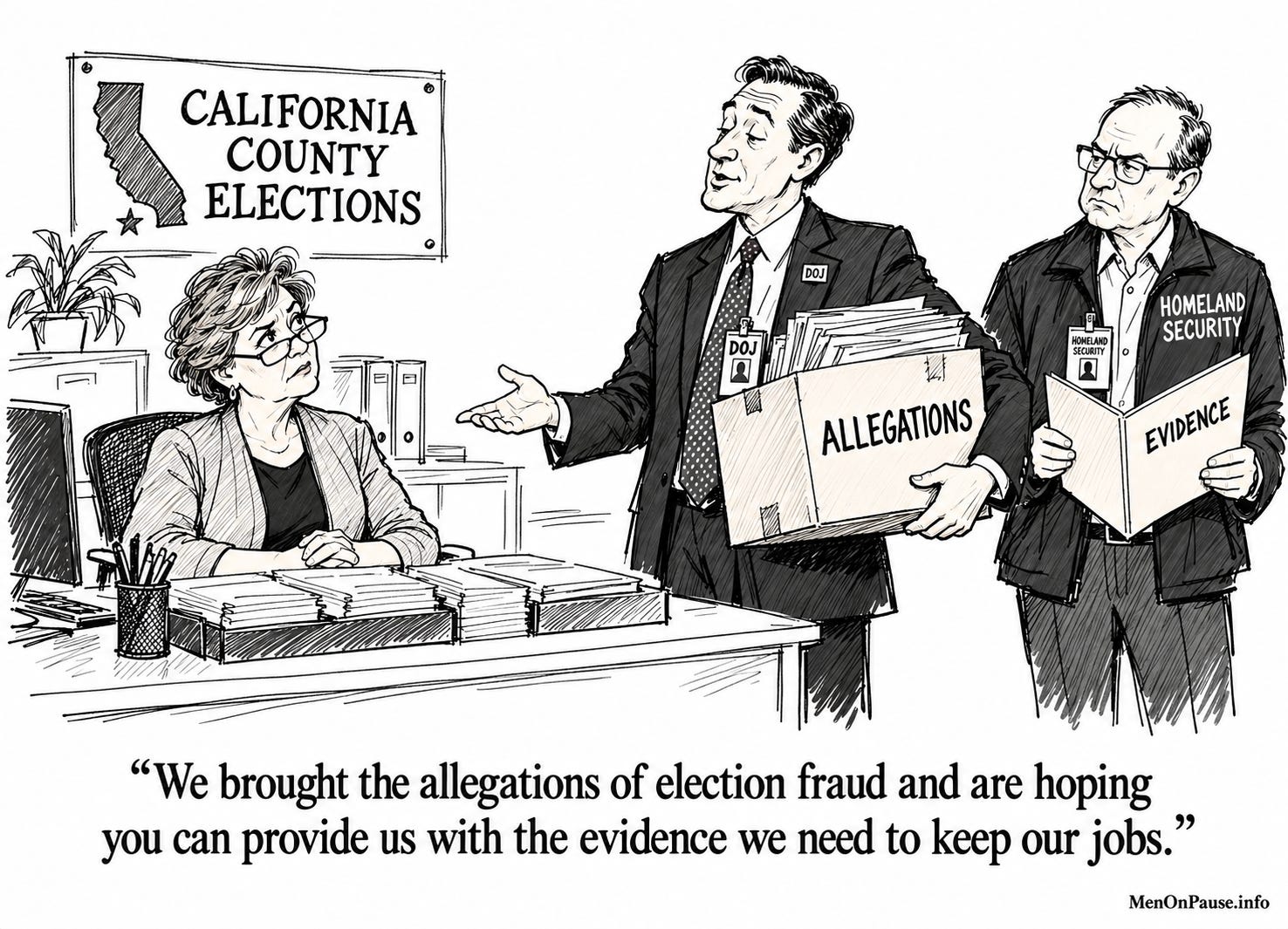
Hot off the press! On Tuesday afternoon, Oct. 28, 2026, U.S. District Judge David Carter (a Clinton appointee) struck down the Trump Department of Justice’s emergency request to set aside 20,000 election ballots of individuals who might not be citizens — this request being part of the DOJ’s high-profile voter fraud case in Los Angeles. The judge’s ruling confirmed what most Californians suspected: Trump’s Department of Justice has been totally out of line in their interference in the state’s election.
Judge Carter described the Trump administration’s actions as “a broad, ongoing pattern of attempted election interference.” He went on to say:
“Never before in American history has the federal government, on the eve of an election, sought to coerce a state and local government to abandon their own Constitutional elections procedures and bend to the will of the Executive Branch.” — Judge David Carter, 10/28/26
He continues, “This request violates longstanding constitutional principles mandating that states have control over their elections.” Carter went on to describe a situation whereby “either party could create chaos for their own political purposes to disrupt the election process. Over 20,000 registered Californians would potentially lose the right that generations of Americans have fought to preserve.” Click through to read Judge Carter’s impressively long, 28-page “ORDER DENYING TEMPORARY RESTRAINING ORDER.” This is one for the history books.
Here’s a timeline on how all of this went down…
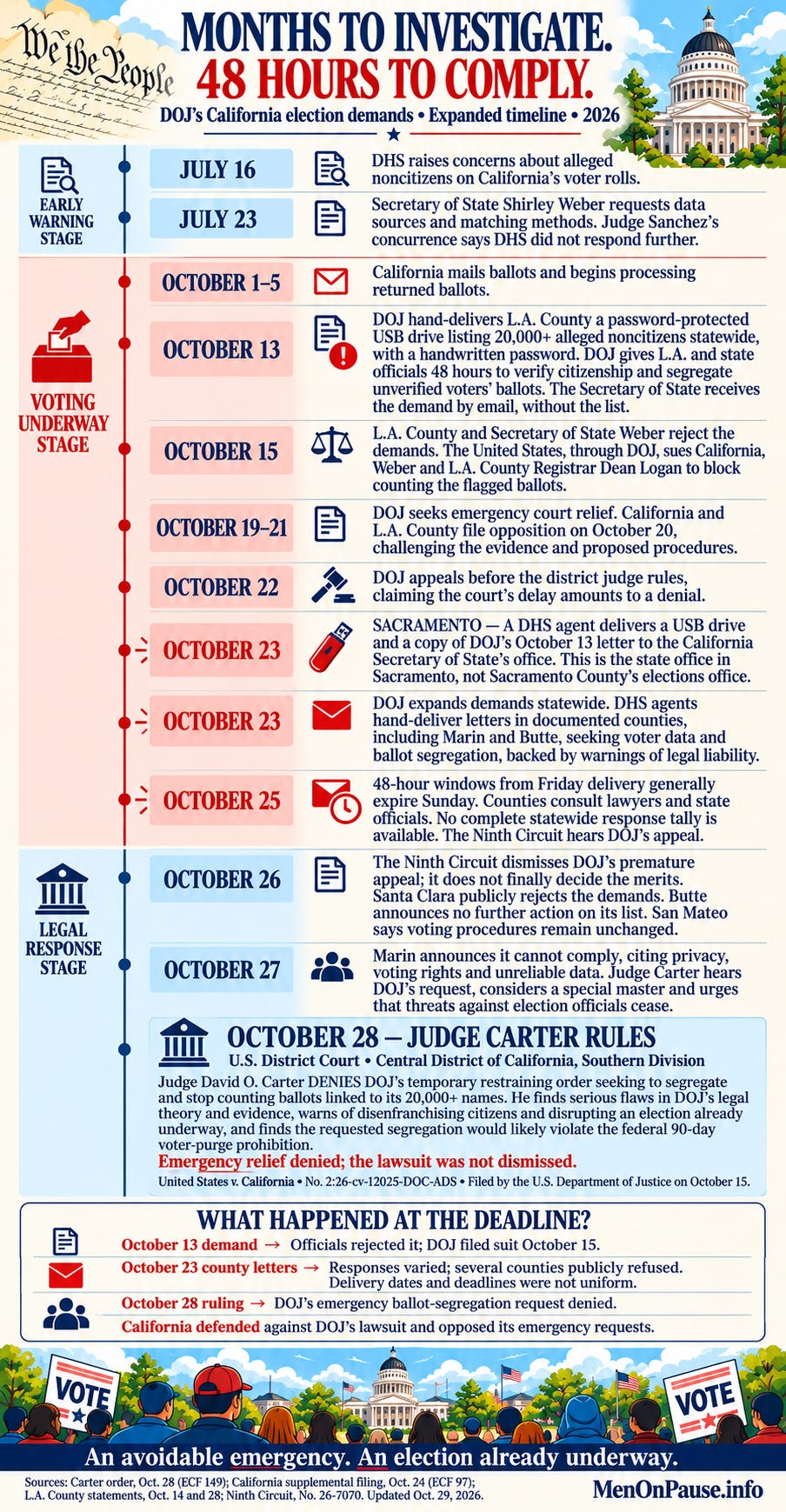
On October 23, 2026, in what appeared to be an attempt to eviscerate America’s confidence in democracy, intimidate people from voting, and to sow the seeds for a legal and/or violent reaction (like the insurrection on 1/6/21) to whatever might be the election results in California, Trump’s DOJ descended upon the state’s 58 county election offices via Homeland Security agents. Agents hand-delivered the DOJ’s demand letters; Napa reported uniformed DHS officers, while San Benito reported agents carrying guns. Did this alarm and distress local election workers? You bet it did. Desired effect achieved!
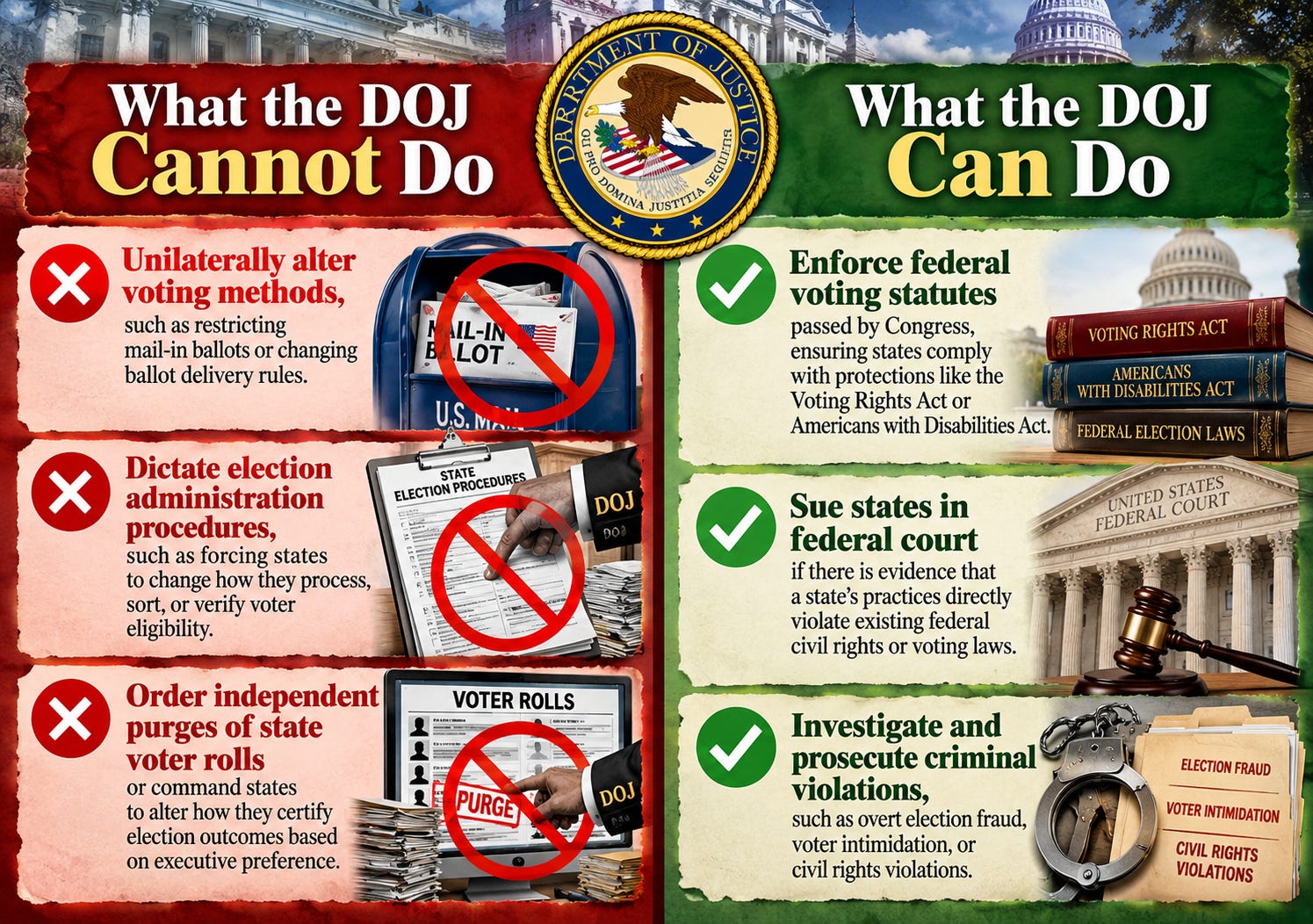
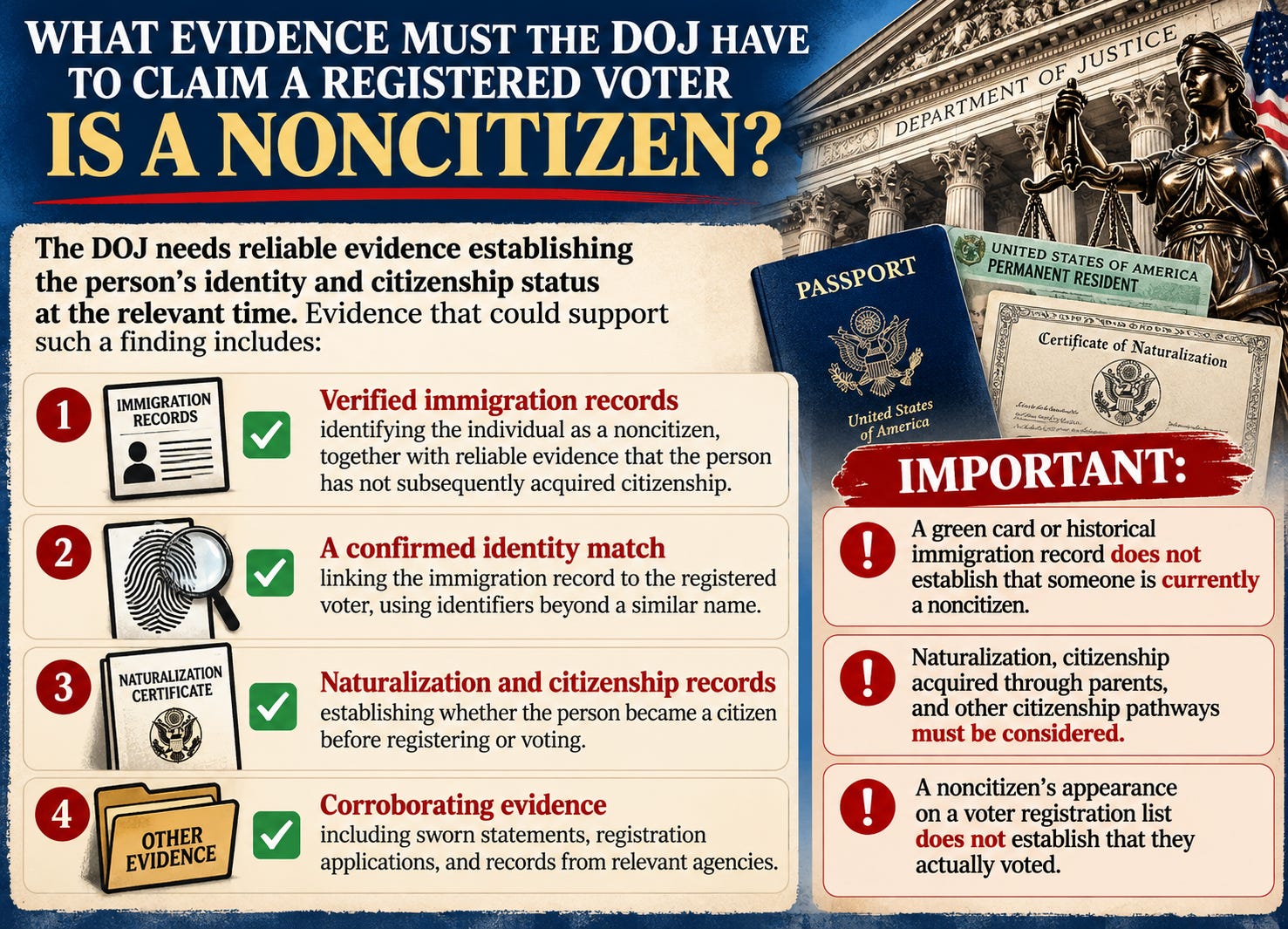
Here’s a synopsis of what the DOJ can and cannot do related to elections:
This is the letter from Craig Missakian, United States Attorney, that was received by Napa County’s Registrar of Voters, John Tuteur, on October 23rd. Similar letters were sent to all 58 county election officials in California that day.
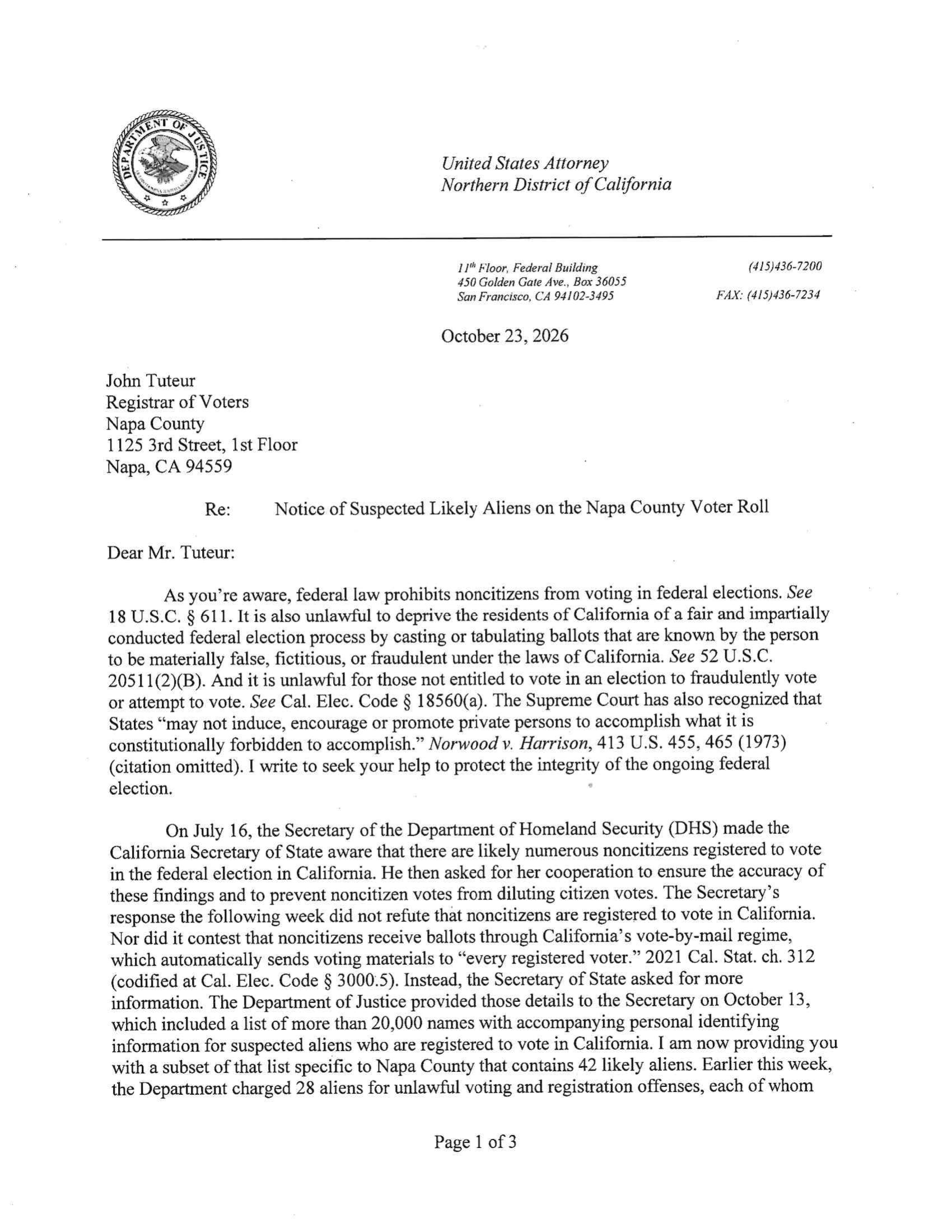
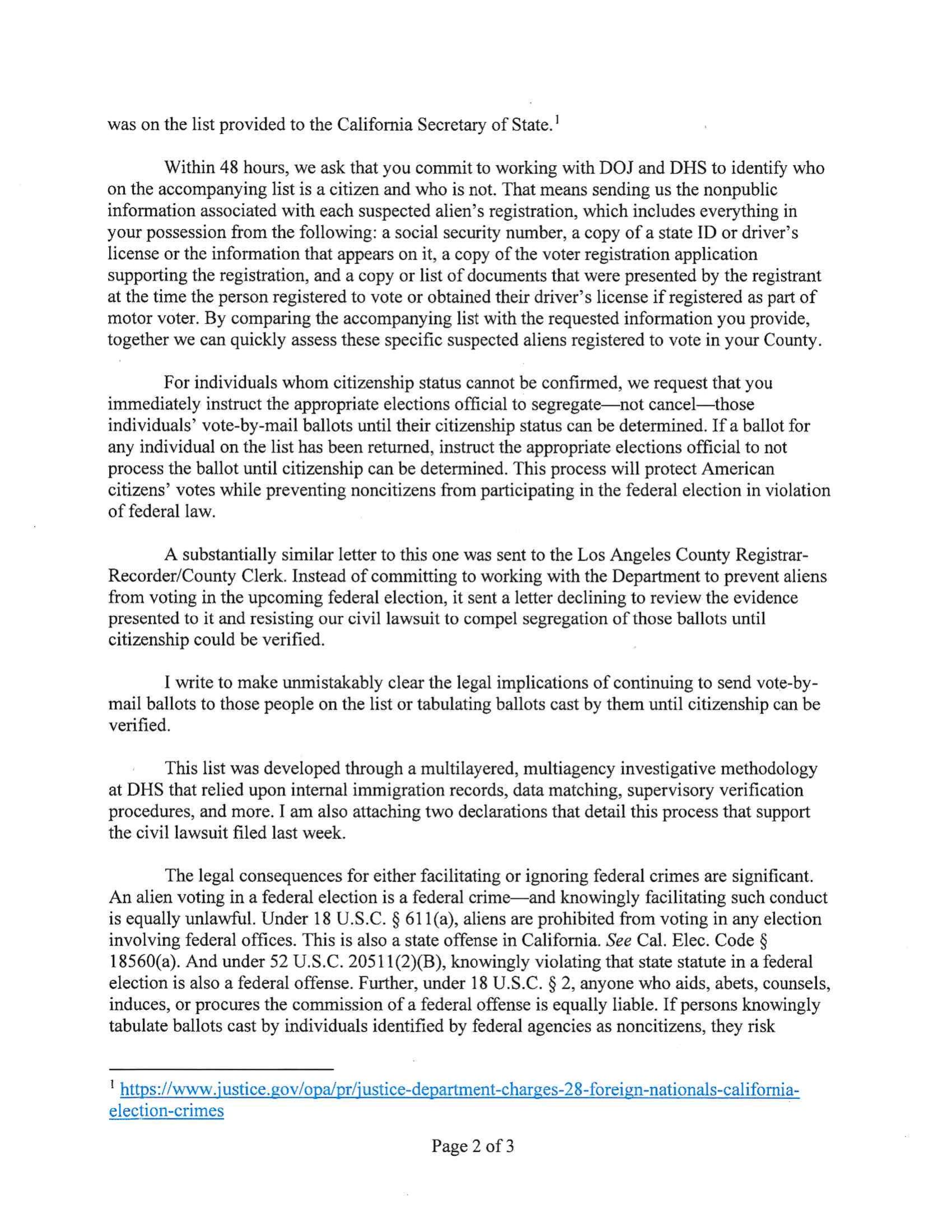
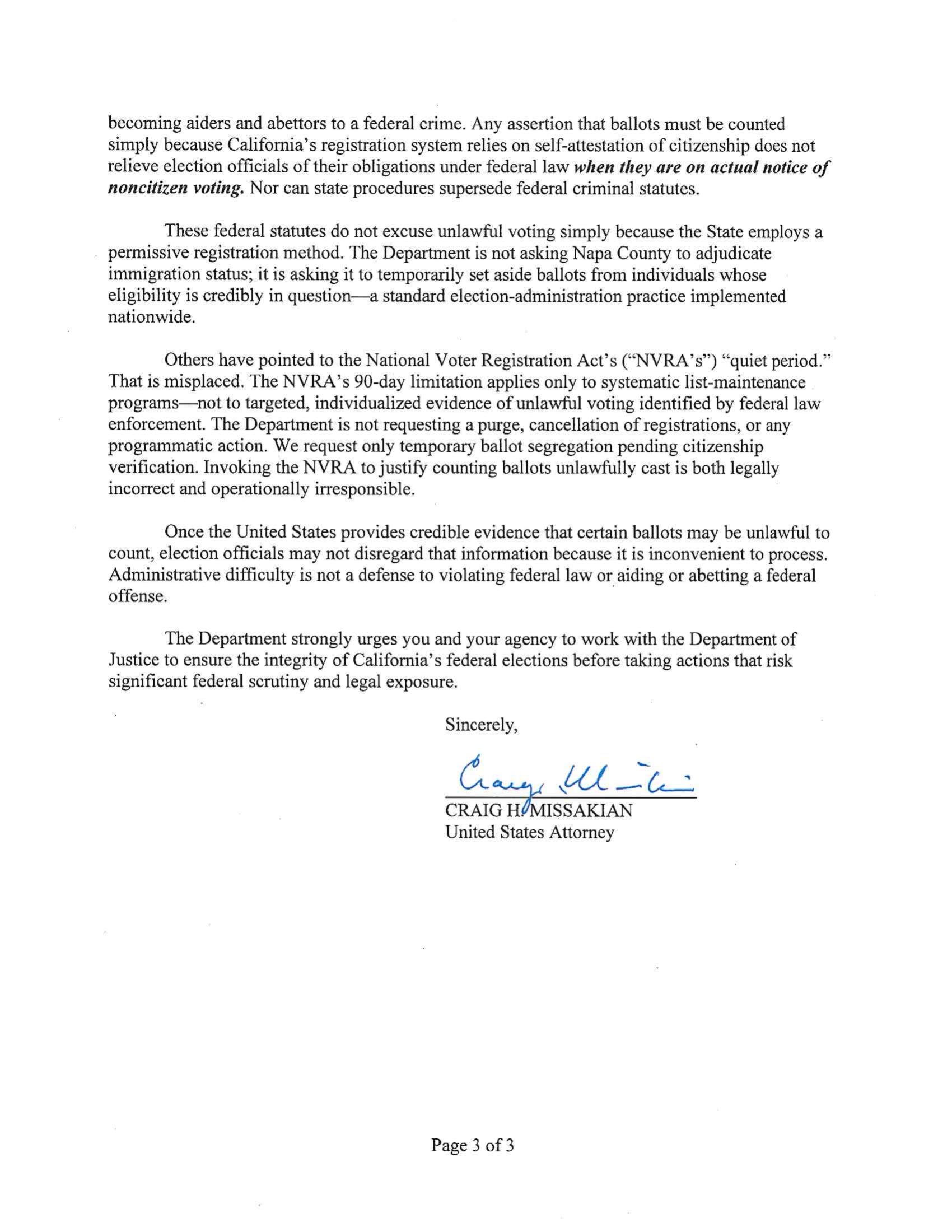
Missakian requested that all local California election officials segregate ballots on the DOJ’s list of supposed non-citizens and not include those individuals in their counts until Homeland Security had ascertained their citizenship: “Once the United States provides credible evidence that certain ballots may be unlawful to count, election officials may not disregard that information because it is inconvenient to process.” Missakian continues applying the thumbscrews to election officials with this: “Administrative difficulty is not a defense to violating federal law or aiding or abetting a federal offense.” Pretty damn threatening, right? Especially in consideration of the DOJ’s failure to present “credible evidence” that the individuals on their lists were, in fact, non-citizens.
A sampling done by Los Angeles County confirmed the sloppiness of Homeland Security's list. Here’s what they determined:
Of the 200 voter-registration records vetted as a sample, L.A. found:
56% had canceled or inactive registrations, and had not been mailed a general-election ballot
38.9% had a meaningfully recorded birthplace which indicated they were born in the United States, i.e. strong evidence of citizenship
71.2% had no voting history whatsoever
Click through to explore in full the case the Trump administration filed against the Los Angeles Registrar-Recorder/County Clerk, Dean Logan, and California’s Secretary of State, Shirley Weber.
The statistics above told election officials all they needed to know: Homeland Security’s list was UNRELIABLE and therefore their claims about voter fraud did not warrant the actions taken by Trump’s DOJ.
One must also question the timing of the DOJ’s requests:
11 DAYS BEFORE AN ELECTION.
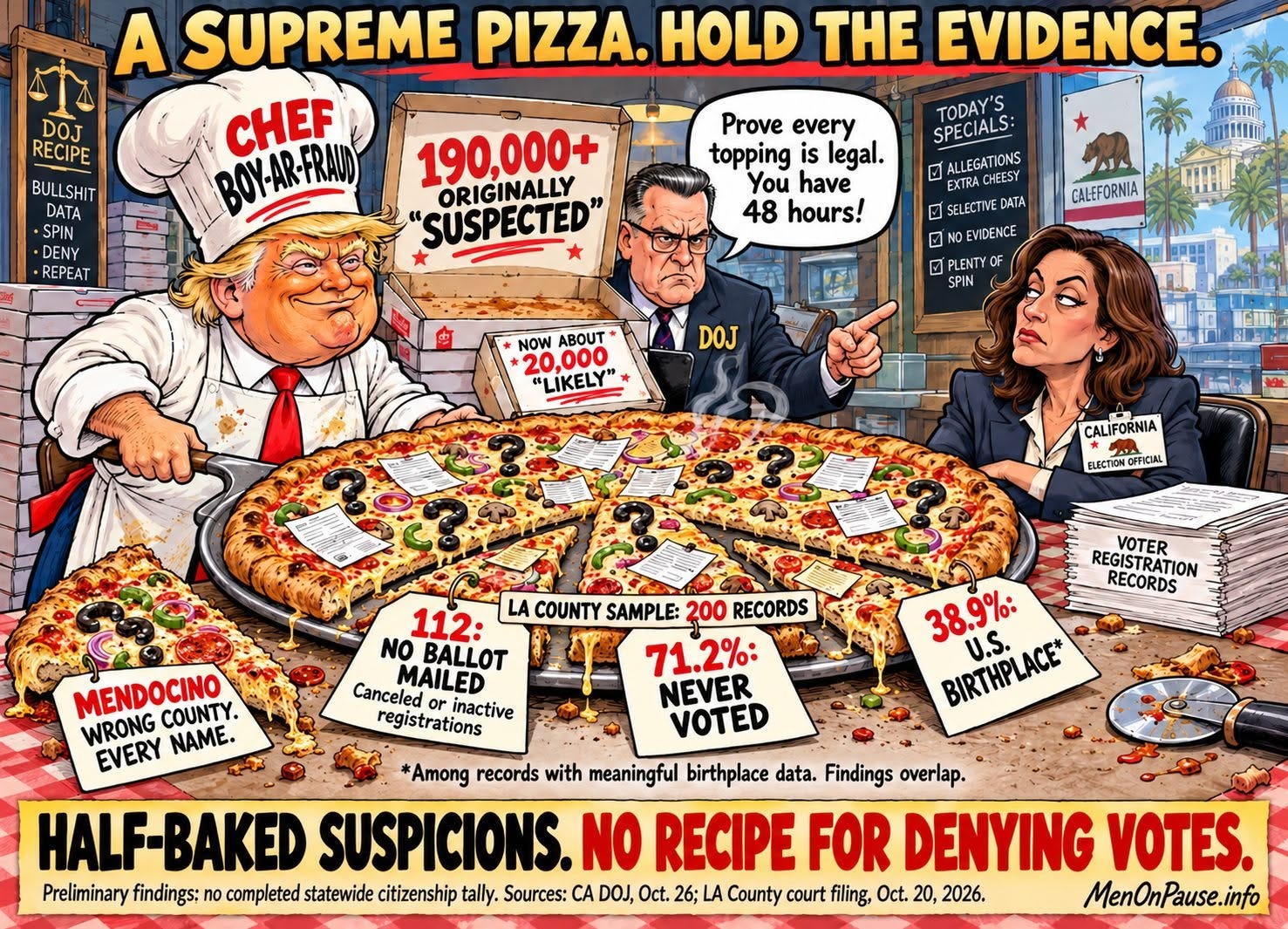
Fact: Of the 23 million registered voters in California, the number of non-citizens voting is almost nonexistent, a fact Homeland Security and the DOJ confirmed in their presentation.
Their initial claim of 190,832 “likely non-citizens” was revised on October 13 to 20,000 “suspected noncitizen registrants.” From that list, the DOJ identified 28 people whom it charged as noncitizens for election-related crimes; 11 of whom were actually arrested on October 19, indicating they likely did not have enough evidence to arrest the other 17 people. From 190,832 to 20,000 to 28 to 11. 😂
The DOJ described all 28 individuals as green-card holders and said they appeared on the 20,000-name list given to the State of California. Keep in mind those 28 cases are, to this day, still allegations, not convictions. And only 11 of them warranted arrests.
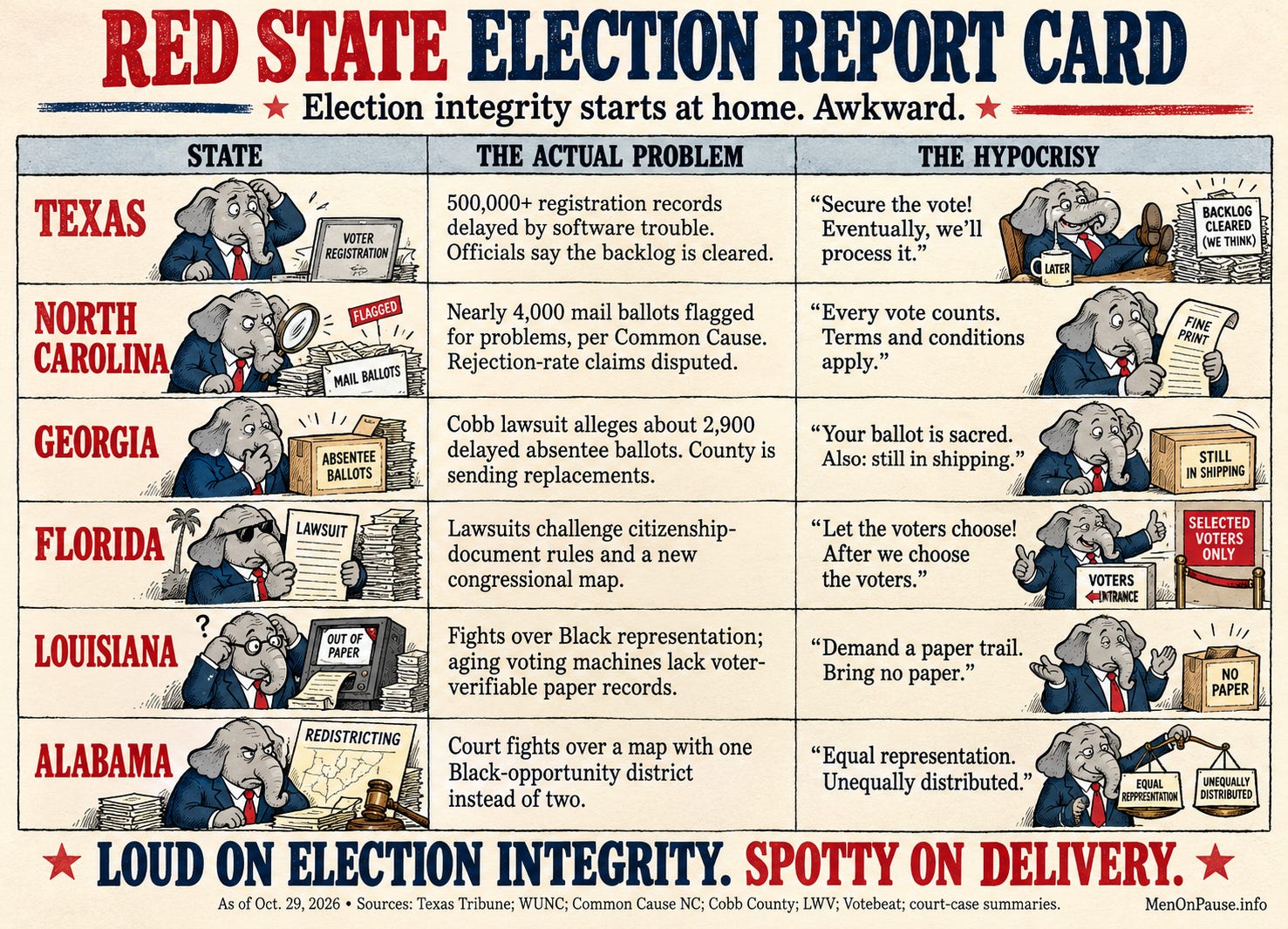
But let’s take this a step further. Considering California’s election system handles over 23 million registered voters, 11 is an extremely small number of people who had voted or were going to be voting illegally. I think most people might consider that a damn good service record. Especially compared to some of the states in the South, where their elections have hit major snags.
To drive the point home, consider that the 11 non-citizen voters who were actually arrested represent only 0.00005% of California’s registered voters. That is fucking laughable.
The Trump administration sought to disrupt California’s election, discredit their election officials, and call into question the state’s final election results (in advance of a final count), all because of a problem with .00005 % of the state’s registered voters? Huh?
Have yourself a good laugh before you pour yourself a 4-finger glass of bourbon.
This entire chaotic mess indicates one thing: Trump and the DOJ need to brush up on their constitutional law. Maybe start with the actual document and hone in on the Elections Clause.
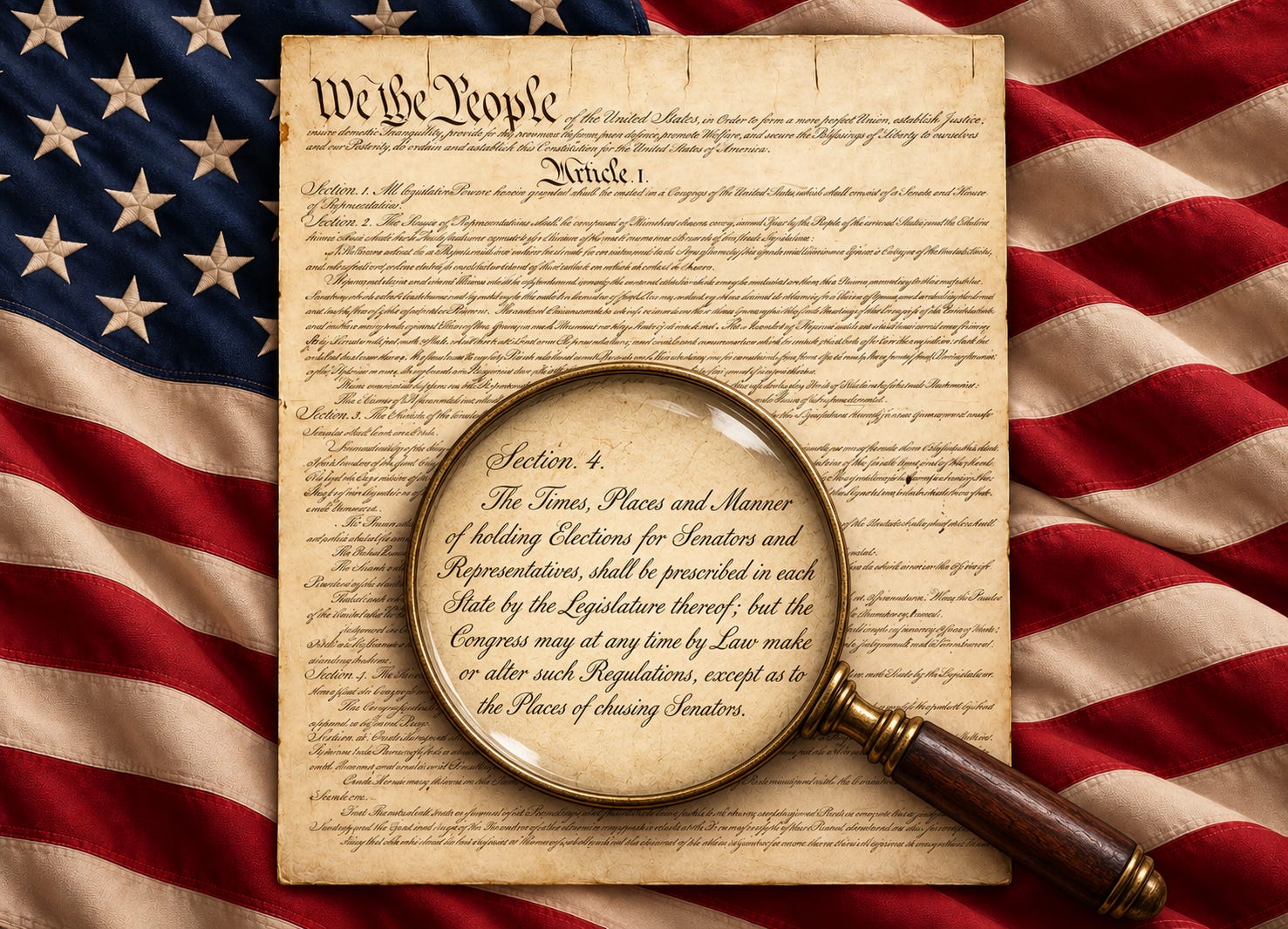
Imagine that. A super important document for all American citizens, that was signed by 38 delegates on September 17, 1787, in the crowded, stuffy Assembly Room of Independence Hall in Philadelphia.
We’re talking about the Constitution of the United States, which became the law of the land on June 21, 1788, after all 13 states ratified it. And guess what? You’re not gonna believe this! The laws in that 239-year-old document are still in effect. Whoa, dude!
And a big hello to the Trump administration.
Someone needs to explain all of this, in detail, to His Majesty — that the Constitution's laws are still in effect. Dude, you have to obey them!
The Elections Clause of the Constitution (Art. I, § 4, Cl. 1) grants STATES, not the executive branch of the federal government, authority over the "Times, Places and Manner" of holding congressional elections. Over the years, this power has undergone legal reform through constitutional amendments and laws passed by Congress and state legislatures — with some tweaking by the courts — but even with revisions, the same overarching concept set forth dictates how elections are conducted in the United States.
Per the Elections Clause of the United States Constitution
STATES RUN ELECTIONS
Note: His Majesty (i.e., the POTUS) has zero constitutional or unilateral authority to change, control, or nationalize election rules and procedures. NONE. And, the Department of Justice, which is part of the executive branch, also lacks the constitutional authority to change or rewrite election rules and procedures. PERIOD. End of story.
Well, maybe not the end of the story while Alito, Roberts, and Thomas are on the bench. If the Dems were to take back the House and/or Senate on November 3rd, all three Supremes might be looking at investigations for actions that may have violated federal disclosure laws, judicial recusal statutes, or constitutional provisions regarding "good behavior.” These three Supreme Court justices have every reason known to man to fudge constitutional details related to election matters, especially on this midterm. The stakes are high for them.
What a mess. Pretty sure James Madison imagined he had all his bases covered when penning this amazing document. But he did not.
To be clear, the DOJ does play a role in federal elections, but its role is specific and narrow: to protect the right to vote under federal civil rights laws and to prosecute federal election-related crimes. If no crime has been credibly ascertained, the DOJ cannot enter an election office willy-nilly and seize or take physical custody of voter rolls and privileged voter information, nor can it compel election officials, under threat of prosecution, to divulge this privileged voter information. That’s a huge no-no, which they are going to find out really soon.
What Trump’s DOJ did to the election process in CA is unconstitutional, as confirmed by U.S. District Judge David Carter.
Under the U.S. Constitution, states maintain primary authority over the administration of elections. Each state has distinct statutory frameworks governing who can access voter data and what specific information may be shared. In California, to prevent identity theft and protect voter privacy, the law forbids disclosing sensitive personal identifiers to anyone who applies (yes, fills out that pesky form) for voter information.
The following voter data is always redacted and never shared:
Driver’s license or state ID numbers
Social Security numbers (SSN)
Images of voter signatures
Any other unique government-assigned voter identifiers
Are we clear? No?
OK, let’s try this again:
Under the U.S. Constitution, the power to regulate and administer elections is explicitly shared between state governments and Congress — not the executive branch. Not the executive branch.
The DOJ is part of the executive branch. As is the presidency, Mr. Trump.
More About the Election Fiasco in California
OK. I must confess something to my readers, right here and now. I am no longer personally practicing “Men On Pause.” I was married three weeks ago. Yes, I am blushing and embarrassed that I am no longer among the proud ranks of all those strong, single, older women out there. Know this, ladies: I still have your backs. And the backs of all women, for that matter. So no, I will not be changing the name of my blog, but I did change my last name.
My new husband… well, he’s a California election official. Holy smokes, can I pick ‘em or what? So yes, I’ve got skin in this game. And what a fine honeymoon we’ve had, especially that part where Homeland Security agents delivered a demand letter from the DOJ to my new husband’s county election office last Friday.
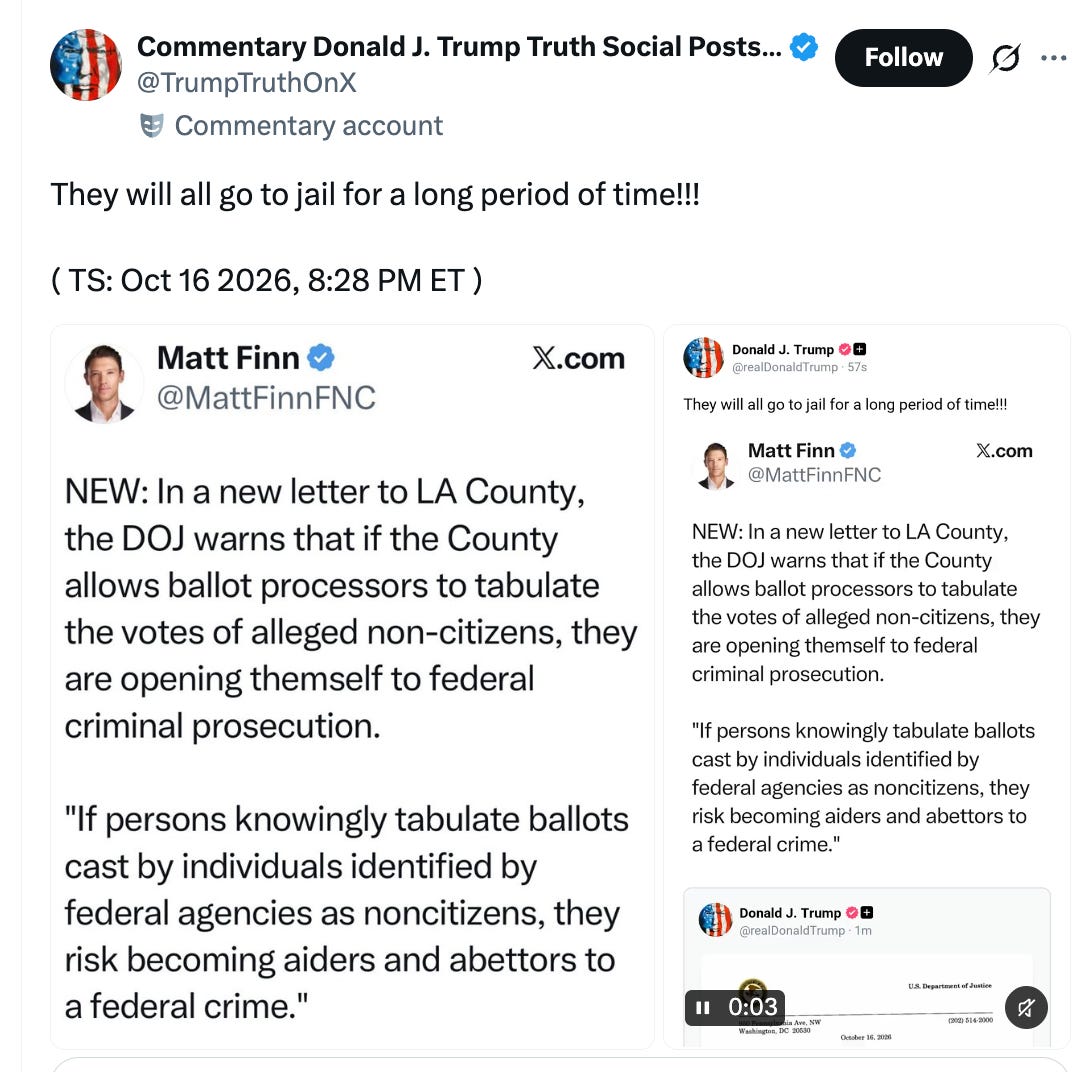
With California voting well underway, Trump’s DOJ demanded that all 58 counties turn over sensitive voter information and set aside ballots from people it suspected were noncitizens, imposing 48-hour deadlines and threatening local election officials with legal consequences for noncompliance. The operative word here: “suspects.” The DOJ did not provide specifics. They just expected officials to pull the ballots from supposed voters on their nefarious list and set them aside. The president of the United States directed his own threat to those local election officials who’d decided to continue business-as-usual with the state’s election procedures, which, I should note, they had taken an oath of office to execute. “They will all go to jail for a long period of time!!!” the president declared on Truth Social.
So there I was last Friday, trying to ready my new husband for potential jail time. He’d taken a bad spill on his bike the day before the DOJ letter, leaving a good-sized chunk of his epidermis on the bike trail and bringing home some impressive contusions. In the days to follow, he could be seen hobbling around town with a cane. I just hoped that before his arrest we could get those stitches out and have him walking properly. Lord knows where Homeland Security might take him if the DOJ actually intended to make good on its threats. The county jail? A detention center? And they might take away his cane — you know, because it’s a potential weapon. How would he make it to the mess hall?
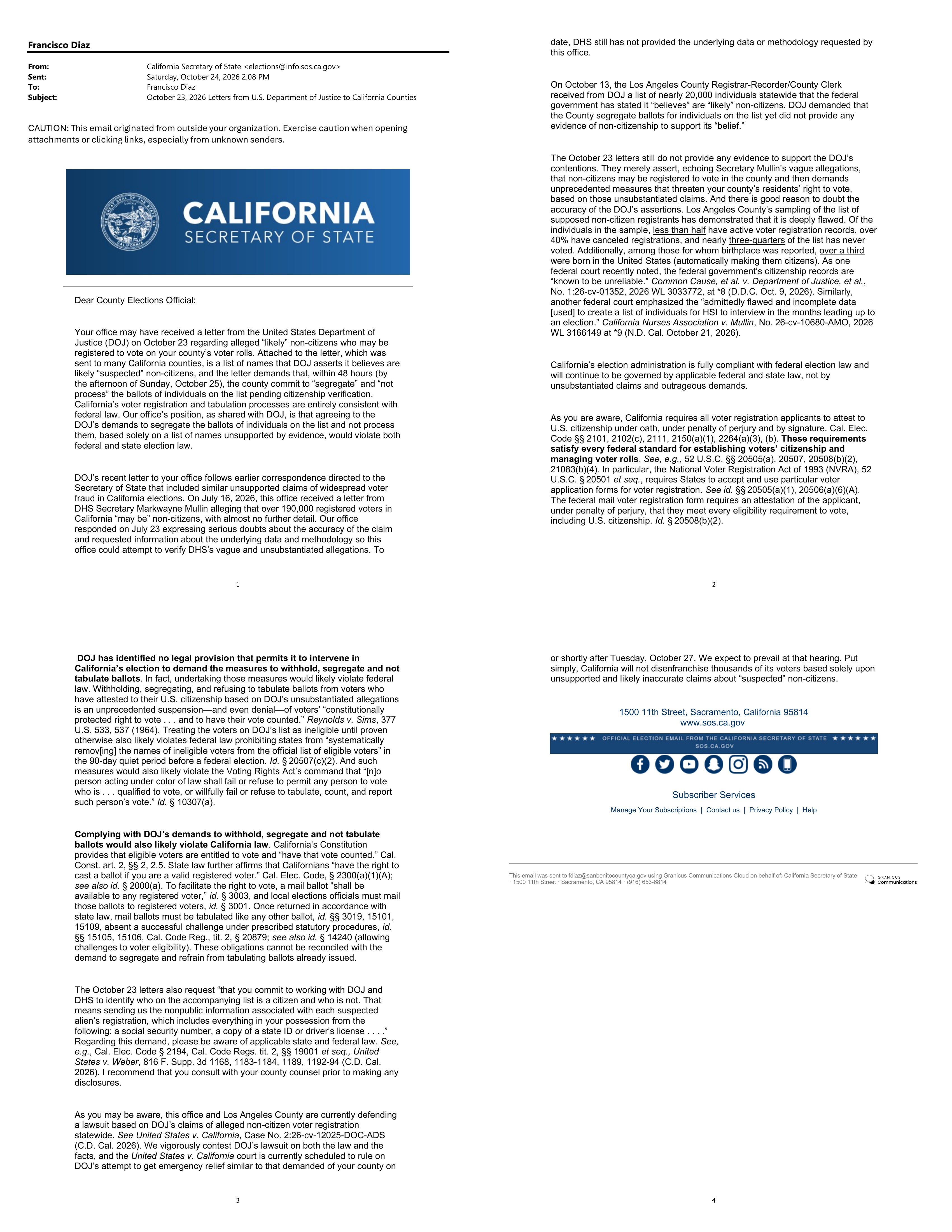
Across California, as mentioned earlier, election officials found serious problems with the DOJ's potential voter-fraud lists. When they sampled the list, they found many eligible voters, a large chunk of people who weren't even registered to vote, and people who hadn’t been sent ballots. All of this raised concerns among election officials across the state that faulty DOJ data might cause lawful voters to lose their votes. And so, election officials decided not to set aside ballots.
For your reading pleasure, here are written responses to the DOJ from three of the state’s election officials: John Tuteur, Registrar of Voters for Napa County, and his boss, the Secretary of State, Shirley Weber, and Dawyn Harrison, county counsel for the County of Los Angeles:
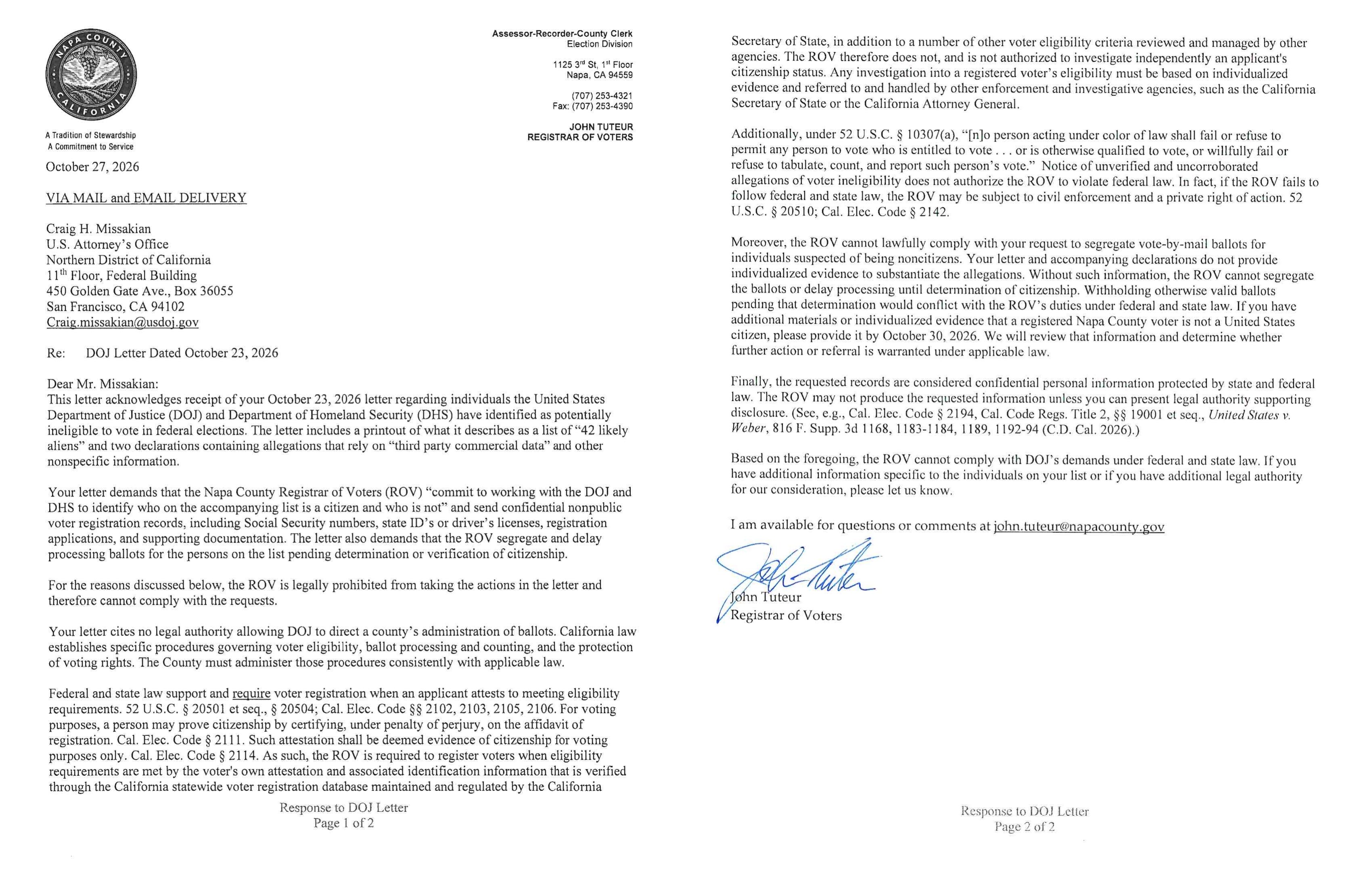
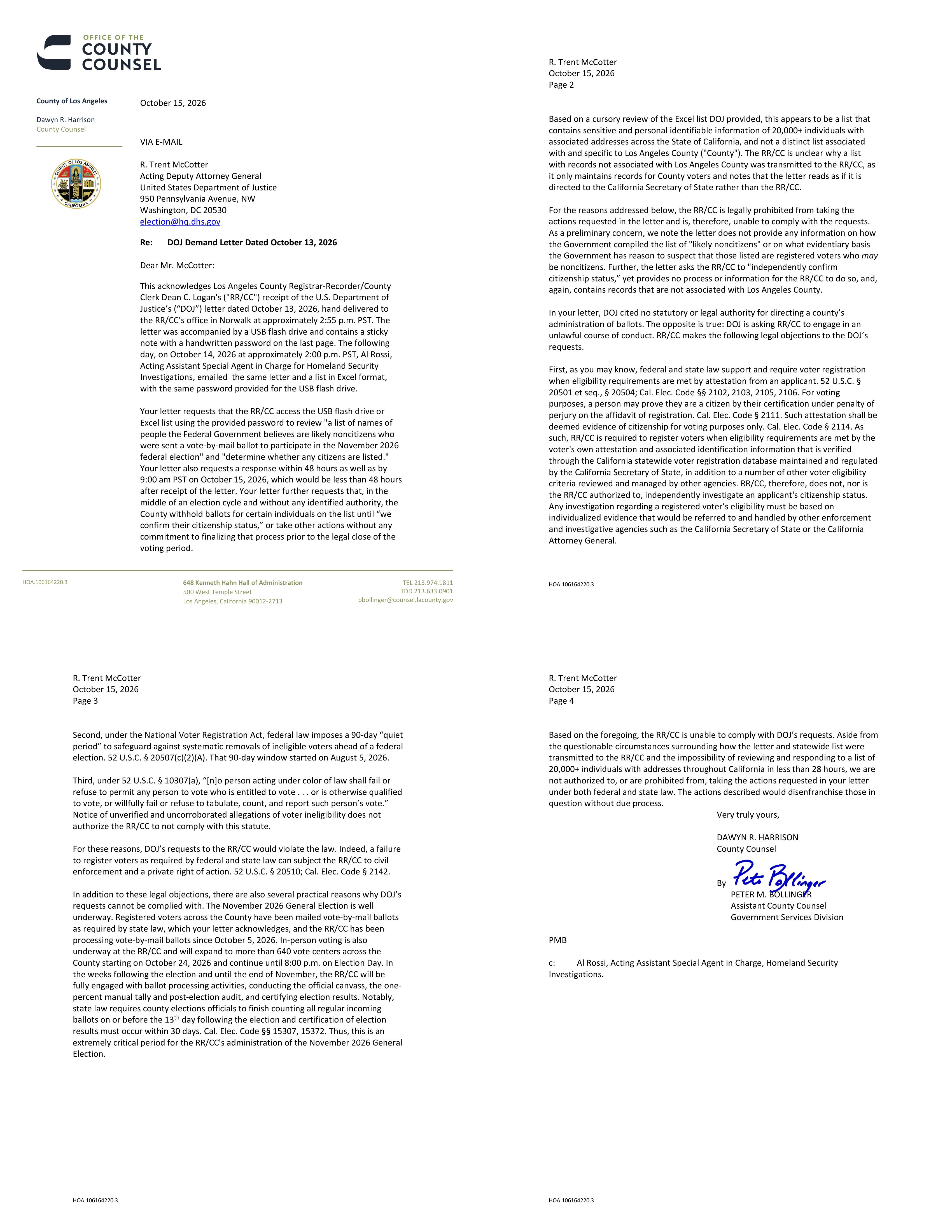
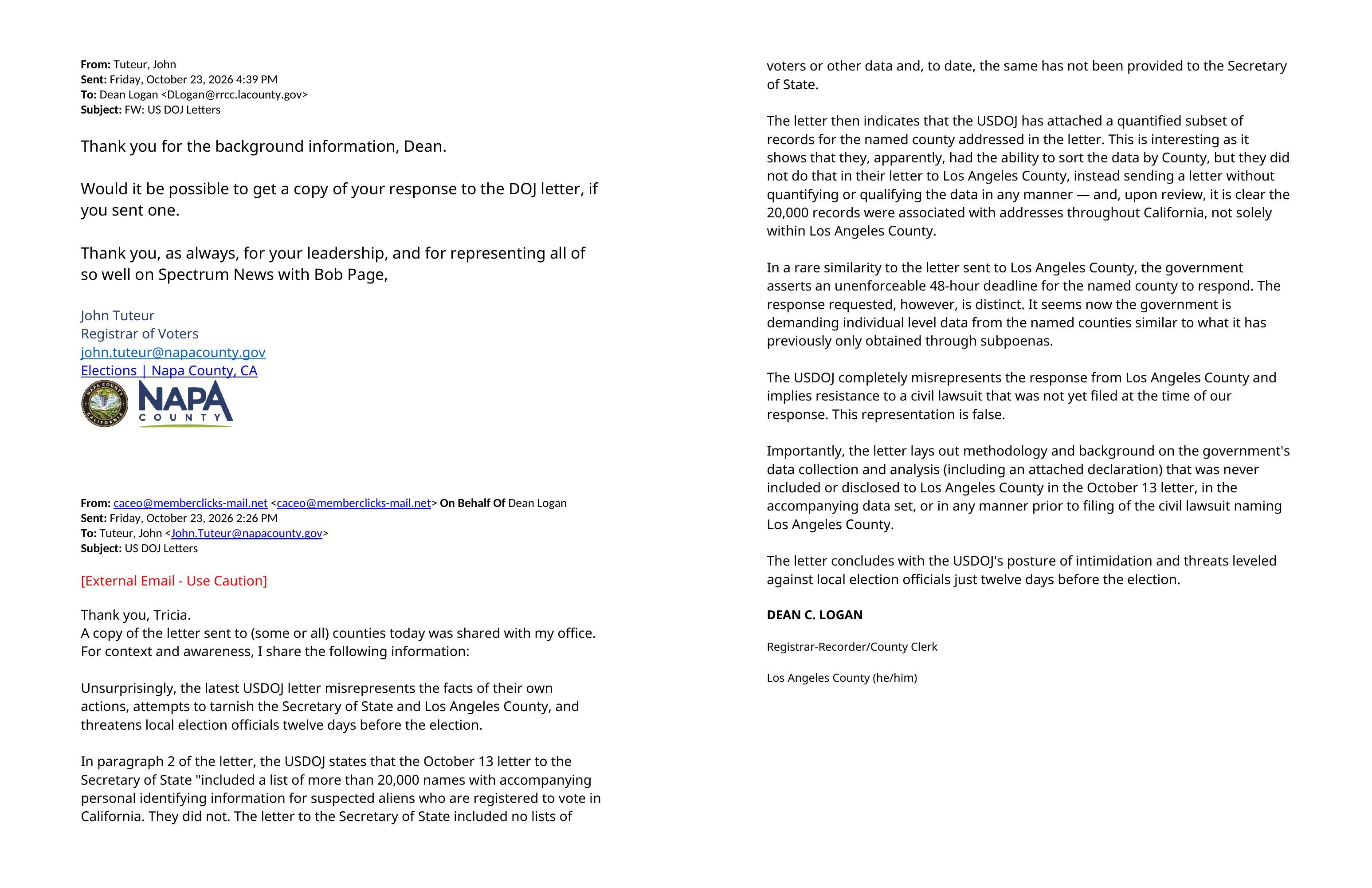
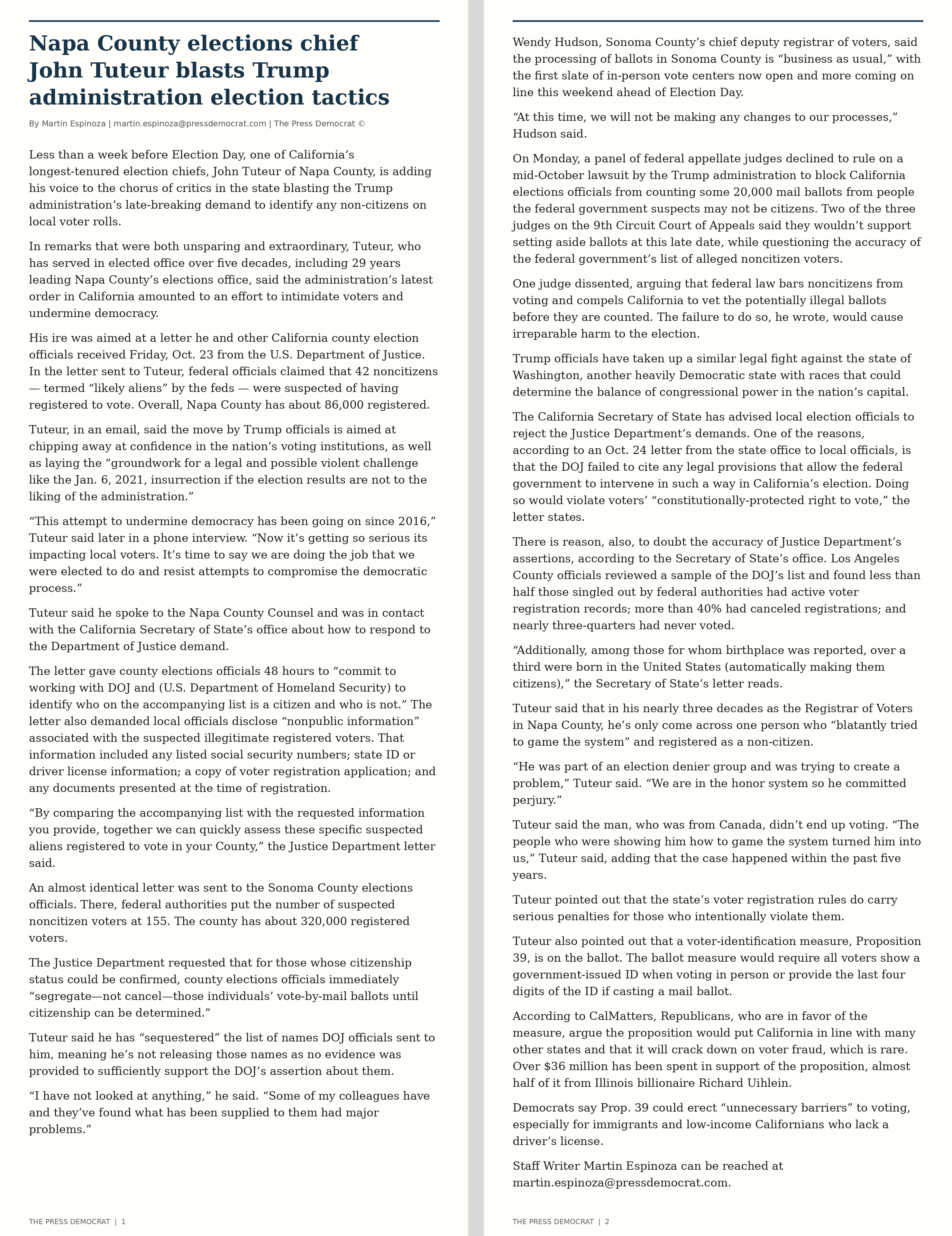
For more information on all of this craziness, I would recommend reading “‘This is not normal’: Feds demand California counties set aside ‘likely’ noncitizen ballots” from the Los Angeles Times. And from AP News: “California election officials frustrated, rattled by DOJ demand to sequester ‘noncitizen’ ballots.” My favorite article comes from Santa Rosa’s Press Democrat: “Napa County elections chief John Tuteur blasts Trump administration election tactics,” by Martin Espinoza, an excerpt provided here:
The DOJ’s emergency appeal to the courts was summarily dismissed on procedural grounds, though the underlying case continues, with a judge considering an independent review.
The central dispute is this: whether federal suspicions justify withholding ballots before ineligibility is established. Beyond that argument, many in the state claim the DOJ is overreaching its authority, since the state has its own procedure for confirming citizenship during the registration process, and that procedure is signing a statement under penalty of perjury that the voter is a citizen of the United States and over 18 years of age. Again… we are circling back to this issue of who gets to make and execute the election rules. According to the Constitution, that would be the state. In this case, the State of California.
California’s local election officials, meanwhile, already have instructions — and have taken an oath. Article XX, Section 3 of California’s Constitution requires them to swear they will “support and defend the Constitution of the United States and the Constitution of the State of California against all enemies, foreign and domestic,” and “well and faithfully discharge the duties” of their offices. Those duties include administering voting, processing ballots, reconciling election records, counting valid votes, and reporting results. Elections Code Section 15302 specifically requires “Processing and counting any valid vote by mail and provisional ballots” remaining after the initial canvass. Election official accountability runs through the law, the courts, state election oversight, and their local elected or appointed offices — not through a personal chain of command ending at Donald Trump. Government Code Section 12172.5 identifies California’s secretary of state as its chief elections officer. His Majesty may find the organizational chart below disappointing. The oath California’s election officials take specifies obedience to two constitutions and precisely zero kings.
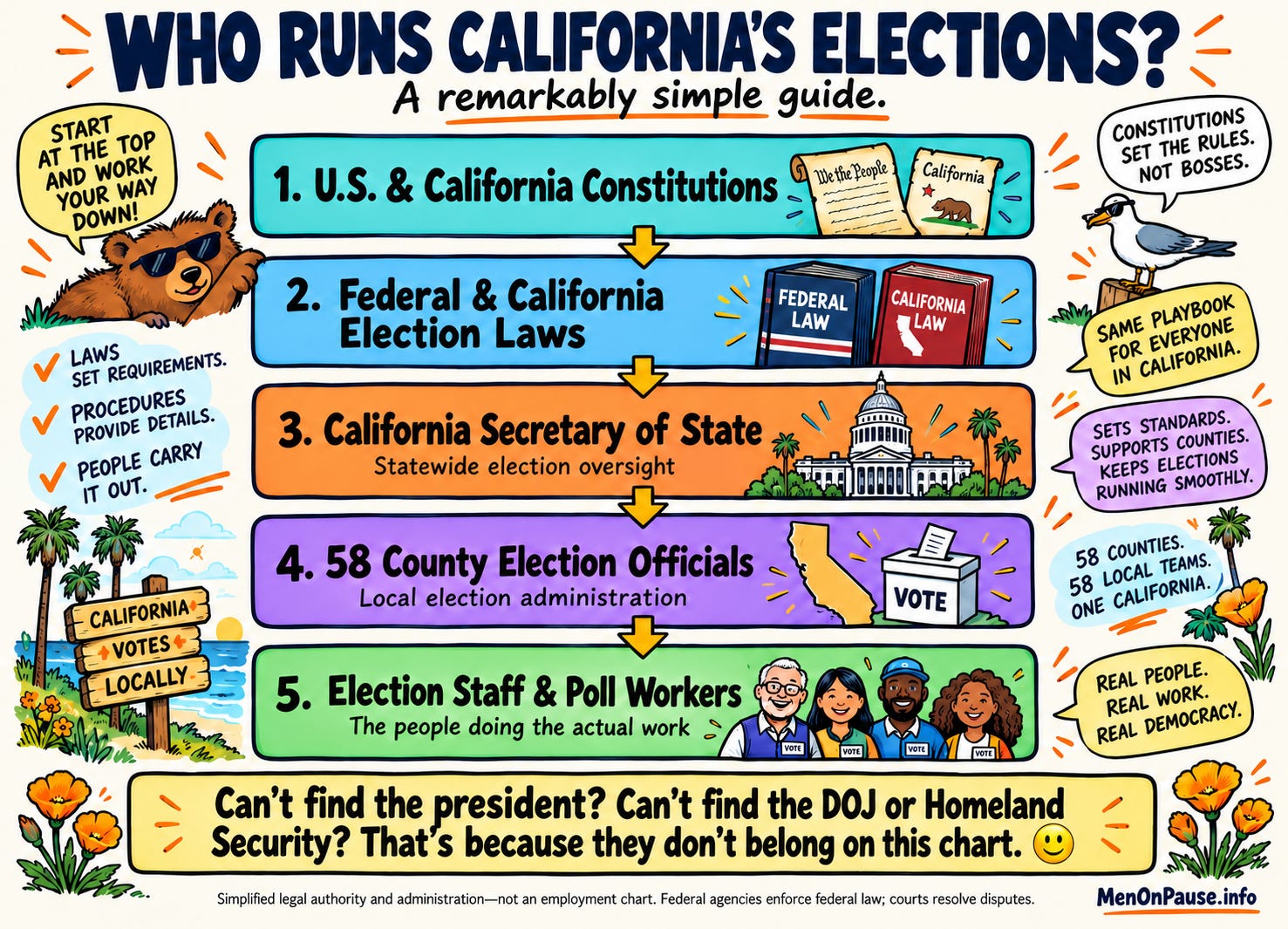
DOJ and Homeland Security crossed into this dispute by turning federal suspicions about citizenship into demands that California change how it processes ballots. According to the court record, DHS agencies assembled the list; DOJ demanded election officials agree to cooperate by making citizenship checks within 48 hours, which would then result in setting aside ballots whose voters’ citizenship could not be confirmed. This is NOT the state’s procedure.
The administration invoked 18 U.S.C. § 611, which makes it “unlawful for any alien to vote” in federal elections, subject to statutory exceptions. That is a criminal prohibition, but not a blank check authorizing federal agencies to invent a new ballot-processing regime. Investigating suspected crimes and prosecuting provable violations are legitimate federal functions. Treating an agency’s disputed list as a binding instruction to county election officials is the asserted overreach.
In his October 26 concurrence, Trump-appointed Ninth Circuit Judge Mark Bennett explained that the statute the DOJ relied on is not “a grant of authority for the Executive to restructure state election administration.” The court dismissed the appeal on procedural grounds, so that reasoning was not a final merits ruling. But the distinction is devastatingly straightforward: having the authority to enforce a law does not make you the author of every law you wish existed. The DOJ’s federal letterhead did not cure that inconvenience.
“The Times, Places and Manner of holding Elections for Senators and Representatives, shall be prescribed in each State by the Legislature thereof.” That’s Article I, Section 4 of the United States Constitution—the Elections Clause, apparently overdue for circulation at the Department of Justice. It assigns states the primary responsibility for administering congressional elections, while expressly allowing Congress, “by Law,” to change those rules. Congress. Not the DOJ, not Homeland Security, not Donald J. Trump. Laws can only be changed through legislation. The executive branch gets no equivalent invitation to improvise.
Federal election laws apply to the State of California, of course, but presidential displeasure is not a constitutional amendment.
For Trump’s Department of Justice, the United States Constitution has become terribly inconvenient.