


It was our usual Sunday evening out, though circumstances had changed. John and I had taken an invigorating hike up into the hills on the west side of the valley, and were now sitting in a favorite eatery on the edge of town, The Bullpen, run by my longtime chef friend, Adam.
Adam had a manly, tough-guy aura — he was burly with a thick, dark beard, and always had a transistor radio sitting on the windowsill of the Bullpen kitchen blaring whatever the current MLB game was. Adam was adept at booth banter, which he had no problem juggling with his cheffing, often putting together an over-the-top Bolognese with fresh-made pappardelle, or braised short ribs with pommes purée and cabernet jus, while calling out baseball stats to anyone within earshot.
Meat and sports. Adam’s specialties.
Prior to being a chef, Adam had been a clubhouse reporter and analyst for both the Seattle Mariners and the Seahawks — this at the tender age of 24 — he was a sports announcer prodigy, of sorts. And despite this being his destiny, given his native talent for broadcasting, Adam’s true passion was food, and so it wasn’t long before he was weaving cooking classes into his already demanding schedule as an announcer. Turns out Adam had as much a knack for food as he did for sports. Big time. I’m talking major league cooking chops. His first gig after culinary school: executive chef at one of the wine country’s top resorts, which is where I first met him in my capacity as a restaurant critic for our small-town paper.
In both careers — as an announcer and a chef — Adam had mingled with every manner of high-testosterone individual: sports figures, announcers, billionaires, winemakers, high-tech gurus, and, of course, other chefs. He could talk on their level about all the things of importance in this world, namely money, booze, food, women, and sports. They revered his cooking, and he played the part of celebrity chef to a T, as documented in the hundreds of photos of him with famous people that were sprinkled throughout the restaurant. Adam had the look, made incredible food, and was raking it in, hand over fist.
Adam was also notorious for being a hard-nose in the kitchen, which was tempered by his fierce protection of his employees, be they sommeliers or scullery staff — a dynamic different from that found in the kitchens of his competitors. Adam was respectful to everyone, except slackers, and in return, his staff was loyal, worked their asses off, and was motivated to meet his high standards in all things. Adam also made a point of bringing on board as many women as men, and elevating staff based on skill and tenacity, not ethnicity or gender — a rarity in the white male-dominated field of chefs and restaurateurs.
Adam was also an outspoken feminist. He had two daughters, and he’d been raised by a single mother. In fact, that’s how he first developed his cooking skills — putting meals on the table for his hardworking mama, Lori. Lori worked an insane number of hours as a paralegal for King County’s prosecuting attorney, this in order to keep a roof over their heads and to ward off her trust fund, drug-addicted ex, whose favorite pastime was taking her to court. Being surrounded by lawyers — criminal lawyers, specifically — is how she kept Bryce at bay. Criminal lawyers know all too well how to deal with sociopaths, and they happily shared these skills with Lori. Since Bryce didn’t work, he had ample time to make trouble for Lori and their sons, and things might have been much worse had she been bagging groceries at Metropolitan Market rather than working in the criminal justice system.
Neither Adam nor his brother Josh had any desire to live with “Dad.” Their father had demonstrated early on that he was incapable of getting them to their Babe Ruth baseball games on time, which always put them at the bottom of the batting lineup, and dinner at his house commenced around 9:00 p.m., which was perfect for Dad, but caused the boys to torture through homework on empty stomachs.
Laundry didn’t get done at Dad’s; there was never enough money for lunch, and Dad was more often than not spending his evenings playing craps with his buddies in the basement or out of the house for a couple of hours on a Friday or Saturday playing pinball at Jerome’s Billiards without the boys. Adam and Josh knew which side their bread was buttered on. There was no butter or bread at Dad’s.
Adam had also discovered, by age 14, that the thing that kept his mother’s spirits up through all of this crap was coming home to a cooked-from-scratch meal at the end of the day, then being able to put her feet up post-dinner while someone else loaded the dishwasher. She absolutely relished this. And so, Adam cooked, and Josh cleaned, with sports radio blaring in the background. They were an awesome tag team. Once everything in the kitchen was back to rights, the whole gang would retire to the futon couch (which doubled as Mom’s bed), to binge-watch episodes of The Office.
All of this is to say: Adam had an appreciation and respect for women — his mother, her boss and quasi-aunt, Janelle Foster, who was the top prosecutor in Seattle, and for all of the women with whom he worked at the resort and his restaurant. And despite their differences, Adam also regarded highly his ex-wife, Beth, who took stellar care of their three children. Adam was an all-around standup guy, surrounded by strong and capable women.
Which is why I wanted to discuss Isabelle’s situation with him specifically. Not only was he one of my best friends, but Adam also appreciated my challenges as a single mother. And I had an inkling he had connections to some of the men we needed to get to know.
Though Adam and I were close, he was even closer to Isabelle, as she had worked for him for several summers both as a back waiter and as an on-the-day coordinator for the large events held at the restaurant. Event work involved early-morning deliveries, and bright, hot afternoons of furniture and tabletop setup that morphed into long, exhausting evenings, guests swirling around the dance floor until the wee hours of the night, while staff stood on the sidelines, reserving their energy for the event strike at midnight.
Events have a way of revealing what a person is made of, their strengths, their shortcomings, and their ability to remain centered, patient, and kind in trying situations. Isabelle trusted Adam implicitly, as he did her. She was an important part of his team. And now we needed him on our team.
Adam was also an important part of our community — dialed in to everything going on — his restaurant a major social hub for locals, young and old alike. Adam knew everyone, and everyone knew him.
And so, that Sunday afternoon, I called ahead to see if he could join John and me in a private corner of the dining room for our favorite bison burgers, and a pitcher of his famous adaptogenic herbal tea. And to talk. I needed a good-sized chunk of his time, perhaps an hour. This was important. Laura would join us if she could, so include some of those garlic parmesan sweet potato fries please.
Bits and pieces of the situation with Isabelle had been floating to the surface for some time, giving every indication that something was lurking below, hidden in the detritus. This something was threatening to pull my daughter under. I could feel movement down there, a subsurface turbulence gently rocking the boat, and I was clutching the thwarts in anticipation of what might come next.
The thing about ambient terrorism is that it doesn’t announce itself. There is no manifesto. No declaration of war. Just a steady accumulation of small violations that, individually, seem too minor to report. But collectively they began to create an atmosphere so suffocating that the target starts to believe the problem is her own paranoia. I’d watched this very thing unfold for two weeks now, and had been documenting it all, just as I would if covering a story for a major publication.
As of today, however, I’d reached a saturation point in the gathering of information. It was time to put everything on the table, share what I’d seen, and to dissect it. All of this needed more than one set of eyes. The details, because they related to my daughter, were a bit too close for me to bring into focus, yet even when I stepped back, I was still failing to see the larger picture. I was both hyperopic and myopic — everything was a blur.
Though I was having a difficult time seeing what was going on, I knew there had to be a common thread. For Isabelle’s sake, I needed to find it as soon as possible.
Tuesday, 9:47 AM: Isabelle was back at Blink’s Market — she needed the regular paycheck, and quitting would have signaled to Howard he had power over her. She was like me: not good at acquiescing to men and always doing her damnedest to keep from revealing her weak spots to them. She dressed tough, she acted tough, and she was tough. Just like her mom. And so it was decided, by Isabelle, that she would continue going in to work, she would do her job competently and be polite, and she’d find clever ways to thwart Howard’s advances, without letting on how repulsed he made her.
Isabelle was positive she had all of this in hand, that she knew what to do, and would not get hurt. There was no talking her out of it, so I bit my tongue. What I wanted to say, had the opportunity presented itself, was that Howard was much meaner than she could ever hope to be, that she didn’t stand a chance against someone that practiced at being cruel — a person fueled by malice, insecurity, and a need for control. On top of that, Howard was one of those men who felt entitled to have whatever he wanted. And Howard wanted her.
I did let her know, however, that if she were going back to that place after what had transpired, I was going to station myself nearby, at least until things cooled off. Isabelle wasn’t thrilled with the idea, but she knew better than to try to talk me out of it. And at some level, she was relieved someone had her back.
And so I parked my Honda CR-V across the street from Blink’s Market, which gave Laura and me a clear sightline to the entrance, while also keeping us out of range of the surveillance cameras sprinkled throughout the parking lot. Once Isabelle made her way inside, Laura and I crossed the road and headed straight to the produce department under the pretense of looking for heirloom tomatoes and our veggies for the week.
Tuesday, 10:02 AM: As I picked through a pyramid of navel oranges, Laura saw Howard emerge from the stockroom. He scanned the store, located Isabelle at one of the registers, then suddenly changed direction. He was wearing the same khakis and polo shirt he’d worn the other day — the day he hadn’t even noticed my presence while he was hitting on my daughter. Middle-aged women, his wife included, were invisible to Howard. And he was wearing that same damn wedding ring, the one he was always touching like a rosary. Howard’s approach was casual and practiced — nothing the fisheye cameras would flag as suspicious or that might alert his wife, who sat religiously in front of the large security monitors every day, making sure the family fortune remained intact and that Howard kept it in his pants. But from where I stood, I could see the calculation in Howard’s trajectory, and the unmistakable look of determination on his face.
Making his way swiftly to the front of the store, Howard positioned himself immediately behind Isabelle, spreading his arms across the entrance to her register area, gripping the countertop on either side firmly, as if to keep her from leaving. At first, Isabelle paid no attention — she was busy checking out a customer — but when she tried to turn around, she found Howard crushingly close — so close, in fact, she could smell the Listerine Antiseptic on his breath — a touch he imagined would impress this beautiful, young woman.
Laura, who was standing in line at Isabelle’s register with a cart full of fruit and veggies, texted me: He just told Isabelle the new inventory “really needs a woman’s touch.” Asked if she could stay late this evening to help him “arrange things in the back.” I don’t need to tell you how this landed in my stomach. Like a rock.
So I swung by Isabelle’s checkout lane, grabbed Laura, and off we headed to the deli for sandwiches, potato salad, and some bottled Starbucks vanilla lattes. Laura’s text told me all I needed to know. It was going to be a long evening, a stakeout that would last at least until Isabelle clocked out for the evening. Provisions would be needed.
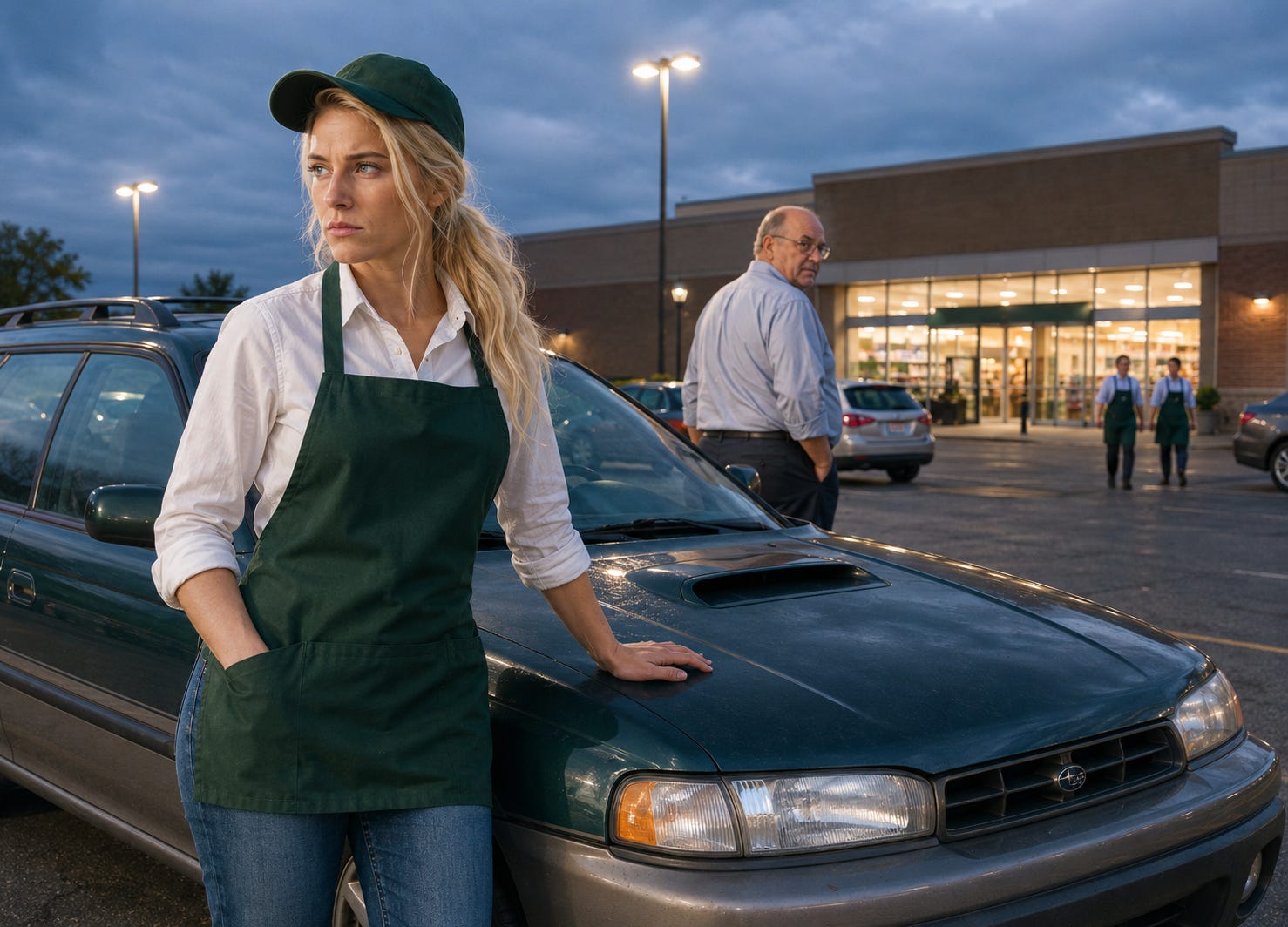
Tuesday, 10:00 PM: Isabelle’s shift ended, right on time. She punched out, grabbed her bag, and headed for the exit. With his wife back at home and no longer glued to the security monitors, Howard saw his opportunity and followed Isabelle to the parking lot, but just enough paces behind to escape detection. As she opened her hatchback, Howard made his move, swooping in to grab her groceries from the cart and help her load them into the car. I watched in disgust the huge smile on Howard’s face, his right hand on the small of my daughter’s back. A married man, over twice her age. Isabelle excused herself from this light embrace by stepping to the side, putting as much distance between them as possible. She then slammed hard the liftback — in one gesture expressing anger, demonstrating her physical strength, and punctuating the end of this unwanted interaction with an exclamation mark.
But Howard was not to be deterred, and he let Isabelle know it. He was furious. Though most of his words were imperceptible to us given the distance, the change of tone in his voice was unmistakable. “Let me get your door,” he commanded, making clear this was not some gallant gesture. Since he was already standing in the path between Isabelle and her driver’s-side door, Howard had only to take one step forward to block her completely. Then, rather than reaching for the door handle to actually let Isabelle into the car, Howard extended his left arm outward and leaned against the car roof, using his full body to shield her escape. She was stuck, here in the parking lot, unable to get into her car. Unless, of course, she were to give Howard a hard shove. And so she did. With both hands.
Howard stumbled backward, nearly landing on his ass, but catching himself at the last minute and tweaking his ankle in the process. Howard was not a young man, and this near fall put the fear of god in him, if for but a split second. Then suddenly, without warning, his face darkened, and his hands began to shake. It was as if a switch had been turned on. His voice became low and muffled — he was telling Isabelle something extremely distasteful, her body communicating pure tension: shoulders up, arms crossed, weight shifted back. Her face had that frozen smile women learn to deploy when they’re calculating the cost of saying no. Then Isabelle’s tectonic plates shifted of their own accord. Isabelle raised her head and pulled herself upright, planted her feet shoulder-width apart, offsetting her feet, one forward, one back; she instinctually curled both hands into tight fists. She made herself immovable and ready to hit Howard square in the jaw with everything she had. I watched in amazement just a few yards away, readying myself to take this fucker to the asphalt mat should she need assistance.
Howard leaned forward and touched Isabelle’s arm again, this time letting his hand slide down to her wrist, then realizing her hand was clenched in a fist. He tightened his grip and didn’t release his hand until over a minute had passed, and he had finished saying whatever bullshit he felt he needed to say — or should I say, that he felt entitled to say. He would make her listen.
Isabelle turned her head to the side, refusing to make eye contact for what she knew to be coming next: Howard’s hugely inappropriate and insulting request, to which she replied simply: “No.” She didn’t shout it, she didn’t cry, she didn’t beg him to leave her alone.
Howard’s face registered disbelief. How dare she refuse him? Who did she think she was? Since her message clearly wasn’t sinking in, Isabelle repeated her reply, this time a tad louder, and still with a stone-cold expression: “No!” Howard sneered and issued a guttural noise from deep in his chest. He was reluctant to release Isabelle’s wrist. Relinquishing control would mean she was winning. But as he stood there, considering his next move, Howard had a moment of clarity. None of this was going to work out well for him, not in the stockroom, not here in the parking lot, not in the back of her car, and most certainly not with other employees witnessing what was going down. So, Howard stepped back, if only slightly, and it was at this juncture Isabelle raised her head and gave him a powerfully hateful look, a threatening just-try-fucking-with-me look, while slipping her recently released right hand into her coat pocket, assertively grabbing whatever was in there. Was it a knife? Pepper spray? A gun, perhaps? Whatever it was, it was clearly something that could cause harm. And in case her gesture didn’t drive that message home, Isabelle flashed him a knowing smile.
How had Howard so misjudged Isabelle? She was not sweet and obliging. She was unyielding. Pleasing him was not a priority for her. She had no intention of obeying him. She was rejecting him on every level: as her boss, as a friend, as a potential lover, and Howard’s malevolence was growing. And horribly, it was giving him a huge hard-on. How could he have so misread the situation, their relationship? If Isabelle’s beauty, kindness and gentle femininity were not for him, who were they for? The thought that any other man should have her was unacceptable to Howard. His body wanted her, and she would be his. Maybe not tonight, but soon.
Isabelle was a bitch. Like all the others.
Howard reassessed his options. Since physical harm seemed a potential consequence of pressing her any further, Howard abruptly stepped back. “You will regret this,” he hissed. He then turned away and limped stiffly back to the store entrance, passing, but not acknowledging, several of Isabelle’s co-workers along the way. They stood in shocked disbelief, having just witnessed the whole scene. Only after Howard was out of view did Isabelle get into her car.
Back at home, Howard’s wife was warming up his chicken pot pie and cuing up Fox News @ Night. She was ready and waiting for him, in whatever condition that might be. Perhaps he would be needing a shower before settling in for his late-night dinner. Sometimes that was the case. He was always relaxed on those evenings, and quiet. She understood. And she would keep his food warm.
As Isabelle made her way out of Blink’s parking lot, we started up the Honda and followed her, but at a distance. My guess: Isabelle needed some headspace. This had undoubtedly been an extremely tense situation. Though Isabelle knew we were right there behind her, she did not catch my eye in her rearview mirror, nor did she wave or shoot me a text.
Halfway back to her apartment, Isabelle pulled into a Starbucks parking lot. She sat in her car, gripping the steering wheel, staring straight ahead, a stone-cold look on her face. I could feel her rage. And her fear.
I gave her five minutes, then texted: Coffee? They’re closed.
She didn’t respond for another three minutes. Then: Not tonight, Mom, please. I’m tired. Time to head home.
Tired. Right. Got it.
Wednesday, Noon: It was hard to believe, but Howard Blink was only one of Isabelle’s current challenges with men. And he was a big one. Howard was her job, her livelihood. And Blink’s was where we shopped. Like for decades. Turns out Howard was not Isabelle’s only headache, as of late; she’d had a deluge of bad situations and she’d not brought them up until now because, hey, who would believe this many men had been harassing her? She did wonder. Was she imagining all of this? Would we think her paranoid? Was this somehow her fault? Poor kid.
This morning’s text, which I only just noticed around 8:00 AM: Mom, I’ve got another problem. It’s my art professor. I may need your help. Like ASAP. As in this afternoon.
Time for Stake Out #2: Logan Hill Junior College, Fine Arts Department. Talked to Laura and she was down for it — in fact, she left ahead of me, arriving at the college early enough to sign up for an art class, get supplies, and position herself in the hallway two doors down from Lichter’s studio. Who does that? You’d think Isabelle was Laura’s daughter. Well, she kind of was. Laura was hoping that being on the inside might reveal important information. At a minimum, it would allow her proximity to the action so we could document firsthand what was going down.
As I would find out from subsequent texts, Isabelle had been having serious issues with an art instructor and the department head, Professor please-call-me-Gordon Lichter. His relentless advances over the last year had been one part frustrating, one part threatening. On the surface, everything he did and said appeared innocuous, if not supportive, but anyone who understood art world politics would have recognized that Lichter was, in essence, threatening Isabelle’s career—her academic career and, in the long term, her professional one. His not-so-well-disguised message: “Put out, or I could make your art career a living hell.”
Laura and I had been talking details on this one for some time, well before Isabelle was willing to admit, even to herself, that Lichter was a problem. We had been rounding up specifics on this guy: who was in his circle, where he had taught, and under what circumstances he had left his other positions. What was a bit odd was that he had been on the faculty at both the Art Institute of Chicago and the Rhode Island School of Design, and that he had paintings in permanent collections at prestigious institutions all over the U.S. and Europe. How was it that Lichter had come to be teaching at a small-town junior college?
The picture was just starting to come into focus, but solid evidence and corroborating witnesses would be needed if we were to take action. Judging from all the vivacious, 20-something-year-old bodies prancing around campus, there were no doubt other victims. We just needed to figure out who they were and convince them to talk.
And so, the three of us — me, Laura, and Isabelle — met briefly before class to discuss a plan of attack. We were all still reeling from the late-night shenanigans at Blink’s, but Isabelle assured us that was now a non-issue. She had tendered her resignation at 6:00 AM, when Rachel Blink arrived to open the store. Though there was nothing Isabelle would have relished more than giving Rachel the blow-by-blow on all that had transpired over the last week and leaving her stewing in that knowledge, Isabelle knew better than to bother. She didn’t like Rachel — no one did, really — but what purpose would it serve to torture her? Rachel would be, had always been, in complete denial about her husband. There was nothing that she, Isabelle, or anyone, for that matter, could say that could have convinced that stone-cold bitch to face reality. All Isabelle would have gotten for trying was an earful — about being a conniving whore, and a worthless employee — expressions of endearment she knew had gone out to other female employees who were forced to resign or were fired, namely those who’d reported sexual harassment and assault to the HR department, of which Rachel was the head. By now, Rachel should have known to run for the hills, that her husband was a serial rapist. But she continued to stand by her man. Cowboy boots firmly dug in.
Isabelle decided to offer up her own version of an appropriate adios: be polite, tell Rachel she was going back to school full-time, and express how much she had loved working at Blink’s. Sorry to be leaving at such short notice. Buh bye. Isabelle ended the conversation with a Mona Lisa smile, signed her final timecard, and got the fuck out of there. Let Rachel’s imagination fill in the gaps without her help.
The only bit captured on video, which Howard would no doubt review, would be that vanilla script Isabelle had adhered to. She’d left not one iota of evidence to bolster any argument Rachel was likely to initiate with her husband. That woman was a powder keg — all that worry, doubt, and mistrust — at some point there was going to be an explosion. This was an upcoming event you could bet on.
Isabelle appreciated that being married to Howard was surely a living hell, but knew at some level that Rachel deserved him. She had started fucking him back in the days when she, herself, was a clerk at the store. Yep. Back when Howard was still married to his first wife, and they had three young children. Not many people remember that.
Wednesday, 2:15 PM: Isabelle made her way to her figure drawing class, where Gordon Lichter was the instructor — a man fifty-eight years old, tenured, twice divorced, and driving a Subaru Outback with a “Coexist” bumper sticker and a Grateful Dead decal. The kind of guy who imagines his faux progressive politics inoculate him against being perceived as a predator.
I sat outside the campus coffee shop with a clear view of the art building entrance, sipping on an iced Hojicha tea and nibbling on a dried cherry scone. Laura was doing recon inside — sitting in the hall, two doors down from Lichter’s studio.
Wednesday, 4:15 PM: Classes had ended, both Isabelle’s and Laura’s. Students filed out, Isabelle being one of the last to leave, with Lichter right behind her. He was walking way too close, talking animatedly, and not so discreetly checking out her legs and ass. I watched him gesture toward the sculpture garden — a secluded area behind the building where students sometimes work on outdoor projects.
Laura texted: He just invited her to “discuss her portfolio” in his office. Told her she has “raw talent that needs nurturing.” Said he sees “something special” in her work that reminds him of his own early pieces. Then, a throwing up emoji.
This is classic negging disguised as mentorship. You’re talented, but you need me to unlock it. You’re special, but only I can see it.
Isabelle declined the last-minute office visit. I could see her shaking her head, pointing toward the parking lot, making excuses. Gordon’s smile didn’t waver, but his posture shifted — he threw his shoulders back, chin up, the physical language of a man who’s been told no and doesn’t accept it. He’s thinking: “Let me rephrase this, bitch.”
And then something else is said. Who knows what exactly. Lichter tilts his head to the side in a cocky way, eyes half closed, gives a slow nod, and has a look of derision on his face. “Am I clear now?” he says as he rounds out the conversation. Isabelle goes pale. I can see it from here. She nods twice, then quickly walks away, nearly running as she nears the parking lot. She waves haphazardly at me in my car, but does not look back at Lichter. She is frantic.
I intercepted her at her car. “Hey, baby girl. How was class?”
“Fine.” But she won’t look at me. She’s fumbling with her keys; her hands are shaking.
“Lichter seem okay today?”
Her jaw tightens. “He’s fine, Mom. He’s just... he thinks I should apply for this summer intensive program. In Santa Fe. He says he could write me a recommendation, but I’d need to, like, work more closely with him. Show him my process.”
“Work more closely? How?”
“I don’t know, Mom. Studio time. Bring my stuff into his office. Critiques. Whatever.” She gets the door open, throws her bag onto the passenger seat. “I’m not doing it anyway. I can’t afford Santa Fe. So it doesn’t matter.”
“Did he suggest any other ways you could... earn his recommendation?”
She froze. Looked at me. Her eyes were wet. “I have to go.”
She drove off before I could say anything more. No reassuring hug administered. This was troubling, and I had no idea what to do since I didn’t really know all that went down.
Laura suddenly appeared beside me, holding a lumpy ceramic bowl, agitated, and blurted out: “He told her she’s ‘hiding her light’ and that ‘women like her’ need to be more assertive about claiming their space in the art world. Then he said most of his successful former students had ‘personal mentorship relationships’ with him. I heard it all.”
“Personal mentorship relationships.”
“His exact words.”
I pulled out my phone and added Gordon Lichter to my spreadsheet. Under “Tactics,” I typed: “Negging disguised as mentorship. Implies access to opportunities contingent on private ‘studio time.’ Frames refusal as a lack of ambition and confidence.”
All of this was leading to a bad place.
I heard nothing further from Isabelle.
Thursday, 6:30 PM: Isabelle was supposed to be at her friend Kaira’s house for dinner with Basti.
I had just been sitting at the dining room table taking notes on the various manosphere sites I’d been perusing, and which had likely permanently damaged my psyche. My phone buzzed.
It was a text from Basti, Isabelle’s on-again-off-again boyfriend: Is Isabelle with you? She’s not answering.
I called her. No answer. I texted: Where are you?
Three minutes passed. Then: Home. Just got here. Phone died.
To Basti, I texted: She’s just gotten back to her apartment. I’m heading over and will let you know what’s up.
I drove over. Her car was in the car park, but when I let myself in, I found her sitting on the couch in the quasi-dark, still wearing her jacket, staring at the wall.
“Isabelle?!”
She didn’t move.
I sat down next to her. “What has happened?”
“Nothing’s happened.”
“Baby girl —”
“I said nothing happened!” She stood up, paced in front of the window, briefly pulled back the curtain as if there was something to see out there, then wrapped her arms around herself. “I just... I was at the coffee shop on Main Street, and Caden was there. With Zane. They were just sitting there, and when I walked in, they both looked at me, and Caden smiled, and I just... I couldn’t stay. I left.”
“Did he say anything to you?”
“No. He didn’t have to. He was just... there. Like he knew I’d be there. Like he was waiting for me. Mom, I broke up with him over a year ago. Why won’t he leave me alone?”
I pulled up Caden’s Instagram. His most recent story, posted forty-three minutes earlier: a photo of a latte with the caption Best coffee in town and a location tag for Main Street Brew.
He knew she’d see it. He wanted to crash her out.
“How often is he showing up places you are?”
She won’t answer.
“Isabelle. I need to know. How often?”
“I don’t know, Mom. A few times a week? He’s always just... around. At the grocery store. At the gas station. Outside the college. It’s a small town. It’s not like he’s following me.”
Except he was. That’s exactly what he’s doing.
I opened my laptop and pulled up Caden’s Snapchat — the account I’ve been monitoring under my fake profile. His location history showed he’d been within a quarter-mile of Isabelle at least nine times in the past week. The grocery store. Starbucks. The community college. Main Street Brew. And multiple times at the hiking trailhead where she goes running.
He wasn’t even trying to hide it. His unspoken message to Isabelle: “So what are you going to do about it, bitch?”
I screenshotted everything and added it to the folder.
Friday, 11:00 AM: I was at Laura’s house. We’d spread out documentation on all of Isabelle’s ex-boyfriends across her dining room table: screenshots, timelines, location data, testimonies from other women we’d met who’d had encounters with these men. Added to the same: Javier Saldivar, Howard Blink and Gordon Lichter. This is getting to be a lot of men.
“This is coordinated,” Laura said, tapping the printout of the timeline we’d built. “Look at the pattern. Howard escalates on Tuesday. Gordon on Wednesday. Caden Thursday and Friday. It’s like they’re taking turns.”
I stared at the evidence. She was right. The timing was too precise to be coincidence.
“They’re talking to each other,” I said slowly. “They have to be.”
Laura nodded. “I’ve been digging into their social media. They all seem to be connected — not publicly, but through private groups. Telegram, mostly. Encrypted. Hard to access unless you’re invited.”
“Can you get in?”
She gave me the look. Duh.
Saturday, 8:00 AM: The farmer’s market was crowded — families with strollers, dogs on leashes, vendors hawking overpriced heirloom tomatoes, artisanal goat cheese and kefir. Isabelle came along because I insisted. Because we weren’t going to let them erase her from public spaces. Because the alternative was watching her disappear into her apartment and never come out.
We split up. Off Isabelle went to forage, hunting for her favorite berries and veg, maybe a rotisserie chicken and some salmon. I shadowed my girl from three booths away, pretending to examine handmade soaps while keeping her in my peripheral vision.
Out of nowhere, Javier Saldivar appeared, a pair of expensive cowboy boots in hand. We’re not talking “cowboy boots,” we’re talking blond alligator leather, with hand-tooled sterling silver detailing, stacked-leather heels cowboy boots. A nothing-short-of-four-thousand-dollars pair of cowboy boots. Lucchese.
Javier was good-looking in a slick sort of way — close-cropped, curly jet-black hair, slim-fit designer jeans, an expensive set of veneers, and a smile that he’s practiced a hundred times in front of a mirror.
“For you,” he said, holding the boots out to Isabelle. “A little pick-me-up. New beginnings, you know?”
Isabelle took a step back and assumed a defensive posture I’d seen more than once this week. “I can’t accept those, Javier.”
“Why not?” His smile didn’t falter, but something shifted in his eyes. There was a hardness. “I know you and Caden broke up. That must be tough. But it’s been a long time, and I’ve always been there for you, Isabelle. I could be there for you now. We’d be great together.”
“I’m not interested, and this is not the way.”
Her words were clear. Unambiguous.
“You don’t mean that,” he said, lowering his voice and bringing his head closer. Intimate. Threatening. “You’re just upset right now. You’ll come around. Everyone does eventually.”
Javier didn’t move. He stood there, holding out the boots like an offering, like her refusal was just a negotiating position. A crowd was gathering. An intriguing scene was unfolding: two beautiful young people — a debonair Latino, a golden-haired princess, and an expensive pair of boots. A real-life fairytale, right here at the farmers market. How would this end? Would she try on the boots? Would they fit? Would they kiss?
Isabelle set down her bags, right where she was standing, then abandoned them. She excused herself, apologizing to the vendor, then quickly wove her way through the crowd to the parking lot. I watched Javier’s expression as he watched her go — there was no disappointment, no embarrassment. No — the look on his face: Victory. And then the look of him calculating his next move.
Javier tucked the boots under his arm and coolly walked in the opposite direction. Once he was out of view, I swooped in and grabbed Isabelle’s bags of provisions, then made a beeline for her car. We’d come to the market together. I was hoping that in the frenzy, she hadn’t forgotten that.
And there she was, in her car. Not crying, but visibly shaking. I knocked on the liftback, which she released, and put everything in the trunk. I then got into the seat next to her and put my hand on her knee.
“He won’t take no for an answer,” she whispered. “None of them will.”
That evening, Isabelle stayed at my house. She was too unsettled to be alone.
After dinner, Laura and I headed out for an evening stroll around the neighborhood. We had some pasta alfredo to work off, and we needed to discuss what was going on out of earshot of Isabelle.
As I stepped off the front porch, I saw them. The boots. On my stoop. No note. No explanation. Just sitting there like a threat. I was too late in hiding them. Isabelle had seen them from the window.
I pulled out my phone and took a photo, posed as they were on my stoop, then I picked up the boots, walked to the curb, and hurled them into the recycling bin I had set out for the next morning’s trash pickup.
I liked to imagine one of the workers at the sorting plant wearing those Lucchese boots at the next quinceañera. Hopefully Javier would be there.
Sunday, 7:00 AM: Laura called. “I’m in,” she said. “Check the link I just sent you. Password is the year you were born.”
I opened my laptop, clicked the encrypted Telegram link, then entered the password. The chat loaded.
High Value Brotherhood. Eight members. Eight men. OK, nine “men,” now that I was a member. A non-voting member. Just an observer until I’d been properly hazed.
I scrolled through the messages, my coffee going cold in my hand.
Caden: Blonde is getting bougie. This needs correction.
Lichter: Agreed. I’ve been working on her in class. Softening her up. She’s scared.
Blink: Had quite an encounter with Blonde this week. It did not end well. She quit working at the market. I let her know this was not the end of things.
Javier: Hey. I just gave Blonde the boots we all went in on. She refused them. Lol. Not unexpected. Am I right? I went ahead and escalated. Left them on her doorstep.
Alexandros: She’s perfect for the protocol. Blonde, submissive-facing, thinks she’s special. I’ll handle the final correction. I have a perfect setup in mind.
Mark: Standing by. Let me know if you need backup.
Zane: This is what happens when they think they can say no to us. Glad we’re all in agreement on this.
Unknown: The Correction Protocol works. We’ve done this before. Either she falls in line, or we break her. Either way, problem solved.
I read it again. And again. There were only two men I didn’t know in the group: Alexandros and “Unknown.” I was going to make it a priority to find out who they were because they were the worst of the bunch. There had to be clues in those hundreds of messages. And clearly all of these guys were locals.
The Correction Protocol.
They had a name for it. A system. A methodology. This wasn’t random harassment. This wasn’t individual predation. This was organized. Coordinated. Ideological.
They were hunting my daughter. And each of her rebukes was just a problem in need of a solution.
My hands shook as I screenshotted every message. Not from fear. From rage so precise it felt like a scalpel. It was sharp. It was precise. And it was deadly.
I pulled the folder from my bag — manila, thick, already fraying a tad on the edges, and organized in the way I organize everything when I’m trying not to lose my mind. Inside: screenshots, dates, times, names — evidence of a coordinated assault that the police would never touch because these men were woven into the town’s fabric. They were the grocery store owner, the art professor, the landscaper, the plumber, popular young men who were, as a rule, liked in our community. They were the men who showed up at church every Sunday. And they were the men who hunted down women on Mondays.
I called Laura back.
“Did you see it?” she asked.
“I saw it.”
“What do we do?”
I stared at the screen. At the eight names. At the casual cruelty in their language. At the way they’d turned my daughter’s autonomy into a glitch in their system.
“We’re going to burn these fuckers down,” I said. “All of them.”
Sunday, 8:30 PM: It was late when John and I arrived at The Bullpen. Adam was already there, sitting in the back booth with Laura. The restaurant was thankfully closed — chairs stacked on tables, lights dimmed, the kitchen quiet for once. Our table was full of food and cold beverages.
Adam ran The Bullpen like a man who’d learned early on that respect is the only currency worth anything. His staff, when they were present, moved with the precision of people who knew they were valued. He paid well, promoted on merit, and didn’t tolerate the ego-driven bullshit that defined most kitchens. In short, Adam treated his staff like he actually gave a shit.
I slid into the booth across from him and Laura. John, next to me, let his hand find mine under the table.
“Thanks for meeting us,” I said.
Adam nodded. “Laura said it was important.”
I pulled out the folder and spread its contents across the table. Screenshots. Timelines. Location data. The Telegram chat logs.
“I need to know what you know about the manosphere,” I said. “The forums. The ideology. The networks. And which, if any, people in town are bought into this bullshit. Have you been hearing anything?”
Adam leaned back, his jaw tightening. “I know enough. I’ve been watching it spread through town for years. The podcasts, the YouTube channels, the private chats. It’s not just online anymore — it’s in the local construction industry, vineyard management, the gyms, the churches. These guys think they’re owed something. They think women saying ‘no’ is a personal attack. Many of them imagine it’s against God’s will, whatever the hell that means.”
“Do you know any of these men?” I tapped on my list of names.
He scanned it. “Howard, yes. We source most of our produce from Blink’s. Caden did all of our landscaping at the restaurant last summer. Gordon — I see him from time to time, and we’ve a trptych of his paintings at the entrance to the restaurant. You just passed them. Javier often comes in with his crew after a big project is done.” He looks up at me. “Why?”
“Because all of them are hunting Isabelle. And they have no intention of stopping.”
The words land like a stone in still water.
I walked him through it. The escalation. The coordination. The Telegram chat. The Correction Protocol. Isabelle’s deterioration — how she’d stopped eating, stopped sleeping, stopped leaving her apartment except when cajoled.
“She’s disappearing, being absorbed by fear,” I said quietly. “Right in front of me. And the system isn’t helping us. The police know Caden’s family. The college protects Gordon. Howard’s family owns half the town. The other men are friends with all of Isabelle’s girlfriends, most of whom seem clueless about these goings-on or don’t imagine them to be as threatening as they are — you know, referring to all of it as “locker room talk.”
Adam’s expression hardened. “So, does that mean you’re taking this on yourselves? Is that what we’re looking at?”
“Yes, I’m afraid that’s our only alternative,” I confirmed.
Laura leaned forward, directing all of her pent-up upset at Adam. “We need intelligence. You see these people here. You must hear things. You know who talks to whom, what they’re worried about. We need you to listen. And document. To pay attention to patterns. To share what you hear.”
“I can do that,” Adam said without hesitation. “And my staff can do that as well, if you give me permission to share some of these details. I trust all of them implicitly. The women on my staff — many have been dealing with this shit for years. It’s one of the reasons they work for me. As you can imagine, no one gives me shit. Ever. These women will know exactly what to look for. And they know how to play the game with these entitled narcissists. It’s the same game they play to get great tips. Hey… if it puts your kid through college, I say, ‘Go for it!’”
“What about consequences?” John asked quietly. “What if this goes sideways — if they figure out what we’re doing — what then?”
That question hung in the air.
“They could sue us,” I said calmly. “They could threaten us. They could try to intimidate us into stopping.” I paused. “But here’s what I know: the alternative is watching Isabelle disappear completely. Not into a new identity, but into herself. Into trauma. Into the kind of broken that takes decades to repair, if it repairs at all. And she won’t be the only victim. She will just be their first — their first as the Brotherhood.”
I leaned forward. “I’ve spent my entire career telling women how to survive in systems that don’t protect them. I’m not going to watch my daughter become another statistic while I do nothing.”
“So we’re really doing this,” Adam said. It was not a question.
“We’re really doing this,” I confirmed.
“Then we need to be smart,” Laura added. “Disciplined. We document everything. We don’t make accusations we can’t back up. We don’t break laws — we use them. The good part of all of this: sociopathic behavior is incredibly predictable. We need to use that knowledge to craft our strategy.”
“Exposure,” I said. “That’s our #1 weapon. These men operate in darkness. They think they’re untouchable because no one’s watching. We watch them, but they don’t know it. We document everything without putting it in their face. Once we have gathered up all the evidence, we expose them. In a most public way. In the light of day.”
“And then?” John asked.
“And then the system does what it should have done all along,” I said. “Their employers fire them. Their licenses are revoked. Their reputations are shattered. Their wives are humiliated and leave them. Their communities reject them.”
Adam nodded slowly. “We don’t have to lay a finger on them. We just have to make sure everyone sees who they are.”
“Exactly,” I said.
The four of us sat in silence for a moment. The weight of conspiracy settled on us — not the criminal kind, mind you, but the kind that changes everything. We were ordinary people making an extraordinary decision. We’d be crossing a line we could never uncross. But the other side of this was the only place to be.
“I’m in,” Adam said finally.
“Me too,” Laura said.
John squeezed my hand. A gesture of commitment that I already knew was coming. A gesture from my normally cautious John that said: I understand what we’re doing, and I’m doing it anyway.
I looked at each of them — and all of it became clear: these people had chosen to stand with me and to do the thing that was right and that needed doing.
“Okay,” I said. “Let’s get to work.”
We sat in the quiet of the empty restaurant, four people bound by the rage we felt, not just toward these men, but toward the society and culture that had made them who they were. We were refusing to watch another woman disappear.
For the first time in weeks, I felt something other than helplessness.
I felt dangerous.
Read: Overpaint, Chapter 1
AMAZING. A page turner! I just love your handling of interesting and telling detail and character. Masterclass stuff. Waiting on E3!
This is certainly timely. I enjoy the “rescue team” being assembled.