


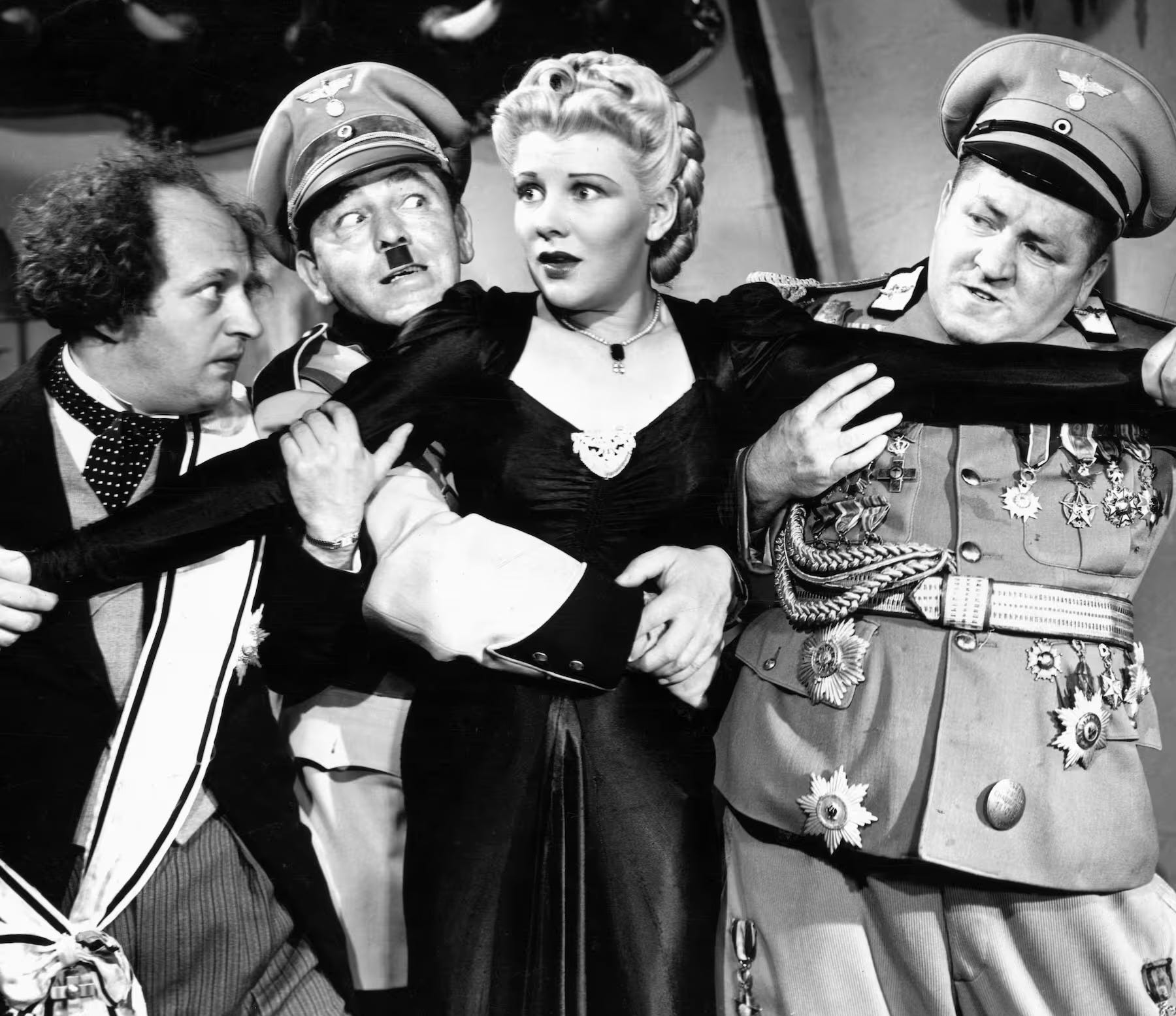
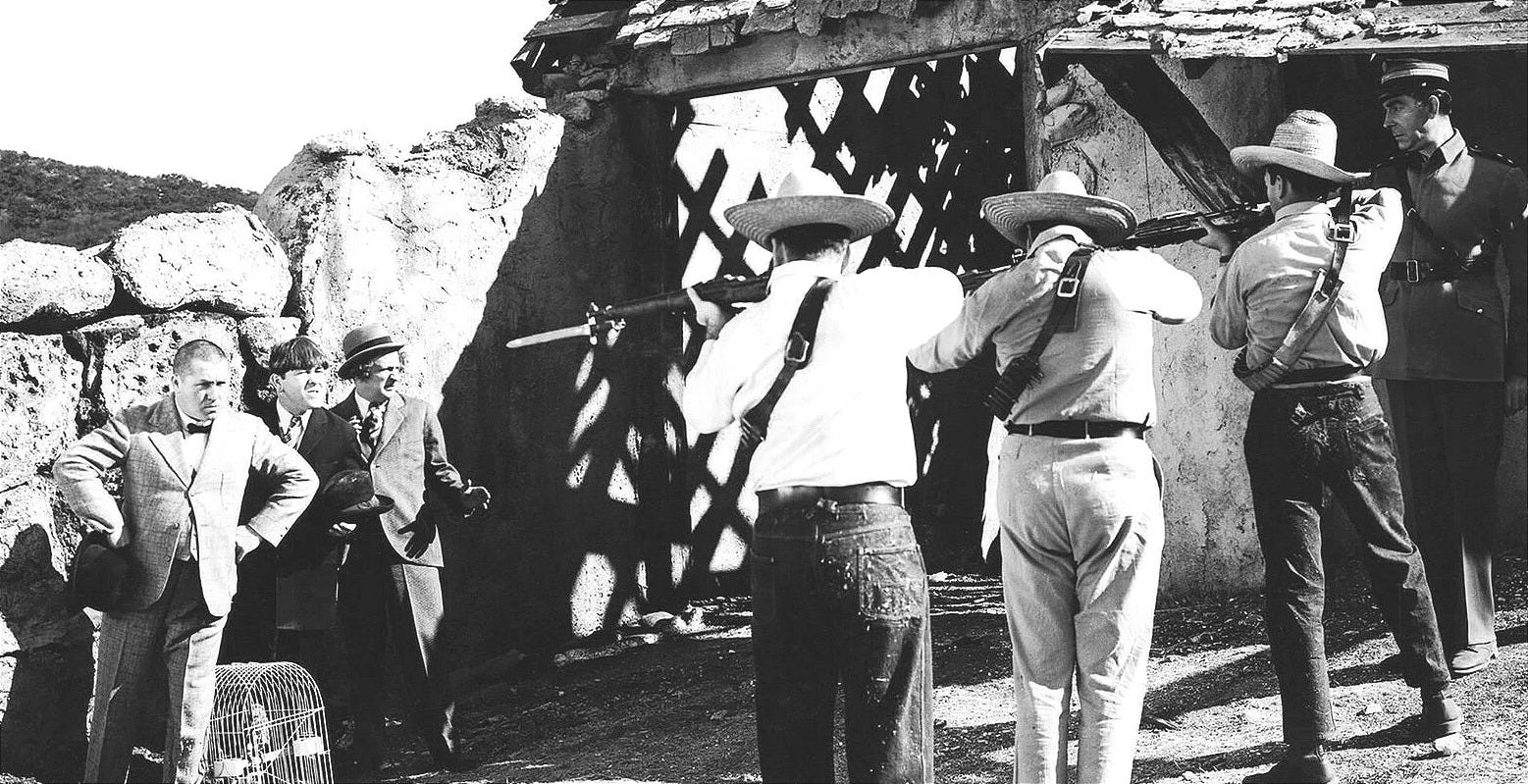
At this point in history, I think we can assuredly rename the United States “Moronica” — you know the place, that fictional dictatorship featured in the Three Stooges' political spoofs, You Nazty Spy! and I'll Never Heil Again. What was once parody is now starting to feel uncomfortably like reality.
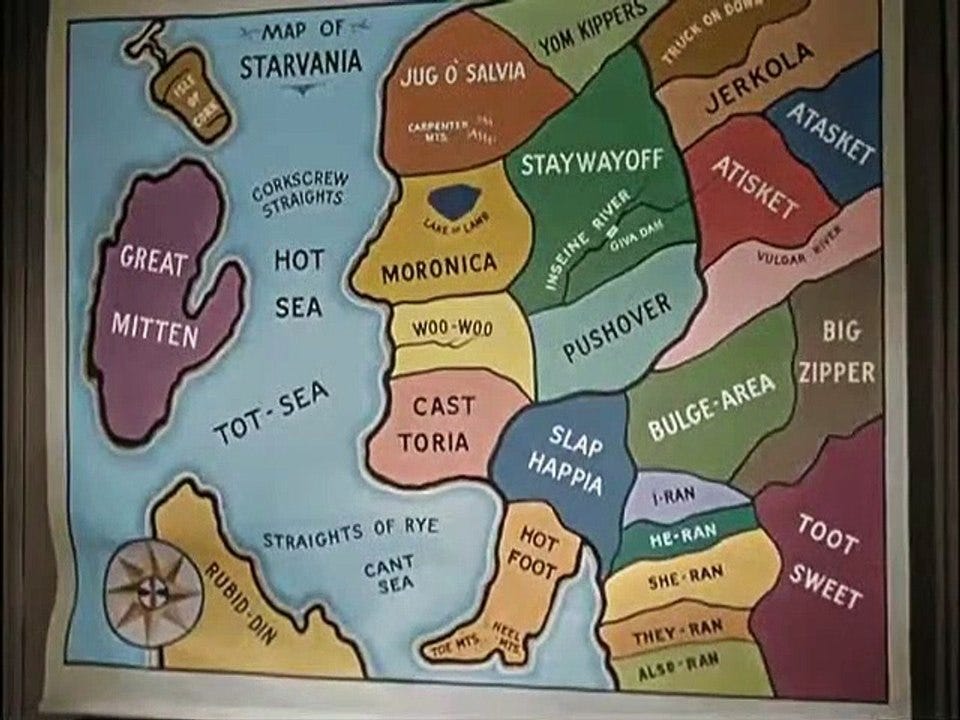
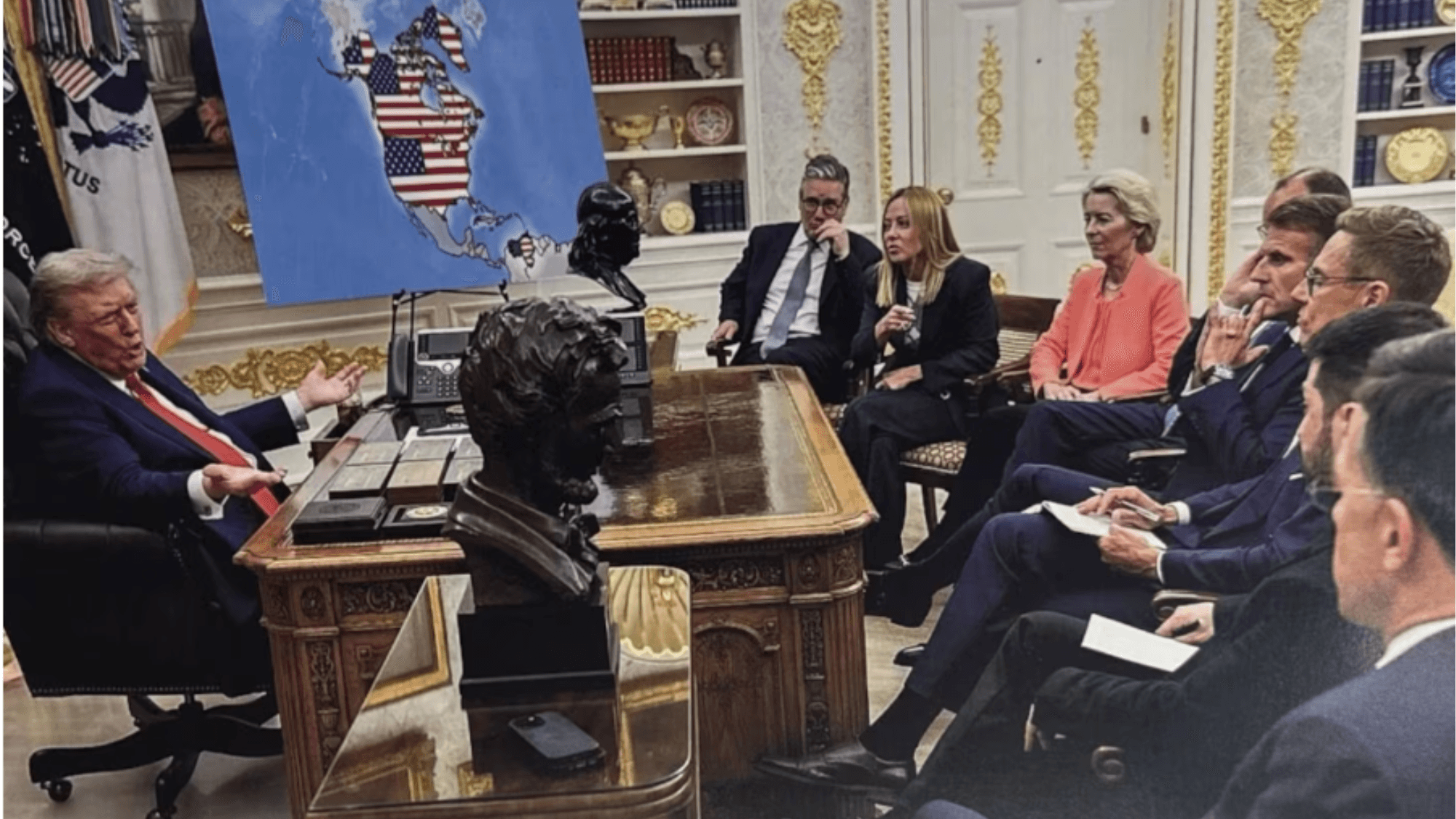
The plots of both Three Stooges shorts, released in 1940 and 1941, were unmistakeably parodies of the events leading up to the rise of Hitler and the Third Reich: a king is deposed, and a group of wealthy oligarchs — eager to preserve their profits and influence — elevate a lowly wallpaper hanger, Moe Hailstone, to the position of dictator, effectively making him their “stooge.” Raise your hand if this plot sounds vaguely familiar.
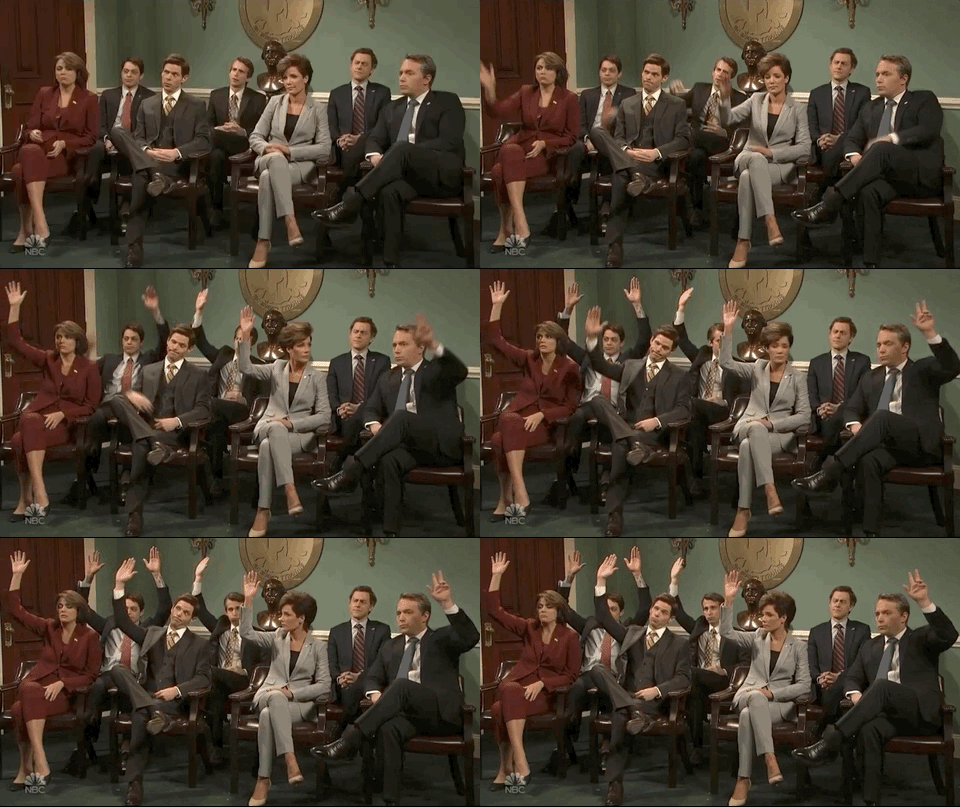
Wow. Every hand. Up.
Remarkably, The Three Stooges were satirizing one of the most feared and dangerous figures in the world, well before renowned political activist Charlie Chaplin released his anti-Hitler classic, The Great Dictator. Both the Stooges and Chaplin were bravely mocking fascism at a time when others in Hollywood remained cautious — no, make that chickenshit.
Does anyone else think this sounds a wee bit like our current-day Democratic Party — a completely useless bunch of chickenshits comingling with a few sexual deviant/misconduct types and smarmy self-dealers? The ladies would be wise to steer clear of guys like Swalwell and Brockman (and there are others), while the rest of you had better back away from that Cherfilus-McCormick chick (from Florida, of all places), who stole millions in Covid funds. But I digress.
Whether you are an official Knucklehead (i.e., member of The Three Stooges Fan Club) or not, these shorts are well worth a watch. Belly laughs are good medicine, apparently. Great, in fact, for both your mental health and your jelly belly, though were the latter true, I should have washboard abs by now. Which I do not.
OK, folks. Time to drop the garden trowel and get to it. There’s nothing like a beautiful summer day spent sprawled out on the couch in your basement, watching the Stooges, eating Bugles, and drinking orange Fanta. YES, they still make both of these, can you believe it?
Here you go. Be ready to laugh your ass off. Fair warning to those of you with weak pelvic floor muscles.
You’re gonna love watching three Jewish men (👆), all of whom grew up in Yiddish-speaking IMMIGRANT households, brutally satirize the leaders of the Axis powers — smack in the middle of WW2. The only thing that might be more satisfying would be watching a crowd of former detainees from the Stewart Detention Center in Lumpkin, Georgia, as they witness DJT meeting his demise via firing squad (which he recently reinstated) after being found guilty of treason and war crimes at his much-anticipated tribunal. Can hardly wait for that TikTok video to go viral.
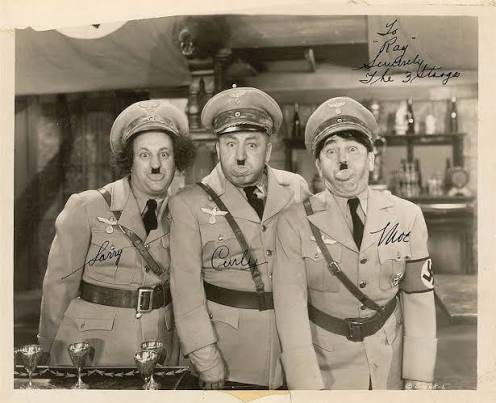
In the Stooges’ Nazi flicks, Moe Howard parodies Hitler, as dictator “Moe Hailstone,” Curly Howard plays “Field Marshal Herring” (Hermann Göring), and Larry Fine is cast as “Minister of Propaganda Pebble” (Josef Goebbels). The Stooges, who in their previous life had been wallpaper hangers, are transformed into a puppet dictator and his cabinet, all of them coached by the oligarchs to run the country of Moronica.
America, Moronica. One can't help wondering: were the Stooges merely joking, or pointing out an enduring truth about the U.S.?
The ruling Nazi-era oligarchs — Hugenberg, Quandt, Krupp, Oetker, and the two Ferdinands, Flick and Porsche — were not so different from today’s American oligarchs. Like Elon Musk, Howard Lutnick, Scott Bessent, Linda McMahon, Doug Burgum, and David Sacks, they enjoyed privileged access to political power while simultaneously benefiting from policies that enriched their sprawling business empires. As they “helped” run the state, regulations inconvenient to their interests mysteriously vanished, favorable policies materialized, and fortunes grew ever larger.
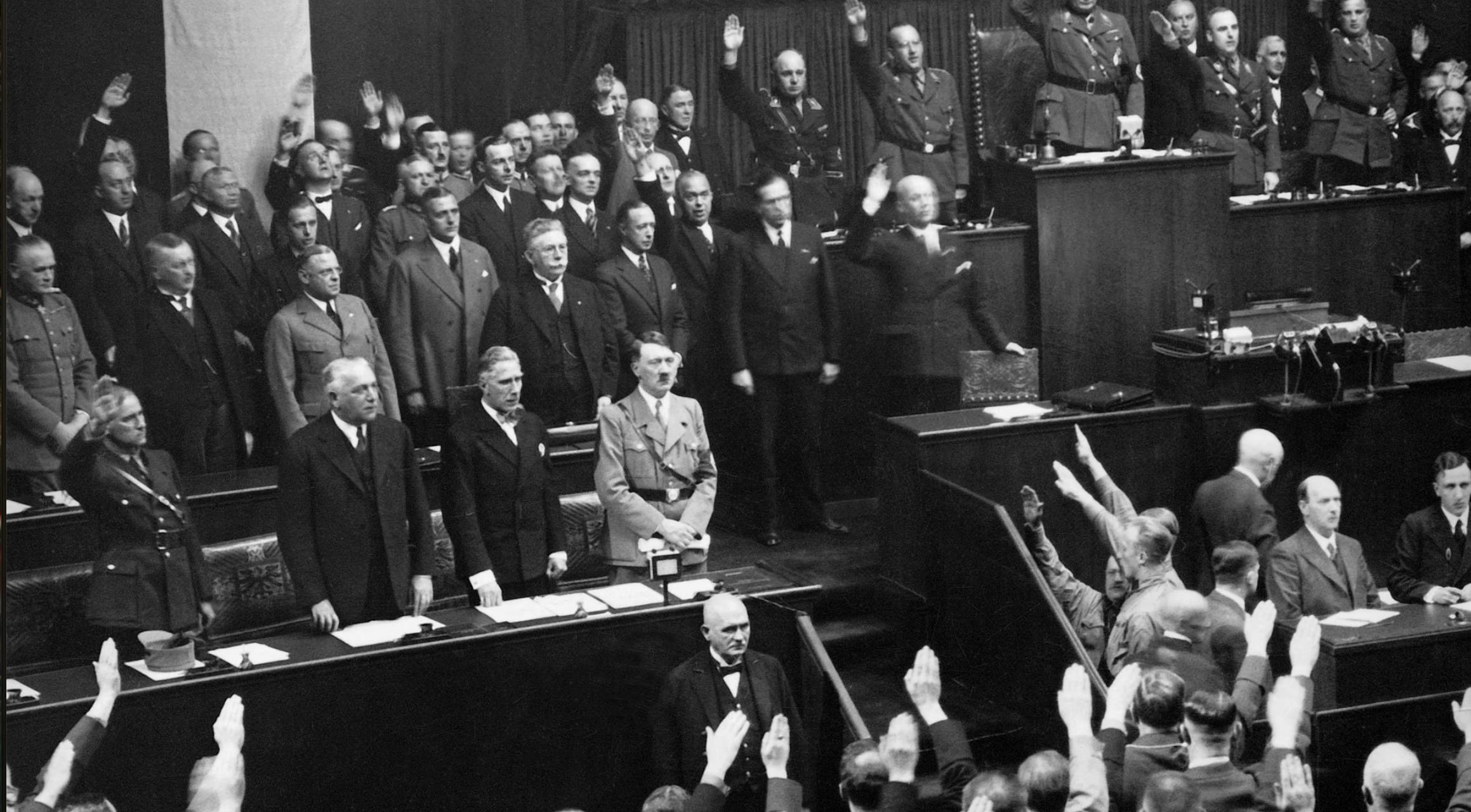
The names and circumstances may differ, but the arrangement is the same: wealthy industrialists and financiers positioning themselves close to the levers of power, all while assuring the public that their accumulating influence is merely an act of patriotic service. History would suggest that such generosity comes with substantial hidden fees. And history would also suggest that all this Arschkriecherein (climbing up someone’s ass) does not, in the end, work out well for these businessmen. The bend-at-the-waist billionaires/trillionaires in Trump’s orbit can expect the same.
Enjoy gloating here: “The Oligarchs Who Came To Regret Supporting Hitler,” from The Atlantic, 2/6/25 (article gifted), and “How Rupert Murdoch helped create a monster – the era of Trumpism – and then lost control of it,” from The Conversation, 8/11/24.
Are you getting this? It’s all the same: Nazi Germany = NotSee America. If you can’t see that, I’ve got an ophthalmologist I can happily refer you to (and a piece of beachfront property in Miami that I promise won’t be affected by climate change sea-level rise).
The oligarchs in the Stooge stories, having bankrolled the trio, assume these idiots will dutifully do their bidding. While Hailstone, Herring, and Pebble are certainly willing, if unwittingly, to play the part of stooges (so to speak), what the oligarchs have failed to anticipate is that the same ineptitude that made the Stooges easy to manipulate also makes them spectacularly incapable of executing “the plan.”
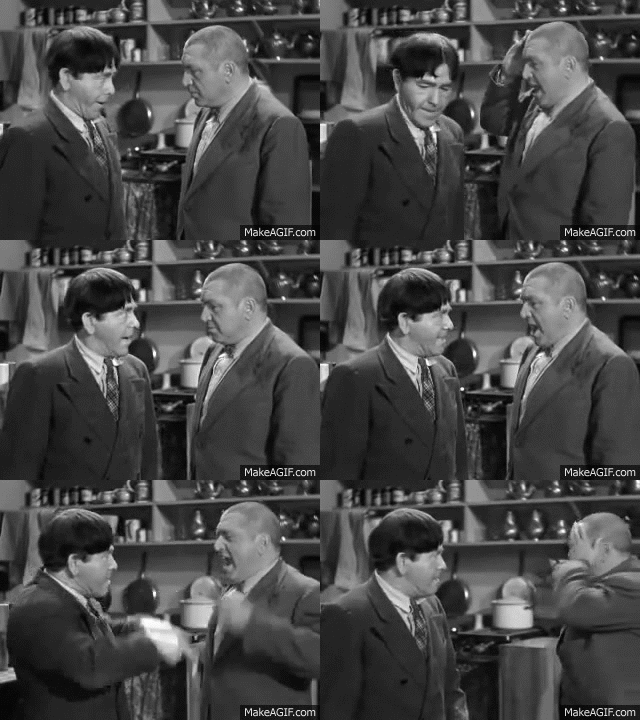
Back to the present day… those of us who don’t don MAGA hats are beginning to feel like unwilling extras in a political farce that never ends. Each morning, a fresh barrage of headlines soils our news feed, the madness escalating. And there is no exit ramp in sight. And while the Three Stooges were able to wrap up their authoritarian buffoonery in a tidy 20-minute comedy short, we’re relegated to several seasons on the remake, with the script writer (most likely Stephen Miller) determined to outdo himself and history with every new episode.
What can be done when White Evangelical Protestants, ideological conservatives, MAGAs, and the GOP (well over half the country) are headed down this road to perdition — on the way, ignoring every red flag that warned us things were vor die Hunde gehen?

Why, pray tell, are people still clinging to this Trump mess? Are they unable to let go? Too embarrassed to admit they failed to buy an extended warranty on a lemon? Too scared to jump off the train? Or are they blithely sailing toward a heavily militarized, police-state version of Amerika — complete with territorial fantasies and the persecution of minorities — because that's the Hantavirus Cruise they eagerly booked and upgraded to first class, convincing themselves that rats were part of the entertainment package?
At times, it feels as though we’re living through a remake of 1930s Europe that somehow got greenlit as a dark comedy. As the plot lurches from one absurd scene to the next, you keep expecting the director — whoever that may be — to lean into an acoustic megaphone and shout, “Cut! This script is ridiculous. Nobody’s going to believe this storyline.”
The trouble is that what begins as satire has a nasty habit of becoming reality. The jokes stop landing. The laughter grows uneasy. And then, as the old saying goes, someone loses an eye — and suddenly things aren’t so funny.
This (👇🏼) is the audience I’m sitting in at this very moment, enjoying a rousing rendition of “Springtime for Hitler” from The Producers — music and lyrics by Mel Brooks, a comedian who bathes daily in Yiddishkeit. All of that confident Jewishness gives Brooks license to satirize Nazis with a ferocity matched by few others.
Mel Brooks is likely the only person on this planet able to pull off a tune so spectacularly tasteless while simultaneously making it irresistibly kitschy and catchy — a brainworm in the public consciousness. His genius lies in turning ridicule into a weapon — a box cutter aimed at Nazi pretensions — stripping them of their self-important mystique and exposing them for what they were (and are): ridiculous, contemptible figures of absurdity, as absurd as the MAGAs who have stepped right into their manure-covered Marschstiefel (jackboots).
If you like “Springtime for Hitler,” you might also enjoy “A Little Peace,” from the flick To Be or Not To Be (1983) — another catchy satirical tune written by Mel Brooks, in conjunction with Ronny Graham. It’s a great ditty about the joys of dictatorial expansionism and imperial exploitation.
If you're down for a brilliant full-length film, the 1942 version of To Be or Not to Be, starring Jack Benny and Carole Lombard, is not to be missed. Directed by Ernst Lubitsch, it is a masterful and sophisticated mix of black comedy, political satire, and spy drama, skewering Hitler and Nazi ideology, pomposity, and self-importance with surgical precision. What's most impressive is Lubitsch and his cast’s fearlessness in transforming fascism into farce, all while World War II was raging.
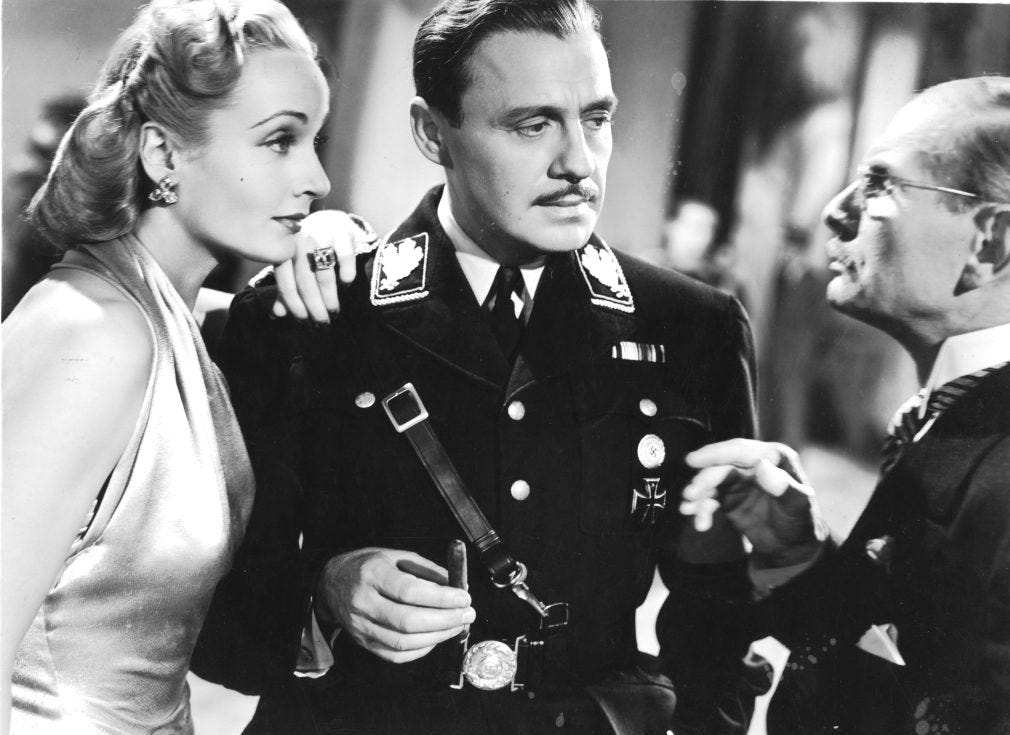
There is no hesitation in repeatedly calling out the enemy in To Be or Not to Be, though true danger lurks behind every joke. Watch in amazement that none of this movie’s content was censored back in the day, then think about where we are now… major networks being pressured to sack comedians, namely Kimmel and Colbert, who are critical of the fossil fuel fascist, all because they called out his atrocious behavior and policies on their shows.
This 1942 version of To Be or Not to Be is peak “mock fascists, collect laughs,” and it is Carole Lombard’s last movie. She died shortly after its release in a tragic airplane crash — January 16, 1942 — as she was returning from a highly successful war bond rally. President Roosevelt declared her to be Hollywood’s first WW2 casualty.
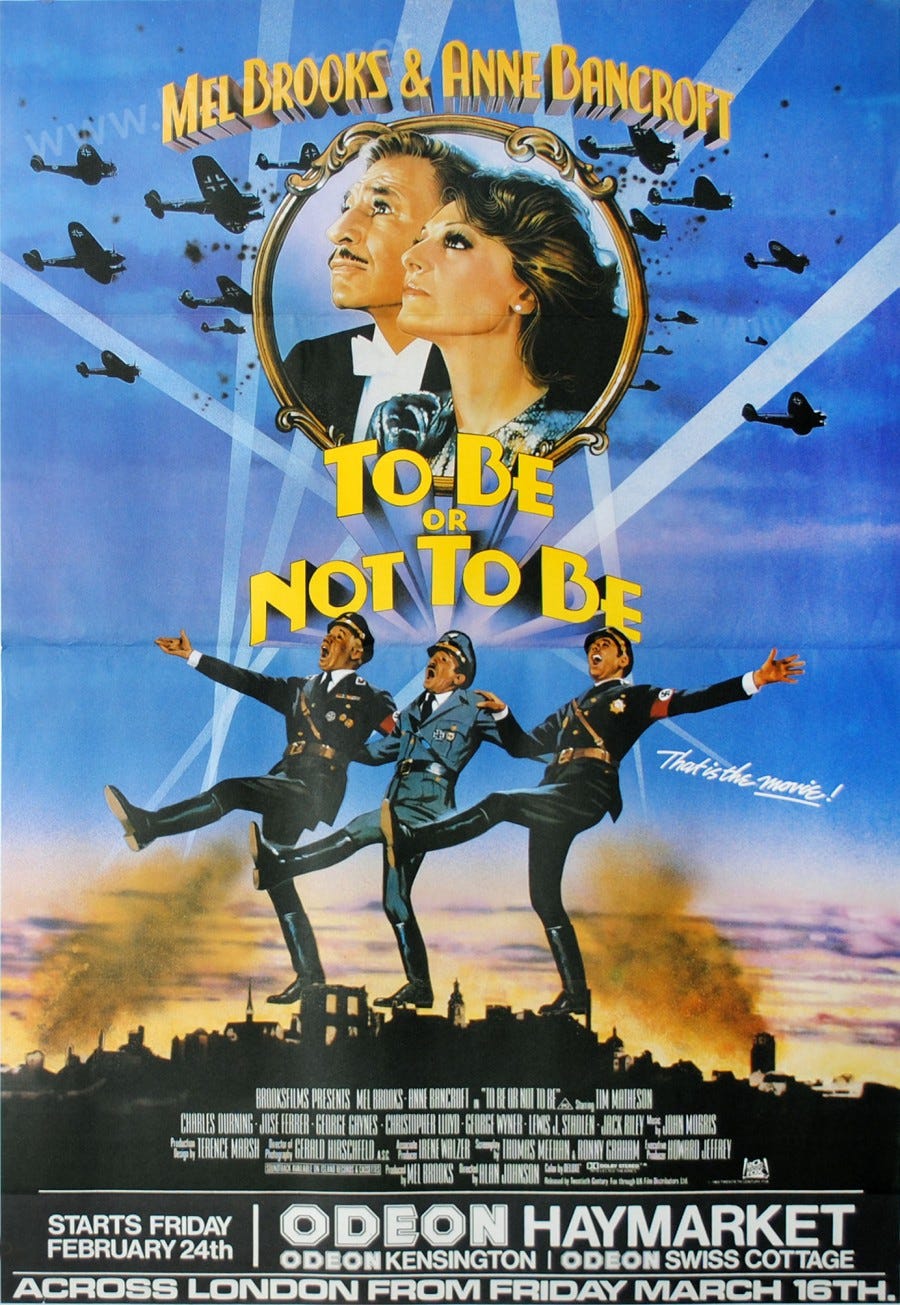
Hey, wake up! Don't sleep on this 1983 version of To Be or Not to Be. Same story, yes, but a totally different movie. It’s an absolute gem that trades subtlety for high-energy slapstick and Broadway-style musical numbers, delivering a distinctive and equally hilarious experience to the 1942 treasure. The biggest difference between versions one and two of To Be is their proximity to the events they satirize, something to keep in mind as you watch both or either.
If you’re looking to watch the entirety of the 1983 To Be or Not to Be, starring Mel Brooks and Anne Bancroft, try Apple TV.
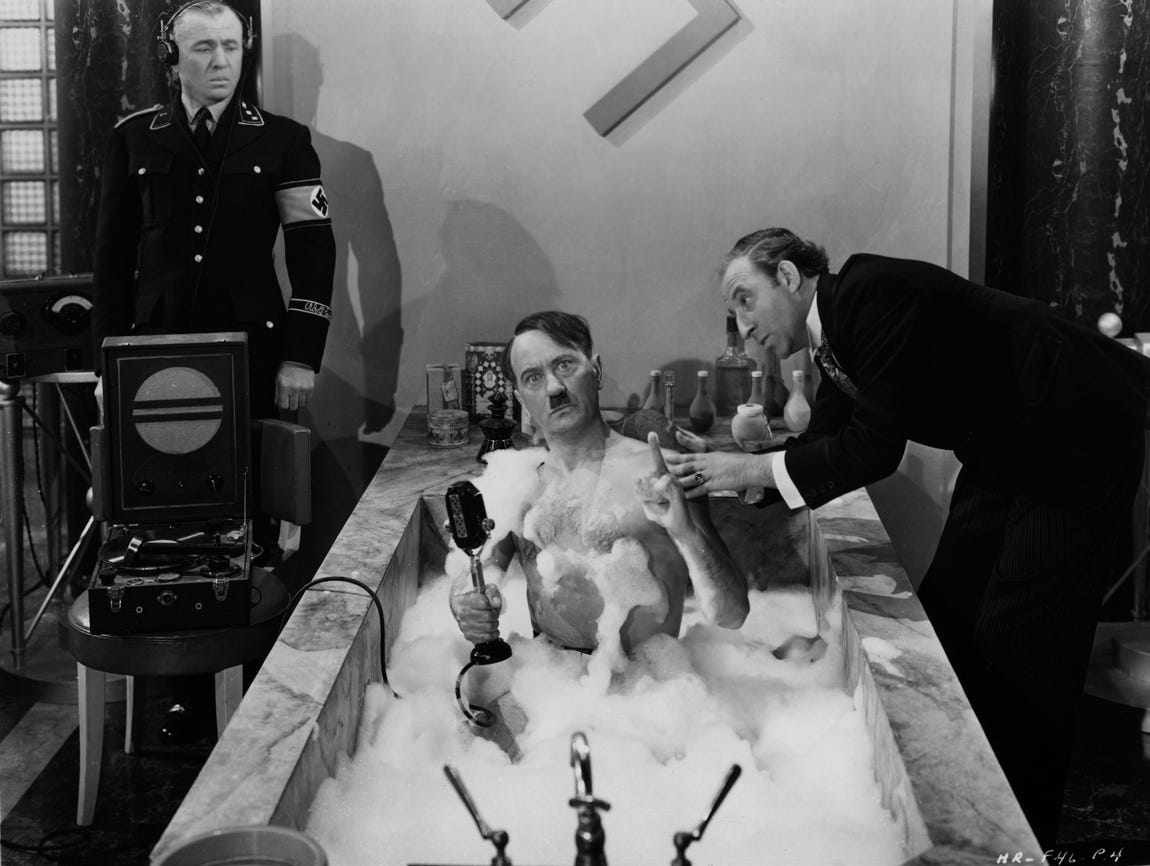
More fun can be had at Hitler’s expense from Hal Roach Studios. These films, while not terribly sophisticated (and chock full of ethnic stereotyping), are nonetheless entertaining. Check out The Devil With Hitler (1942) and That Nazty Nuisance (1943).
Bet you didn’t see this one coming: Walt Disney as outspoken critic of Hitler and Nazi Germany. When most people think of Walt Disney, they’re imagining Bambi, Pinocchio, and Fantasia — not anti-fascist propaganda. Ironically, all three of these films struggled at the box office during World War II as overseas markets disappeared and U.S. audiences had more important things on their minds.
By the early 1940s, Disney’s Burbank studio had effectively become an important part of the war effort. The U.S. military occupied a big chunk of their lot, and roughly 90% of the studio’s output was converted to supporting Allied causes: military training films, educational shorts, and features like Victory Through Air Power.
Disney also produced two remarkable animated assaults on Nazism: Der Fuehrer’s Face and Education for Death. One mercilessly lampoons Hitler and fascist ideology; the other delivers a chilling portrayal of how totalitarian regimes indoctrinate children from birth. Together, these films helped sell War Bonds while delivering a powerful message: dictators who thrive on fear and spectacle lose their mystique and power when reduced to figures of ridicule.
Comedy and satire often succeed where reasoned arguments — and sometimes even physical force — fall short. When America was at its best, we understood this. Along with free speech, a dominant economy, and a powerful military, the freedom to mock dangerous ideas and the people promoting them was one of our greatest strengths.
During World War II, American filmmakers, cartoonists, comedians, and journalists relentlessly exposed the absurdity of Nazi ideology, targeting fanaticism, puncturing propaganda, and turning the Third Reich’s self-important strongmen into objects of ridicule. It would seem that when someone is trying so very hard to convince the world he’s a godlike figure, being laughed at hits harder than a bullet grazing an earlobe.
These Disney shorts weren’t trivial entertainment, nor were those put out by other animation houses during the same time period. Their satire weakened the Nazi brand and Hitler’s bravado, chipping away at the aura of invincibility he and his followers worked so hard to cultivate. Ridicule = kryptonite to the Nazis’ manufactured grandeur.
Which brings me to this scene from The Wizard of Oz, which was released just one week before Germany invaded Poland on September 1, 1939. The scene feels remarkably prescient, whether intentionally or not, speaking directly to a timeless truth about power: behind the booming voice, the spectacle, and relentless propaganda, there is often just one smallish man frantically pulling levers behind a curtain.
Dorothy = a hero. 💯 Just for getting them there and pulling back the curtain.
Complete your comedy tour de couch with The Ducktators, Herr Meets Hare, and Daffy the Commando — a triple feature of animated anti-fascism, ninety minutes of dictators getting dunked by waterfowl, rabbits, and a certifiably unhinged duck.
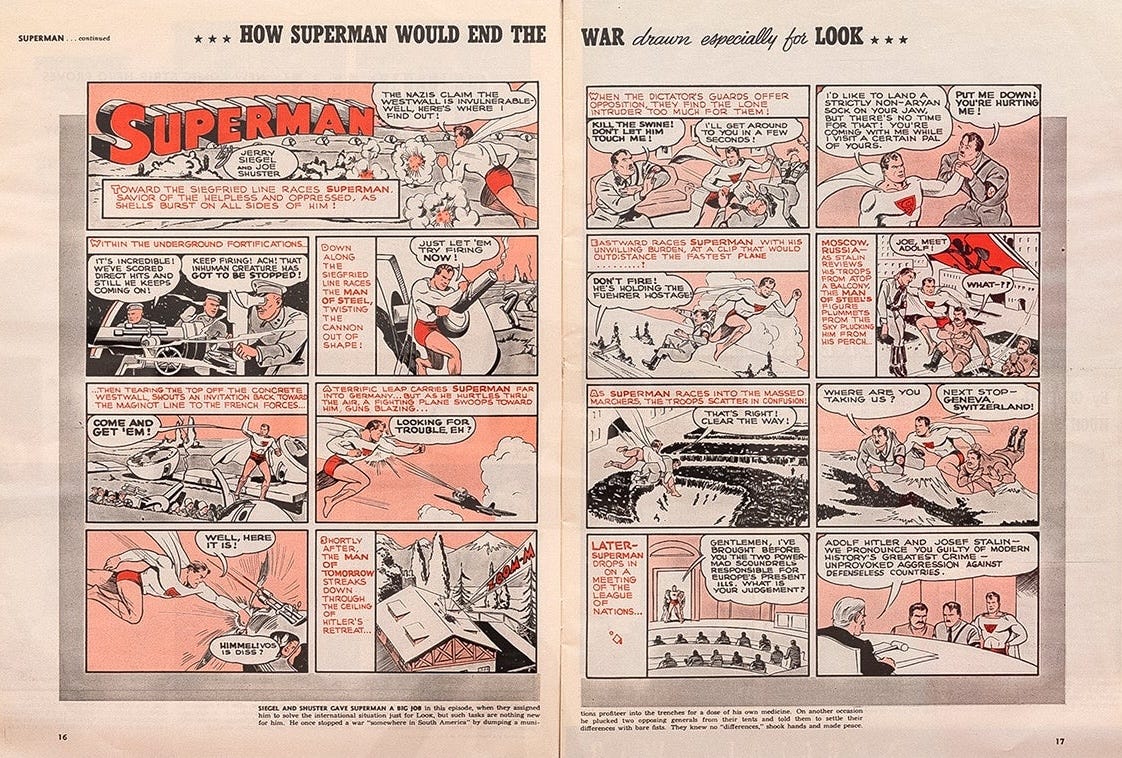
Throughout the 1940s, a remarkable flood of comic books, animated shorts, and satirical films helped Americans make sense of a world gone completely off the rails. These works did more than entertain: they deflated fear, elastrated fascism, exposed dictators as frauds, and made clear what was at stake in a conflict that seemed to be taking over the globe. For many Americans, cartoons and comedies were a down-to-earth civics lesson — a crash course in democracy, delivered with slapstick, satire, and a punchline — by the best teachers, ever: Jack Benny, Bugs Bunny, Curly Howard, Superman, and Charlie Chaplin.
Thanks for this fresh appreciation of The Three Stooges. I spent some of my 70s childhood watching The Three Stooges shorts and films, but I was never that entertained by slapstick. I enjoyed Lucille Ball's physical comedy and loved Mel Brooks' genius, but The Three Stooges were a bit over the top for me. As I matured, I segmented comedy into two categories: George Carlin vs The Three Stooges. Thus, reading your article gave me a new appreciation for what they were doing. I still don't know if I find them funny, but I'm always grateful to learn more about the details and devices utilized by an artist because it, of course, widens my horizons about artistic history and possibilities.
The stooges were not only mocking Germany. They were mocking the growth of Nazism in the United States. It was active within Republican Congressmen, who used franking to use taxpayer dollars to distribute Nazi propaganda through the US mail. Father Coughlin had a Nazi militia. American fascists had rallies, one in Madison Square Garden. A huge munitions plant in New Jersey was blown up.
Listen to Maddow’s podcast, Ultra, parts 1&2.