


Our mom had been gone for quite a while. We were under the impression that she was just away for the summer, however long that was. It seemed like forever to me, and I was tired of waiting. I wanted to see her and for her to make blueberry pancakes again and to go back to doing our tuck-ins with Eskimo kisses at night. All of this waiting was hard, and I was feeling pretty mad about it.
The best I could do, in lieu of pancakes, was to open that last can of blueberries, the one I’d found in the back of a moving box on the pantry floor, next to the whisk broom and dustpan. My brother and I were starving that night, and I was pretty sure that if I could open that can (while my father was dozing on the couch), our hunger problem would be solved. It took many tries to get the dull blade to pierce the lid, and then all the strength I could muster to hold the grips while also turning the handle. My hands were pretty small back then, but I did it! And without too much sloshing.
I often thought about what would happen if our can opener broke. We would starve, surely. There was nothing else in our apartment that could open cans, and practically everything we ate came out of one — that weird ham and lima bean loaf, tuna, peas, spinach, salted peanuts, fruit cocktail, corned beef hash, coffee creamer, powdered milk, date pudding, even crackers — all of my Dad’s National Guard rations. The few things we actually bought at a grocery store and that were stored in the fridge were dill pickles, hot dogs, milk, Cool Whip, mayonnaise, bologna, ketchup, yellow mustard, a tub of Parkay, and the occasional block of Velveeta cheese. And once in a while, there was a styrofoam carton of eggs. I had it memorized — I knew every food item in there.
But that wasn’t as much as the list might suggest. The refrigerator shelves always seemed empty, minus the condiment storage on the inside of the door, which was packed. Condiments for what, I wondered. You needed hot dog buns or bread. That seemed obvious. In the freezer were a few cans of orange juice concentrate and a single box of frozen strawberries, and sometimes a one-pound packet of hamburger. In the cupboard were boxes of Jell-O and pudding mix, Kool-Aid packets, Quisp, Quake, and Captain Crunch — variations on the same cereal recipe. Quisp was for my brother, Quake for me. These were our special cereals for Saturday morning cartoons.
On the counter was a loaf of Sunmaid Cinnamon Raisin Bread, and, representing the fruit kingdom, were two overripe bananas. Always a lot of sugar when our dad was in charge, and no fresh veggies. That would be too hard, having to clean, cut, and cook vegetables. Oh yeah, and actually pick them out at the grocery store with two squirming kids in tow. Sometimes, though, Dad would buy a can of mushrooms, which he would pan-fry in Parkay with lots of salt, but that was for special occasions, whatever those were. I also remember having a baked potato from time to time. I loved those, though I think the adult in charge forgot they needed to be washed because they were always a bit gritty.
Minus scrambled eggs, hamburgers, hot dogs, and fried mushrooms, pretty sure my dad couldn’t cook. That didn’t really matter, as it turned out. We figured out how to eat without his help. He was often too busy to put dinner on the table, so when we got hungry, we just stood in front of the open fridge, made rolled-up bologna with yellow mustard, and took bites of Velveeta cheese right off the block. And if there was leftover orange juice, we drank it straight from the pitcher. The juice at the bottom was especially sweet because all of the frozen concentrate had pooled down there.
Some nights, we waited for what seemed like hours for Dad to finish typing a paper for class — I mean, the sun would be going down for god’s sake, and he’d still not put out any dinner. We complained and complained, but it was like he couldn’t hear us. When I think of that now, I think “fuck you!” — I can’t imagine having done this to my own kids. But bless his heart, Dad finished his ever-so-important doctorate, and going forward could be addressed as Dr. So-and-so. The big degree: that would be something to brag to the family about, in addition to being the first of his siblings to produce grandchildren. You win, Dad!
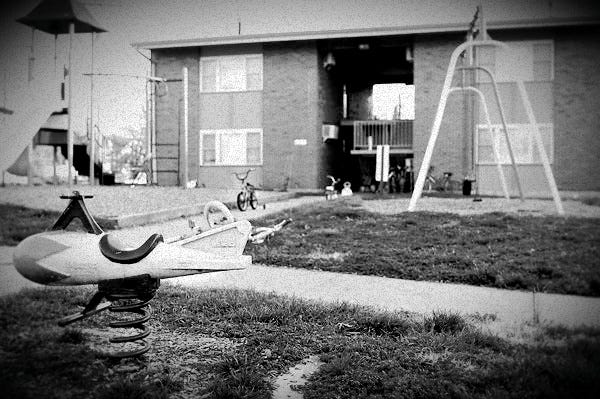
Those summer nights in Missouri were something. I loved them, and I hated them. They were unbearably hot, humid, and mosquito-filled, but it was exciting to be on campus. There was always music in the distance, people laughing outside on their patios, and the smell of BBQ. The neighborhood kids would ride their bikes around the perimeter of the playground in the center of the married student housing complex until it was nearly pitch black, and the sound of tired parents could be heard calling them in for the night. We didn’t have bikes, so we just sprawled out on the living room floor in front of the box fan, making cities with Lincoln logs, Legos, and the antique wooden blocks from Grandma Grace. My dad worked at the kitchen table, typing, reading, and writing in spiral notebooks, his textbooks and periodicals piled on empty chairs on either side of him. Pretty important stuff, surely.
But on that particular evening, Dad was snoring away on the couch, and I was feeling especially sad for my mom and determined to have those blueberries. We deserved them. We missed our mom, and we were hungry, and I was way too tired to care about getting in trouble. So, I gathered up my little brother and we stood over the kitchen counter putting away the entire can, a spoonful at a time, he on a step stool next to me so he could reach. First, I held the can, then it was his turn, and we each used our own spoon so we wouldn’t get kooties.
Hans and I were good about sharing most things, except the Matchbox cars, as we had figured out long ago we really only had each other, what with our parents coming and going willy-nilly. When we weren’t at the babysitter’s (which was every single weekday year-round), our parents paid no attention to us. They were always doing stuff, like studying for their classes or smoking a cigarette with the neighbor on the front stoop. Only my mom smoked, actually. My dad could be found fiddling with his fishing gear or trying to fix something on the car. Most of the time, my brother and I were left to our own devices. Were anyone to take notice of two small children (age four and five), they might have found us wading in the river two blocks over (yes, unsupervised) or taking excursions into the woods down the hill from our apartment, or, kid you not, hoofing it on the 4-lane highway that ran along the backside of our apartment complex. This was the route to Kentucky Fried Chicken, as I remembered it, and I was fairly certain we could walk there. I was, perhaps, a little off on exactly how far it was to the Colonel’s, as we never managed to get further than the first exit before some random adult stopped to pick us up in their car and take us back to the apartments.
Frankly, it was fun doing whatever we wanted, and we were oblivious to any of the perils that might await us. Hey, we’re both still alive.
That summer, we still had a father, but our mother, well, hopes of seeing her again were beginning to fade. August came, and when she didn’t turn up at the train station, as Dad had promised, we began to panic. And it was after this I had my last phone call with her. During that conversation, I mentioned Dad had a new friend who stayed overnight with us on weekends. Carolyn. That was the last time my mom called.
In my five-year-old’s mind, it seemed inevitable that one day, the other shoe would drop — that my dad would disappear, just like my mom. This was obviously something adults did. They didn’t talk about leaving. One day, you just woke up, and they weren’t there to help you get dressed or to put toast in the toaster. My dad was showing the telltale signs. Hans and I were becoming increasingly invisible to him. He was preoccupied with his schoolwork, spending time with Carolyn, and hanging out with his buddies, like Tony, from the university. He would drag us along to things, but didn’t notice what we were up to, and accidents started to happen. One night, at Tony’s house, Hans and I and Tony’s kids, piled into the car sitting in the driveway at the top of the hill, pretending we were going on vacation, and someone (probably me) accidentally put the car into neutral, at which point it rolled backwards down the drive, across traffic, and into a ditch. Scary, yes, but by some miracle, no one was hurt. Another night, my brother was lost for hours on campus. My dad didn’t notice he’d left the apartment until it was dark outside. I was the one who figured out he was probably watching the outdoor movie on the hill a block away. Sure enough, there he was, with a baby bunny he’d captured, watching The Music Man.
It was a little scary, the thought of our being out there on our own, but I’d thought things through, and I had some plans. I was keeping track of the places we could live — places where there was a covering and we could be out of the rain. The playground near us had really good cement tunnels and a covered tower with rope ladders. And I’d kept track of the households where people seemed to enjoy feeding us, like the East Indian family that lived across from us in the apartment complex, the one with huge bags of rice and beans in their kitchen. I loved their food — the smell and taste were heavenly. There were always pots of beans and chicken stewing away on the stovetop, and for some reason, Tara’s mother loved to give us food. Whenever we came by to play, she would make us a bowl of rice and yellow lentils, even when it wasn’t lunch. So, it seemed we had meals buttoned up if we were in a pinch.
And every time I found coins, I saved them so we could eat at Kentucky Fried Chicken, if we needed. Other preparations included making a neatly folded stack of our baby blankets, the ones with the satin edging, so they would be ready to go. I repaired some of them with safety pins from the sewing kit in the bathroom. The blankets were small and easy to carry and would be perfect as covers and as pillows. And then I put our coats and hats in order, and some toys and the Dr. Suess books, our crayons from Aunt Joni, and our drawing pads. I still needed to find something to carry all of this in, but it was coming together. Having everything ready made me less worried.
This was our reality. Without any explanation of what was going on, and with our days spent largely without adult supervision, minus my Dad occasionally peering out the front window at us on the monkey bars, we lived in limbo. We had no idea anything was wrong or even unusual. This was all we knew. In those days, Hans and I protected each other fiercely — whether we were at the babysitter’s or on the playground. Though Hans was small for his age, he knew how to bite, and word got around not to mess with that kid.
Waiting was the name of the game for us. We were waiting not just for our mom, but for everything. We waited for dinner, waited for our dad to wake up on Saturday mornings. We waited for the next episode of Batman, for our turn on the swings. We waited in line at Dairy Queen to get a Dilly Bar, waited in the crabapple tree at the babysitter’s for our dad to pick us up after his classes, and we waited for our Fuzzy Wuzzy soap to get fur. There was a lot of waiting.
And we were waiting for some things we didn’t even know we were waiting for. Like kindergarten. What was that even? That weird word had come up in some discussion I’d heard between the other parents and our babysitter. Toward the end of summer, everyone was talking about it — kindergarten, that is. Everyone, except my dad. How were kids going to get picked up in the afternoon? Did they need to send a sack lunch? Did girls have to wear dresses? Oh yes, and the dresses had to go down to your knees and be worn with knee socks. Those were the rules. Clearly, adjustments were necessary, and considerable planning involved with this kindergarten thing. And shots. These kids had to get shots at the doctor’s office. I was sad to hear that my friends wouldn’t be around to play with, but glad I didn’t have to get those shots.
Then one afternoon, our German babysitter asked my dad, in her stilted English, what he was going to do about my getting to school. Hands on hips, she gave it to him. Why hadn’t he bothered to sort any of this out? I’d never seen her like this, and clearly neither had my dad. He was really taken aback. Usually preoccupied with a bit of flirting every morning, I could see his focus shift from Anna’s beautiful waist-length, brunette hair, and stylish miniskirt to her furrowed brow and scolding. She was pissed and told him in no uncertain terms that he needed to get over to the school and take care of business. Now. Though my dad seemed resistant to taking instructions from a woman, especially this pretty, young thing, I sensed he was scared of her. She was tough as nails, and woven in the conversation was a threat — that other parents would find out he’d screwed up. What would his colleagues think of him?
So, straight over to the school we drove, and while Hans and I sat in the car, my dad made his way to the office, where apparently, he signed me up for school. Out he came, striding, in his Sansabelt pants, without his usual smile, a big manila envelope in hand. And back to the apartment we went. Nothing was said. I was still in the dark.
That evening, my dad holed himself up in his bedroom, a stack of books on his bed. He had exams to study for. He was not to be bothered. Out to the playground we went.
Partway through the evening, Tara’s mom came out to gather up her kids, and there I was, the last kid on the playground. My brother had already gone upstairs to get food.
Mrs. Singh, who was dressed in a colorful sari, asked if I wanted to go to a party with them. There would be lots of food and dancing. But of course! How could I resist? I had only to put on a clean dress and some shoes, she said, as bare feet were not allowed. Off I raced, up to the apartment. When I got there, Dad’s door was closed and Hans occupied with his Matchbox cars on the living room floor. I worried that if my dad found out about the party, I wouldn’t be allowed to go, or he’d make me take my brother, or worse, that it would take too long to get ready, and the Singhs would have left. I couldn’t have any of this, so into my room I scurried to look for the required dress and shoes. Only one dress remained on the rack. The others, dirty, lay in a pile on the floor.
Mrs. Singh had been clear about the clean dress. And then there were those shoes — the Mary Janes I’d had from the year prior. I pulled them out. The dress went on, but barely — I couldn’t get the zipper all the way to the top. I must have grown. And the shoes. I could no longer fit in them at all, and there were no others. Just a pair of flip flops, one of whose Y-shaped strap had come unmoored from the sole earlier in the day. The only foot covering remaining: my big, ugly black galoshes. The ones with buckles. Galoshes were meant for rain and snow, and this pair was designed to go over one’s shoes. They looked awful and made squeaky noises when I walked. These were for winter, not August, and to be paired with snow pants. But they fit. And that’s all I had. I stepped into them, buckled them up, then off I went, quietly closing the front door behind me as I departed.
All four of the Singhs were dressed in colorful Indian attire and heading out to their car when I arrived. I was right on time, thank goodness. But I could not have been more embarrassed; the contrast between how I was dressed and how their children were dressed, well, it was not just about cultural differences — their parents had taken the time to polish their shoes and brush out their hair. Clothing had been neatly ironed, and tops carefully paired with bottoms. The whole family sparkled. Mrs. Singh took one look at me, and I saw the expression, though it flashed only briefly across her face. She felt pity for me. But immediately, she tucked that pity far out of view, flashed a huge, toothy smile, then wrapped her soft arms around my shoulders and whispered that we were going to have so much fun and that my boots were perfect because she was going to let us to play in the big fountain at the hotel after the reception was done.
The evening was magical, though my tummy twinged throughout the party whenever someone gave me that look. We ate, we danced like whirling dervishes, we ate some more, and we sprawled out on the oriental carpets. And although I was the only white kid at the reception, I melded right into the swirl of colorful saris, the curry smells, and bendy, vibrant sounds of the sitars, happily stuffing myself with garlic naan and rice kheer as I sat cross-legged next to Mrs. Singh. It was just about the best night of my life.
As promised, Mrs. Singh took us to the fountain afterward. It was lit up, its refreshing spray a welcome relief on that hot August night. Tara and Jared took off their shoes, and I took off my boots, and in we waded. Mrs. Singh encouraged us to soak ourselves to the skin under the mini waterfalls, laughing heartily at the sorry state of our clothes afterward. Into the backseat of their car we piled, making a wet mess, then up to their apartment we went for a quick drying off. Mrs. Singh then walked me home, my small hand in hers. With a smile, she delivered me to my father, who seemed surprised to see me on the wrong side of the door — he had not realized I’d been out.
That night, I slept as never before. A full tummy, cooled from the fountain, and my senses full of every beautiful thing. I could have written The White Album, so inspired was I.
The next morning, it was back to the babysitter grind, though I felt like a new person. I was so happy that even Anna’s dreaded liverwurst sandwiches and tomato soup at lunch tasted delicious to me. I asked for seconds.
Then, two days later, it was the first day of kindergarten, something I learned upon waking up. There was no ceremony to the day. It was the usual bowl of cereal with milk and a small glass of juice. Every last ill-fitting dress of mine lay on my closet floor, dirty. I picked the navy one with strawberries, the last dress my mom had made for me.
I would be breaking the rules at school from day one. All of my dresses sat way above my knees, and I had no knee socks. As if to intentionally make things worse, my father decided to cut my hair with my craft scissors at the breakfast table. My bangs were in my eyes, he said. Fortunately there was no mirror, or I might have fallen to pieces in seeing how crooked his result. And there were still no shoes. So, I threw on my magic black galoshes, the ones I had danced the night away in only two days earlier.
We got in the Rambler and drove to Shepard Elementary, my school, the place with that mysterious word: kindergarten. My dad, embarrassed by me, by his car, by his incompetence, and his general lack of planning, dropped me off at the end of the block to walk to my first day of class alone. I was the only kid without a parent. And you guessed it, the only kid wearing galoshes.
At the entrance were Tara and Mrs. Singh. They had a lunch for me. It was in a brown paper bag.
This would turn out to be my second happiest day, ever.
🫂
It sure sounds like you went through hell. My family moved a fair amount--three times between Seattle and Boston--all exciting road trips--and my parents never neglected us. What you went through is unbelievable!
A lot of the moving was so my mother could finish her degree, and then live in a place where she could--and did--get a good job (Boston--both ended up at Tufts for many years.) If you count years in France and in Stanford, we have five moves, and they and my older brother had six.