


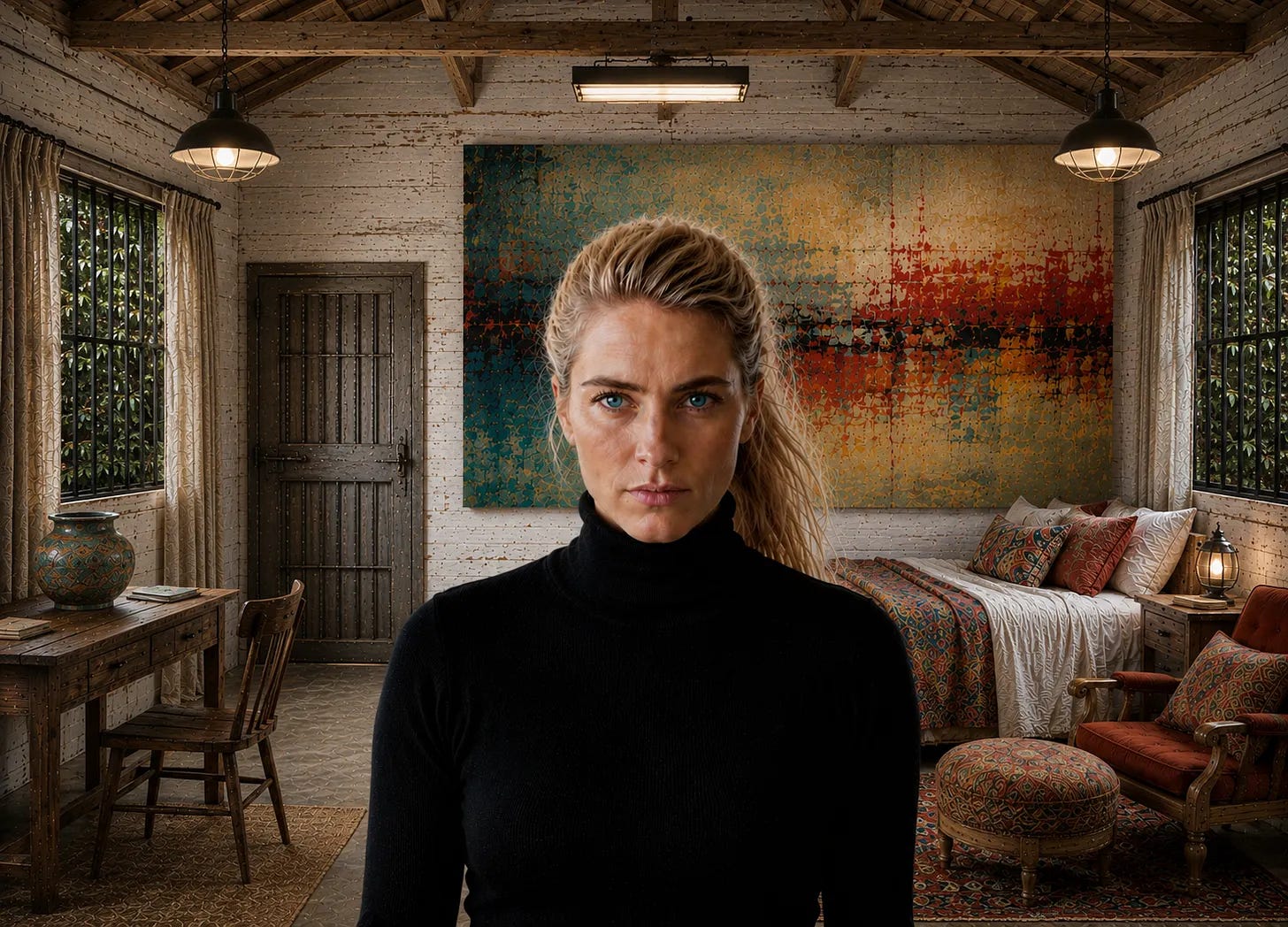
The call came at 12:47 AM on a Tuesday. Laura’s voice was tight and low. “You need to get to Isabelle’s apartment. Like now.” I was already swinging my legs out of bed, reaching for my linen pants and flip-flops in the dark. “What’s happened?”
“Just come. I’m already here at her apartment.”
John sat up, blinking. “What’s going on?”
“I don’t know yet,” I said, grabbing my keys and phone off the nightstand. “Can you keep your phone handy? It may be nothing; we’ll see.” I was so tired, but wired from fear, a feeling of dread in the pit of my stomach.
“Grab a croissant. And call if I need to be there, please.”
I shot out the front door, fired up my CR-V, and headed out, trying to right the chaos of my hair as I drove, and rubbing my hand across my chest only to discover I’d forgotten my bra. Shit.
The streets in my neighborhood at night were always quite dark, but there was the added element of the road being slick from rain, with a mushy layer of fallen leaves. Old Town had not changed much in a hundred years, minus the size of the trees that lined the streets and filled backyards. They had become huge, and city ordinances prevented tidy-obsessed neighbors from chopping things down willy-nilly. The roots wreaked havoc on our sewer system, but that was a small price to pay for the privilege of living in an urban forest. Coast redwoods lined both sides of the street one block west of mine and the alley behind my house. There were sycamores, bay laurels, and valley oaks sprinkled throughout front and back yards, and every manner of other native plant. I kept part of my backyard wild and filled with amaranth, and gave the other half to vegetables and a box of bees. My detached garage was mired in mountain lilac on all four sides, with a huge fig tree and several of its volunteers guarding the space between my yard and Roger’s. There was barely room for a squirrel to squeak through. It felt wild and protective, and we had our own food source, growing right there, off the kitchen.
Old Town was literally a forest in the middle of town, with little Victorian cottages tucked between statuesque old farmhouses on double- and triple-lot properties, the occasional Craftsman bungalow kit house thrown in for good measure. Very cozy, but with a clear delineation between the haves and the have-nots. Regardless of social rank, all inhabitants were expected to keep up appearances, to make things look nice, to put in colorful seasonal flowers, keep leaves raked, and maintain planter boxes. There were only a few rebels amongst the citizens of Old Town: one hoarder fellow who was a militant Unitarian Universalist (the UU being his beard for his compulsive saving disorder) whose house, including the entrance, was choked by bamboo, and an older woman on a corner lot who had really let things go after a bad spill that left her unable to walk. Sadly, none of the neighbors had stepped in to lend her a hand.
I was driving way too fast through the neighborhood, on my sleepy street, where dim porch lights glowed like distant constellations, and mostly older folks slumbered in bedrooms at the back of their cottages. The majority of the houses on my street had been, back in the day, weekend cottages for wealthy city dwellers looking to escape the oppressive San Francisco fog that settled over the city every July and August, or Fogust, as it was jokingly called. The North Bay had sun. Lots of it. And back before global warming had set in, there wasn’t a cloud in the sky for months. Not even cirrus clouds.
In only a few minutes, Isabelle’s apartment complex loomed in front of me— a sprawling 1970s structure with peeling paint and a parking lot full of potholes. The apartments were spacious enough, but dated, with industrial-style carpeting, linoleum floors, and Formica countertops. Still, they were clean and functional, decent spots for young folks to do their adulting: getting to work on time, doing their own grocery shopping and cooking, doing laundry, making beds — all that stuff. The Blalock family owned this particular complex, along with half the other rental properties in this town. I’m talking about Zane Blalock’s parents. Caden’s best friend. A Brotherhood member we’d seen in that Telegram chat room. He was one of the guys who’d been watching Isabelle, coordinating their next steps. Of intimidation, that is. Hey, it’s just a sport, right? No harm, no foul.
Well, we’ll see on that.
The point: Isabelle’s apartment had never been safe, despite the complex’s well-lit paths, its swimming pool with chaise lounges neatly lining the perimeter, the warm laundry room with ample folding tables, and its game room with vending machines. All a façade.
Laura’s car was parked in the shadows near the dumpsters. I pulled in beside her and killed the engine. She emerged from the darkness, her face pale in the glow of her phone screen.
“They’ve escalated, Louise.” “It’s bad.”
We took the exterior stairs two at a time. The door to Isabelle’s apartment stood unlocked. Inside, every light blazed. Basti sat on the couch with his arm around Isabelle, who was staring down at her hands. Kaira was sitting on a stool near the window, keeping watch from the living room window, her phone clutched in her hands like a grenade.
“Mom, I don’t know what to do.” Isabelle’s voice was hollow. I knelt in front of her.
“What has happened?”
She couldn’t speak. She just shook her head. Laura handed me her phone. The screen showed Isabelle’s Instagram account — except it clearly wasn’t her account anymore. Someone had hacked it. The profile picture had been replaced with an AI-generated image: Isabelle’s face, unmistakably, digitally superimposed onto an explicit, sexually suggestive body. There was Isabelle, nearly naked in expensive-looking lingerie, hands posed provocatively, eyes half-closed. It made my stomach drop and my skin go cold. I kept scrolling. There were a dozen more posts in a variety of settings — the backseat of a car, on a desk in someone’s office, leaning on a tree in the woods — all timestamped within the last two hours. Deepfakes created with Grok, according to the kids, each one more graphic than the last. There was Isabelle’s face, her blue eyes, but not her body. Imagery created in her likeness without her consent. None of this her choice. And all of it out of her control. And we could not get into her account to delete the posts or shut down the page.
The captions were even worse. Available tonight. DM for address. Looking for a good time. No strings. And then, below one picture, a particularly haunting caption that included her full address, parking instructions and a phone number. Yet another outlined her availability for a “get-together,” noting that she was unavailable during her classes at Logan Hill JC. All of it was spelled out, as if this were her life — having sex with random men — all the fine details lending an air of credibility to this incredibly graphic IG page. A final flourish: she was “eager” and “waiting for your text or call,” with kissing emojis.
“Jesus Christ,” I whispered.
“It’s on Facebook too,” Kaira said, her voice shaking. “And X. They’ve posted everything, everywhere. They’re saying she’s —.” Kaira couldn’t finish her sentence. She was sobbing. Basti filled in, “This has happened to Kaira as well.”
“They’re making out like I’m a whore,” Isabelle said flatly. “That I’m asking for it. That anyone who wants me can just show up, and I’ll be grateful. You get this? They’re setting me up to get raped.”
Basti’s jaw was clenched so tight I thought his teeth might crack. “We need to call the police.”
“And tell them what?” Laura’s voice was sharp. “That someone posted fake nudes? They’ll say it’s a civil matter. That she should contact Instagram’s support team and maybe hire a lawyer? That there’s nothing they can do unless someone physically assaults her?”
“But they published her address,” Basti said.
“Yeah, well, Caden’s dad plays golf with the police chief,” I said. “And Zane’s family owns this building and half of the rest of town. You think they’re going to investigate these people? They’ve been getting away with these sorts of things for years.”
Silence.
Isabelle looked up at me. Her eyes were red, but dry. She’d gone way past crying, and was heading into some harder, colder place. “They’re not going to stop, are they?”
“No, they’re not,” I said. “That you can count on.”
“Then what do we do?”
I looked at Laura. She nodded.
“We disappear you,” I said.
By 2:30 AM, we had the outline of a plan.
It wasn’t a good plan. It wasn’t even a complete plan. But it was a plan, and that was more than we’d had an hour ago. “We move you out before sunrise,” I said. “Everything. Furniture, clothes, art supplies, everything. We make it look like you just vanished. I want us to clean the entire apartment, as well, as if it were ready for inspection. You’re on a month-to-month with a required two weeks’ notice. These fuckers are not getting to keep your deposit on top of your dignity, and we’re not paying for another month here. I am positive they know their son is up to his eyeballs in this stuff. How could they not?”
“Where does she go?” Basti asked.
“My place. The garage barn out back. It’s detached and opens onto the yard, which has eight-foot redwood fences on all sides. All relatively new, very sturdy. No one can see the yard from the street or the alley if we’re careful. She’ll be able to go from her space to the house or to just be outside without being detected.”
“Your garage?” Kaira looked skeptical. “Isn’t it falling apart? And the big sliding doors and side door aren’t exactly secure from what I remember.”
“I already texted Adam. He was up late closing an event and has already been over to Walmart for supplies. There’s a group of four heading to the house to secure everything, and I’ve got a 24-hour locksmith from several towns over who’s meeting up with them. By the time we get over there, there will be new locks, bars on the windows from the inside, the works. It’ll be secure enough.”
“And her car?” Laura asked.
“Adam’s storing it at his place. Out of sight. And he’s going to leave a nondescript gray Honda Civic parked in the alley behind Erin’s house. The plates won’t connect to Isabelle. She’ll be able to use that vehicle at some point.”
Isabelle was shaking her head. “This is insane. I can’t just disappear. I have school, I have — I don’t know — this brings everything I do to a halt.”
“You have eight men who just published your address and phone number alongside fake porn,” I said. “You have a coordinated group of predators who’ve broadcast a message that you’re available for the taking. You have Zane Blalock’s parents as your landlords, which means they have keys to this apartment and access to the security cameras in this parking lot.” I let these facts settle in.
Isabelle flinched, then closed her eyes. This was more than she could deal with.
“I know this is terrifying, sweetheart,” I said, softer now. “I know you don’t want to leave your life behind. But staying here isn’t safe. Not anymore.”
“How long will this be for?” Her voice cracked. “How long do I have to hide?”
“I have no idea,” I admitted. “But we’ll figure it out. I promise.”
Isabelle looked at Basti, then at Kaira, then at me. “I already quit my job because of Howard and stopped going to my art class because of Lichter. Now I’m supposed to just vanish? Like I’m the one who did something wrong?”
“No,” I said. “You’re the one they’re hunting. There’s a difference.”
“Is there?” Her voice was bitter. “Because it feels the same.”
No one had an answer for that.
Finally, Basti stood up. “I’m going to go get my Transit. It’s pretty much cleared out and should be able to hold everything. We’ll only need to make one trip from the apartment to your house, Louise.”
“I’ll help pack,” Kaira said.
Laura was already on her phone. “I’m texting Adam. He’s sending over a couple of waitstaff to help empty the apartment, and his banquet captain is going to stay and do a quick final clean and vacuum.”
I looked at Isabelle. “We need to move fast. Can you do this?”
She closed her eyes and shook her head. Then she took a deep breath through her teeth. When she opened her eyes again, something had shifted. Her face was not registering acceptance, exactly. More like fury and resolve.
“Let’s go,” she said.
We had to work in near silence, moving through the apartment like burglars.
Basti and Kaira dismantled the bed frame and pocketed all the bits of hardware, while Laura and I packed clothes, toiletries, and books, stuffing everything into plastic bins and pillowcases, wrapping all the hanging clothes in sheets that could be dragged down the steps. Isabelle moved through her apartment like a ghost, touching things — the thrift-store lamp, the succulent on the windowsill, the painting she’d made last spring — as if memorizing them.
“Of course we’ll leave the furniture that came with the place,” I said. “We’ll just take what’s yours.”
“What about my lease?” Isabelle asked.
“I’ll deal with that later—it’s in my name, anyway. Right now, we just need you gone.”
“They’re going to charge me for the two weeks.”
“Let them,” Laura said. “Better than staying here.”
By 5:15 AM, Basti’s Ford Transit was loaded. He was going to drive it to my place via back roads, avoiding main streets and any traffic cameras. Kaira would ride with him. She’d left her car on the street a couple of blocks from the apartments. Laura and I would take Isabelle in my car, separately, no convoy.
“Phones,” Laura said. “Power them down, please.”
“What?” Isabelle looked stricken. “I can’t just —”
“They could be tracking you,” Laura said. “Location data, app activity, everything. If you want to disappear, you need to actually disappear. Please turn it off, for all of us.”
Isabelle stared at her phone — her lifeline, her connection to everyone she knew — and then, slowly, she powered it down and set it on the kitchen counter. Laura picked it up and put it in her purse.
“I’ll get you a burner,” I said. “Which will be just for emergencies. We’ll get this sorted, I promise. It’s going to take a few days, and we need to find someone who’s not from town and is tech-savvy. Until then, you’ll have to watch ‘Dexter’ from start to finish. All eight seasons.” I chuckled.
She nodded, but I could see the loss in her eyes. Another piece of her ordinary life, gone.
We left the apartment at 5:43 AM. The sky was still dark, but the horizon had begun to pale. Isabelle didn’t look back.
The drive to my place took all of twelve minutes.
Isabelle sat in the passenger seat, staring out the window at the empty streets. Laura followed in her car, keeping a careful distance. No obvious connection.
“I’m sorry,” Isabelle said quietly.
I glanced at her. “For what?”
“For all of this. For dragging you into it. For whatever I’ve done to cause this.”
“Stop.” My voice came out sharper than I intended. “This is not your fault. None of it. You didn’t ask for this. You didn’t do anything to deserve this. Do you understand me?”
She nodded, but I could see she didn’t believe it. Not really. That’s the idea, isn’t it—to make you think you’re the problem. Make you apologize for being hunted. Classic domestic partner abuse. As if any of these men had been Isabelle’s “partner.” This was really twisted shit.
“We’re going to fix this,” I said. “I don’t know how yet, but we will.”
“What if they find me?”
“They won’t.”
“But what if they do?”
I didn’t have an answer for that. So I just drove.
My house sat three lots in from the corner, tucked between our local district attorney, a man I trusted with my life, and a two-flat with two pairs of husband-wife journalists from the local newspaper. And then there was my house, one of the aforementioned kit houses. The house was cute as a button, a persimmon tree on one side of the front yard and a huge sycamore shading the front of the house. The entire backyard was enclosed by a tall redwood fence, and the garage was perched on an alley — its slightly sagging 1920s structure looked more like a barn — with only the roofline visible from the front.
Adam’s truck was already in the alley when we arrived, his guys keeping a lookout for any snoopers, be they innocent or the men from whom we were hiding Isabelle. When we arrived, there were three other vehicles I didn’t recognize.
“Whose vehicles are these?” Isabelle asked, worried.
“Friends,” I said. “People Adam trusts.”
We pulled into my neighbor Erin’s driveway. I had called ahead to let her know a bit about what was going on. The Transit was already backed up to the garage, its rear door open. Basti and Kaira were unloading things, and Adam was directing traffic, pointing and gesturing like a general, his guys taking care of the bigger items, the locksmith working diligently on the new locks, which looked to be up to penitentiary standards.
He saw us and came over. “We’re almost done with the locks. Bars go up next.”
“Thank you,” I said.
“Don’t thank me yet.” He looked at Isabelle. “You okay, kid?”
She shrugged. “Pretty much. All of this is a huge shock.”
He smiled, but it didn’t reach his eyes. “Fair enough. Let’s get you settled. Louise — shouldn’t we get her into the house, out of view? I’m worried that all of these people are attracting unwanted attention. I don’t want it to be associated with Isabelle.”
By 8:30 AM, the garage had been transformed from a storage space into something almost habitable. Laura had brought over her sister and daughter, who in turn brought a carload of cleaning equipment — mops, vacuum, soaps, sprays, scrubbers, etc. Someone had strung a hose in from the backyard through one of the windows and hooked it up to the utility sink, and neighbor Eric, Erin’s husband, had put up curtain hardware and installed several industrial-looking light fixtures. The two of them had also brought over some nice wood shelving, an old desk and chair, and a treadmill from their garage. Laura’s team contributed some much-needed rugs.
When all was said and done, there were proper locks on all the doors, and bars on all of the windows — the kind that lock from the inside, so Isabelle wouldn’t be trapped if there were a fire. The interior had been swept and scrubbed, the cobwebs cleared, the old oil stains covered with the rugs that Laura had pulled from her own basement.
Isabelle’s bed was in place and made up with her linens; there was an easy chair and a television. But no laptop or phone for the time being. I brought in several boxes of books and left those for Isabelle to put onto the shelves.
It wasn’t beautiful. But the space was secure. At least as secure as we could make it.
All of Isabelle’s belongings were stacked inside: bins of clothing, art supplies, books, decorative items, non-perishable foodstuffs. Her life, compressed into a 300-square-foot space. And we’d set up a camping toilet, a mini-fridge, and a coffeemaker with all the necessary supplies. It was the best we could do for the time being.
She stood in the doorway, looking at it all, and I saw her face crumple.
“Hey.” I put my arm around her. “I know this isn’t what you wanted.”
“I had an apartment,” she whispered. “And a life.”
“You still have a life. It’s just a little different. Okay, a lot different. Consider this an adventure—one that’s better than the alternative.”
“Different.” She laughed, but it came out broken. “That’s one word for it.”
Read Overpaint, Chapter 1, here.
Read Overpaint, Chapter 2, here.
Hmmmm...and what would you do for women who have less resources, less community? Your story had all the answers for this scenario. Most of us don't have every option available, or the convenient solutions to every single question. I think more of us are in the world of very few people, often little reliable family members, and absolutely in dire financial need. And we are much more likely to be exploited, because we are seen as having fewer resources. We are not a minority.
Our friends are our salvation. That barn sounds pretty cool to me.