


I hadn’t slept well for days, my nights punctured with worry. I was up and down, in front of my computer, trying to find out as much as I could about these men — our neighbors, men who live among us and who think nothing of hurting the women in our community. It was high noon in the Wild West. Time to draw our guns.
The same issues and problems we’d been having in town resonated through the national news every night, the din building to unbearable levels. It did feel like end times; JD Vance was right. End times that he and the people in his circle created. 100%. Those fuckers.
We’d been taking turns staying with Isabelle. She really couldn’t be alone, both for logistical reasons related to her having difficulty moving, and because she was getting seriously depressed. Laura brought over an emotional support kitty, one of the six currently living in her household — Billy Jean King. Billy loved her new digs, and the garage really needed a mouser, so there we were. A match made in heaven. Kitty could put away a couple of mice a day, and would then spend the afternoon cashed out, digesting her feast in the warm spot behind Isabelle’s knees. All that purring and biscuiting had to be doing her a little bit of good.
That fucking Logan Hill Courier ran the item on page three of the Thursday paper, below a piece about the county’s demolition of a vacant middle school on the east side — Isabelle’s former school. Hard to believe it would soon be turned into vineyards, like we needed any more of those. And above the news brief was a half-page ad for Blink’s Market. A weekend sale on avocados, sweet corn, and stone fruit. No thank you, we’ll pick those up somewhere else.
Local Man Hurt in Accident on North Route 12
Caden Galt, 25, of Logan Hill, was treated and released at Regional Hospital South on Tuesday following a single-car accident on County Road 12 near the utility easement north of Miller Road. Galt, a Logan Hill High School valedictorian and owner of Galt Landscaping, sustained minor lacerations and is recovering at home, according to family. The female driver was also treated for injuries. The cause of the accident remains under investigation. Galt posted on IG Wednesday: “Grateful to be here, recovering with family. Thanks for your messages of love and support.”
The female “passenger.” WTF.
I had to read this three times. Then I closed my laptop, went into the kitchen, made myself a cup of coffee, and stood at the window looking out into the backyard. The birds were still doing their thing, my bees were working their asses off, and though my veggie garden looked like shit, which it always does as we head into fall, it was still pumping out copious amounts of food. I conducted a long, private internal monologue that I will not reproduce here in full since it was profanity-laden. The gist of it was this: There is no fucking way these fuckers get to do this fucking shit. Yes, I did tone that down.
By Thursday afternoon, the Nextdoor app was doing what the Nextdoor app does, turning incomplete information into a community narrative not akin to compost made with dog shit, i.e., something you can’t put in your veggie garden unless you’re okay with E. coli, Salmonella, and parasites like roundworms. It was toxic.
This game of “telephone,” played by about five hundred of my neighbors, started with Prayers for Caden!! By the time I came across the post, it had forty-one comments. The first twenty or so were warm wishes and prayer emojis. All to Caden, of course. Then someone, whose profile described them as the deacon’s wife, mentioned that Caden had been driving a young woman around — someone who had troubles. And wasn’t it sad how other people’s issues and their refusal to take responsibility for their own problems put innocent people in danger? She went on: “Caden was a gem for not speaking out publicly about this young woman. We should keep her in our thoughts,” she said. “Hopefully this was a lesson learned.”
Can I throw up?
Forty-one comments. The female “passenger.” A young woman with troubles. Caden doing the right thing. This was way more than I could stomach.
I forwarded the thread to Diana.
Here is what I gleaned from the accident report, which was based on what Isabelle had conveyed to me and the police as she lay in the ER. She had been driving; the crash was being attributed to driver error. There was one passenger, Caden Galt, who had been in the passenger seat, and he sustained minor injuries. There was no mention of Caden forcing his way into that car at the Miller and Fourth intersection. No mention of his having ascertained Isabelle’s whereabouts through tracking devices supplied to him by The Brotherhood. Fault for the accident was 100% on Isabelle. Yes, this was her own doing. She confirmed this to the officers without reservation. This was her story, and she was sticking to it, taking full responsibility for the accident. All of this was now public record.
What actually happened on County Road 12 was unambiguous, and nothing like what the report would lead everyone to believe. But my daughter — she could see the writing on the wall. This group of men, Caden Galt and his family, their various social circles — all of them wanted nothing more than to take her down. So, rather than engaging in a game of tug-of-war, she dropped her end of the rope. In retrospect, this was sheer brilliance on her part. No one expected her to do this. They had no script for this alternate scenario. Isabelle had taken all the sport out of their hunt, and now she was in hiding, staying put. And she had a doctor’s note excusing her from court until her condition was stable.
Laura came over Friday morning with her laptop and a box of files she’d been building for the last three weeks. She set up shop at my dining room table, in that exact same position she always takes when she’s working a problem she’s intent on solving. Coffee on the left. Laptop dead center. Pad of paper and gel pen on the right. The look on her face: someone who’s found the missing corner piece of a large, ugly puzzle. There it was in the litter box. That was not going to stop her from brushing it off and putting it in place, urine and all, confirming in no uncertain terms that the puzzle was solved.
“Where do we start?” I queried.
“Gordon Lichter,” she said. “He’s left a paper trail long enough to wallpaper a high-tech billionaire’s mansion. Every room.”
Gordon Lichter had been a professor of art at Logan Hill Junior College for six years. Before that, he’d been at a private arts school on the East Coast — he spent nine years there. He had departed quietly, mid-semester, following what the college’s internal records described as a satisfactory resolution of a faculty conduct matter, which is institutional-covering-their-ass-speak for we paid someone to stop talking and have resolved the problem permanently. The settlement documents were sealed. The complainant’s name was not on the public record. Dead end on that one.
But the timing of his departure was curious: mid-semester. Add to that a carefully non-committal letter of reference from the school’s department chair — a letter Laura obtained through a public records request to LHJC’s hiring file. Public community colleges retain outside letters of reference in their personnel files, and this one described Lichter’s scholarship as distinctive and his classroom engagement as energetic and said nothing else, which is academic code for: do not hire this man, written by someone too chickenshit or too complicit to say what really needed saying. Besides, Lichter had likely threatened to sue the school if they divulged any additional information. His departure already meant the loss of numerous grants that had come their way because of his scholarship. The school was hemorrhaging. This, too, we could document.
Before that, Lichter had been at a small liberal arts college in the Midwest. Laura discovered a Rate My Professor thread from that period, now six years old, in which four students used variations on the same language: made me feel like opportunity was conditional, don’t take office hours alone, brilliant, but getting to work with him comes at a cost, had to drop the class. The thread had been flagged for removal at some point and was partially truncated, but the cache existed.
“Well, there’s the pattern we’ve been looking for,” I said, stating the obvious.
“Yep, a documented escalation,” Laura added. “The East Coast school paid to make it go away. Logan Hill was asking the wrong questions during their vetting. Lichter’s hiring file shows a background check from a vendor that only covers criminal history, not Title IX issues. No call had been made to the previous department chair. This was a rush hiring.”
“All of which is a story in and of itself,” I chimed in.
She agreed. “But not one we’re telling, at least not yet. Not until we have someone, or several someones, willing to talk.”
I nodded in agreement.
Cora Fineman came over Saturday and sat at the table with us for four hours. She brought a binder — she always brings a binder. I’ve come to understand that the binder is Cora’s equivalent of Laura’s arrangement at my dining room table. It means she’s worked the problem thoroughly before showing up. She walked us through her documentation hierarchy with the patience of someone who knows the difference between evidence that seems powerful and evidence that can actually accomplish something in a proceeding.
“Your narrative is strong,” she said, after reviewing what we had, “But your corroboration is partial, and the gap between those two things is where cases go to die.”
“So how do we close it?” I asked.
“If possible, you need to find the person who got paid to stop talking,” she said. “Or to find someone at that school who saw the whole thing go down and who kept notes. Someone who was sick and tired of Lichter, but didn’t really have an axe of their own to grind. Those people are out there. They exist. And they are usually the most compelling witnesses, because they are not personally involved. The question is whether they’ll talk to you, and then whether what they have to say is admissible.”
Cora said all of this without drama. She’d sat across the table from a lot of outraged, talented, hardworking women. Women who’d spent years learning to translate their rage into legal action. These women were dangerous. And men who think with their dicks never see them coming. They write them off.
“We also need to think about sequencing,” she said. “Right now you have Lichter, with a credible predation pattern, institutional failure at two prior schools, and no named complainant who’s willing to go on the record. Then there’s Howard Blink, with multiple cases of sexual harassment, several of which purportedly escalated to sexual assault, a parking lot incident which Louise documented contemporaneously, and then there’s his wife, who, by all accounts, is not willing to see what’s right in front of her and turn him in. I do believe she is key to his situation. She could likely bring him down big time if we can convince her, and that may take our helping her — empowering her to take his business. More on that later. With Caden, there’s a documented stalking pattern over eight weeks, which is corroborated by some of his Signal postings; then there’s the crash and a victim who told the police it was her fault. You have seven or eight other men who participated in the Telegram channel, with varying degrees of documented behavior. Have I missed anything?”
She laid everything out on the table like a map.
“The question isn’t whether any of this is real,” she said. “It’s what order you present it, who owns each piece, and whether you’re building toward an outcome you can actually achieve, or just making them uncomfortable.”
Laura said: “What’s the outcome we might actually be able to achieve?”
Cora thought on this. “Well, for some of them we’re looking at civil liability, professional consequences, licensing action. For Caden, potentially criminal charges, depending on whether Isabelle is ready to revise her statement. For Lichter, it’s institutional removal if we can find the first complainant or someone else at LHJC willing to testify. There is no question in my mind that there are other women. There always are. For the group as a whole, we’re looking at exposure. We need to show they are all friends, that they discuss these sorts of matters as a group, that they plan and assist each other, and that they’re getting off on all of this. We need to take a course of action that puts them in the public eye or places them in the public record through legal action. The logistics of that are something I need to consider, and I will likely be conferring with our friend next door, Roger — the D.A. I am positive he will have thoughts on all of this.” She paused. “That last scenario may be our most durable. With exposure in the press, all it would take is a simple Google search for any of these names to pop up at the top of the feed. That would make their shenanigans well-known for years. That means that anytime someone thinks about doing business with them, considers taking their class, wants to hire them for a job, or to go on a date —these situations would pop up via AI. Much more effective than just about anything else, in my opinion. Don’t you think?”
I thought about my column. I thought about the fifteen million people who read Louise Falco of Letters to Louise every week, and what they would do with a carefully documented account of eight men in a small town who had organized themselves into a well-oiled machine designed for hunting young women they decided were in need of correction.
I kept this thought to myself for now. But I was hatching a plan. Not only would a column of this sort draw in new readers, but it would put these issues front and center. Nationally.
Diana joined us on Sunday, the day we started what Laura called the chain-of-custody system and what I privately called my Black Bucket List, though I did understand that Diana’s framing might be more appropriate in a real court of law, versus Judge Judy’s courtroom.
Our system would be this: every bit of documentation would be logged with a source, a date, and a reliability designation — verified (public record, direct witness, contemporaneous documentation), credible allegation (multiple consistent accounts, not yet independently confirmed), or rumor (single source, unverified, potentially relevant). Nothing could be moved from one category to the next without corroboration. Anything in the rumor column was on hold in terms of action until it moved up the ladder.
“I realize this feels as slow as molasses,” Diana said, watching my face.
“It feels like we’re giving them opportunity to do more damage,” I said. “It infuriates me that we have to let them continue doing this.”
“I hear you,” she said. “But that’s the trade. We could move fast and make claims we can’t support, but they’ll spend the next three years using those claims to discredit everything else we do. It will kill our credibility. We need to build something that holds. And in the interim, we provide support to other victims. That’s the best we can do.”
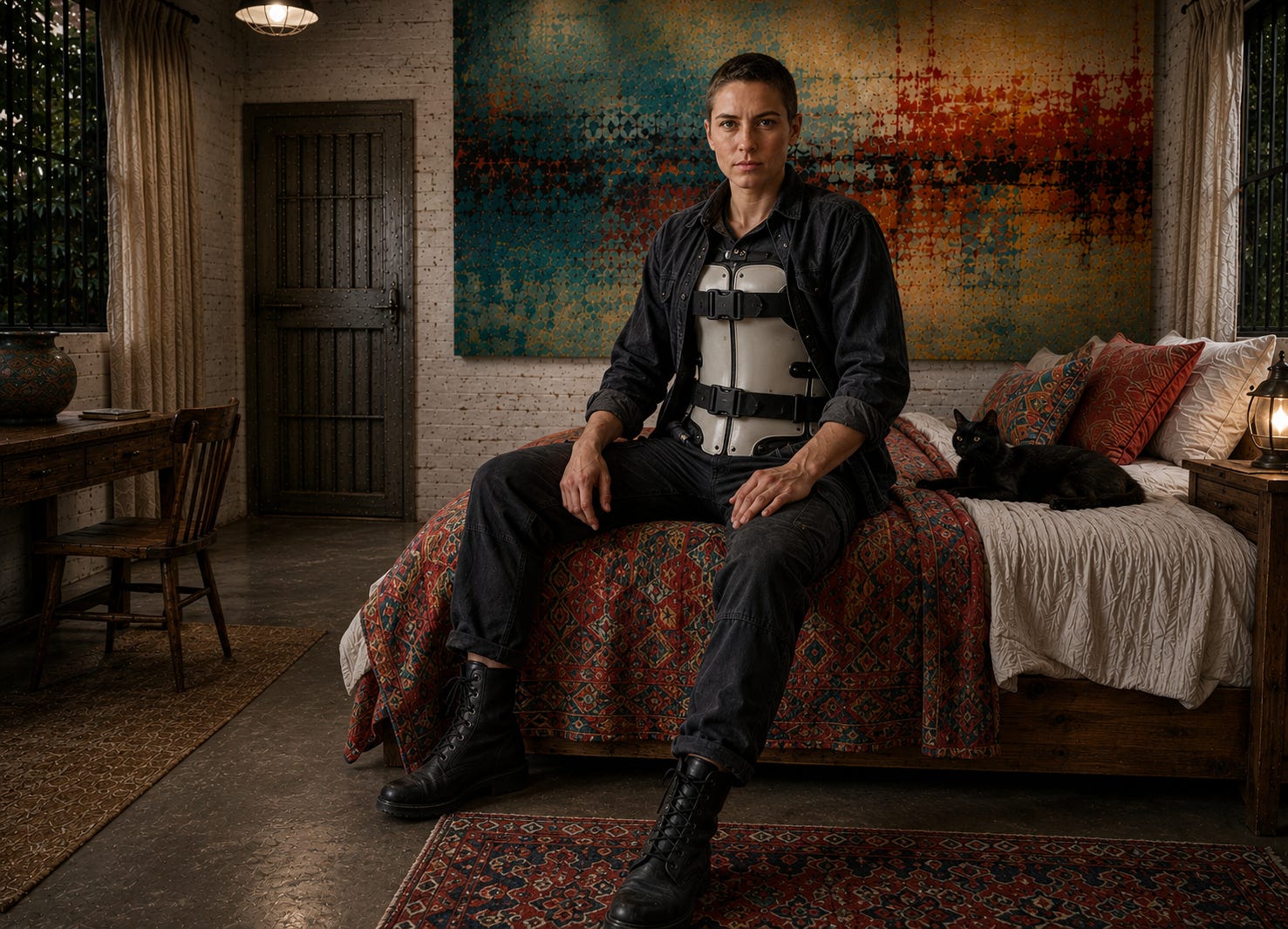
Isabelle is in a TLSO brace in my garage. She is twenty-three years old, and she has two fractured vertebrae. A man put her in that device on purpose. The word patience is not currently in my vocabulary. I was going to need to work through this with a psychotherapist, or someone was going to get dead.
“Okay. I get it. We have to stay within the system. Our problem is they are working outside of it. That’s so very frustrating.”
Diana looked at me carefully. “Louise. What you’re building — if you build it the way I’m describing — is something that could result in real consequences for multiple men, including potential criminal exposure for Caden and civil liability for several others. The shortcut version gets you a news cycle. Maybe two. This version gets you something that lasts.”
“And in the meantime?”
“In the meantime, we keep Isabelle safe and document every single thing. Every threat, every incident, every contact, every text message, every rotten egg leveled at your front door. Contemporaneous. Time-stamped. Witnessed where possible.” She paused. “And we explore whether she’s ready to talk to Trujillo again.”
Isabelle was not ready to talk to Trujillo again.
She was, however, ready to talk to Adam, which is a different thing entirely and also somehow more useful.
Adam came by Tuesday evening through the back gate with a dish of steaming hot osso buco. Adam was of the belief that trauma responds to braised veal shank, and he was not entirely wrong in that. He knocked gently on Isabelle’s door, then sat in the garage with her for two hours. I tried very hard not to hover outside the door. It was killing me.
I know what was said only because Isabelle broke down and told me a few days later, and because Adam is simply incapable of holding back information he feels might help the people he cares about. It became apparent that he had a specific and very important piece of intelligence to share.
The week before the crash, a man Adam did not recognize had eaten dinner twice at The Bullpen’s bar. Alone. He was not a tourist — nothing about him gave off that vibe. In Adam’s estimation, this someone was in the restaurant to be seen, but without being memorable. He had made three phone calls during dinner, then left a cash tip large enough to make the server remember the color of every hair on his head. And he had asked, in an apparently offhand manner, whether the gray Civic parked on Prospect behind the dry cleaner belonged to anyone the server knew. He was looking for parts for his daughter’s car, and that one looked to be on its last legs.
The server said only that she didn’t know whose car that was, even though she did. It belonged to her boss.
The man smiled, nodded, and went back to his food. The server then made a beeline for the kitchen and let Adam know the situation. Adam hadn’t thought much of it at the time. He was sure thinking about it now, after this accident.
“What did he look like?” I asked.
Adam described someone we couldn’t immediately place — someone who was neither among Isabelle’s acquaintances nor in the Telegram threads. This guy was in his fifties. Greek or maybe Italian, Adam thought, though he acknowledged he was a bit foggy on that part. He’d been wearing expensive casual clothing and had a watch that looked simple and practical, but that Adam knew to be worth upwards of $20K — an A. Lange & Söhne. Damn.
Laura pulled up the partial Telegram identity they’d been referring to as “Unknown B.”
“Alexandros,” she said. It wasn’t a question.
The name Alexandros appeared in The Brotherhood’s Telegram threads eleven times over the two months’ conversations — at least those Laura had been able to access. He was peripheral in the early messages — a voice of apparent authority, who was cited rather than present. He appeared to have entered the thread directly in the final two weeks before Isabelle’s crash, in a role that could only be described as coordinator.
He was the one who flagged the Civic.
And he was the one who wrote, four days before the crash, a message that read: Route confirmed. North on 12 is perfect. No surveillance, soft shoulder, utility infrastructure at the bend. Caden knows the road. He just needs the window.
Laura took a screenshot of this the first time she read it. She had not told me about it until now because she had been, she said, trying to confirm Unknown B’s identity before introducing this information into what we were building.
I read the message again: He just needs the window.
I put my laptop down on the table and walked to the kitchen window in front of the sink. I looked into the backyard, sizing up the back gate and the high-tech security cameras John had installed that swept the alley continuously in a twelve-second loop. They were unobtrusive — difficult to spot unless you were looking for them.
Unknown B had known the road and the car. He had known about the bend. This crash was not Caden losing his cool at an inconvenient moment. This collision had been expertly choreographed. The destruction of the car and Isabelle’s injuries were the apotheosis of the ballet.
They’ve done this before, kept running through my mind. Somewhere around the twelfth repetition, I knew what needed to be done. I needed to find the other victims. I needed to prove this was a thing, not some isolated incident, not a single person being targeted. There is no way this was a one-off.
It was not long before the proof of my theory arrived, and from an unexpected direction.
Three days after Adam’s osso bucco delivery, I received an email — to my personal email account. This was not the Louise Falco column address, nor any other address I use for purchases, bills, and the like. This was an address I had given out to maybe thirty people over the last five years. The sender? a.ortega.jc@hotmail.com. The message was just twenty words long:
I know what happened to the girl before Isabelle. I am not ready to talk, but I will be soon.
I stared at the message for god knows how long. Huh? What was this?
Then I forwarded the email and my response to Laura and Diana. I had carefully typed back: Take all the time you need. I’m here and ready whenever you are.
I didn’t know who A. Ortega was, or even which girl this email might be referring to. Was she someone who’d also been on a car ride on a lonely stretch of county road? Had she had her address posted publicly with lewd instructions as to her supposed sexual proclivities? Or was she one of the many who’d had a nasty encounter in the stock room at a grocery store? Perhaps she was a “promising” art student in need of mentorship.
What I did know was this: The Brotherhood had used their Correction Protocol before. They had used it on someone else — someone who had survived it, but who had likely been silenced by it. And perhaps that someone had found a way to rebuild their life around them — and had witnessed what happened to Isabelle. If we could just find this person — who was likely watching from the shadows — we might be able to convince them to tell their story. We just needed a small sign, that first indicator of readiness.
Our counter-operation had entered a new phase. I began to feel the architecture of what we were building, the way a properly designed structure announces itself when you’ve put enough of the load-bearing pieces into place, and the thing begins to hold its own weight. We were no longer only defending Isabelle. We were beginning to understand the shape of the machine. We were getting our bearings.
In the barn, Isabelle was painting.
On Thursday, Isabelle had asked me for stretched canvases, so I brought four. She wanted specific paint colors — raw umber, titanium white, burnt sienna, and a tube of phthalo blue, which she expressed needing specifically because it would fight with everything else. Basti had done the deed for me, driving all the way to the art supply shop in Redding. He came back with a bag of paints, which he handed over the back gate as if delivering important prescription medications.
Isabelle was working on a huge canvas, building on something she’d already made — a painting she’d finished well before the shit hit the fan. Unceremoniously, she had primed over the entire piece and was now painting over it. The ghost of the original was ever so slightly visible through the first layer — a bright, colorful landscape of some sort, trees and sky, ordinary, pleasant imagery. Over it, she was laying down a severe geometrical pattern that was developing into a steely gray, with bright bits of blood red and random dagger-like imagery in front of, behind, and to the left of the pattern.
Isabelle was painting over her old life. Not erasing it. Painting over it. The original was still there, hidden and preserved under the fresh, thick layers of acrylic paint. The landscape remained part of the painting’s structure, informing the new surface without determining it. The same could be said for Isabelle’s new, short hairstyle and her faux hazel eyes. It was still her, deep down inside, though to the rest of the world she was now Izzy. I had to get used to saying that name, or there were going to be problems.
I stood in the doorway and said nothing. I watched in awe.
Isabelle didn’t look up. She was wearing her TLSO brace under a loose shirt, which gave the impression of an Olympic swimmer; her posture expressed an unusual rigidity. She held her brush with the grip of someone working through pain and around unnatural physical constraints. She was deciding, stroke by stroke, where to put the paint so as to experience relief. It was an interesting way to create, and it worked, in an odd sort of way.
“What’s it going to be?” I asked.
“I don’t know yet,” she said. “It will reveal itself.”
I thought about telling Isabelle what Laura had found — about A. Ortega’s twenty words. I thought about that message he just needs the window, and about the bend on County Road 12 and the transformer’s buzzing at A-440. I imagine Isabelle still heard that exact pitch in the middle of the night when all else was quiet.
I didn’t share any of these thoughts or the details of my nightmares. Probably never would. Isabelle had enough to deal with.
Tonight she was painting, and the garage was safe. The gate cameras were making their rounds, and for this one hour the safety perimeter was holding.
Tomorrow we would begin building our case. These men would not be getting away with anything. No way, no how. We were smarter and a helluva lot more motivated.
READ ALL OF OVERPAINT